
Your needs, this model
Does it fit your priorities?
Would the 2.5-liter Alkanatur pitcher work if its filter runs by gravity rather than a button dispenser?
The exact listing is 2.5 L and the maker estimates about four minutes per liter by gravity. This route is not powered dispensing.
Explore this need in the finder →Is this specific Alkanatur cartridge the feature you want rather than one of its sibling filters?
The gray zeolite filter is described as adding magnesium at 18 mg/L and the maker lists alkaline pH 8.5–9.5; it is qualitatively positioned for higher-heavy-metal concerns. The three listings share the pitcher body but have distinct filter identities.
Explore this need in the finder →Would you use this cartridge when an exact lead-reduction result is not established?
No named lead result was established for this exact configuration. It may fit a filter preference if lead evidence is not essential; it is not a match when a lead result is required.
Explore this need in the finder →Zeolite changes the cartridge, not the pitcher format
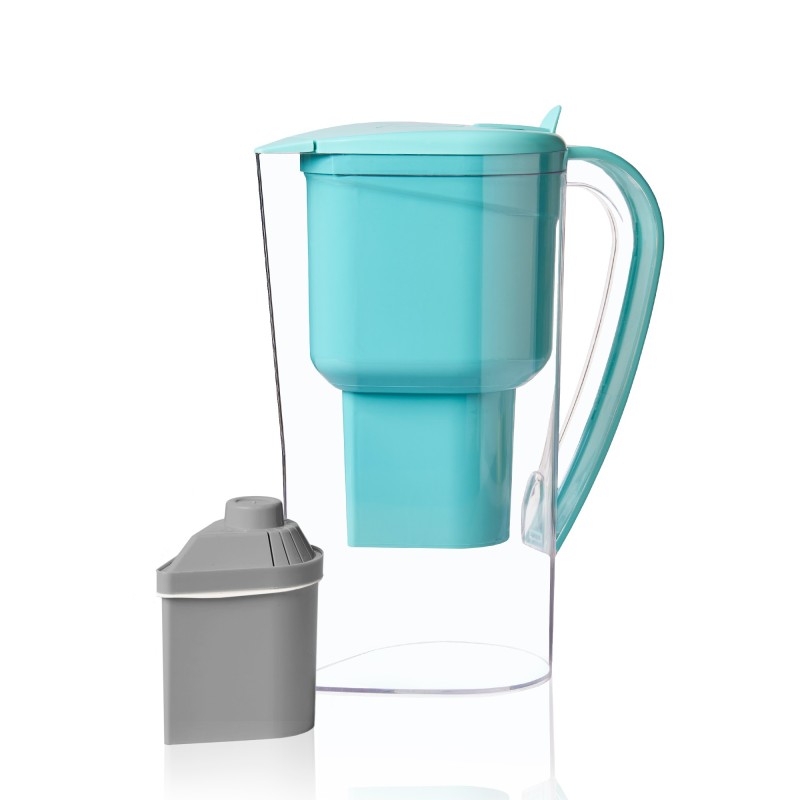
The Alkanatur Pitcher with Zeolite Filter pairs the familiar 2.5-liter plastic pitcher body with a gray cartridge made with natural clinoptilolite zeolite. Alkanatur lists turquoise, green and pink body finishes; the exact product image used here shows only the turquoise pitcher and gray cartridge on a studio background. The body is described as BPA-free plastic, not glass. The precise plastic resin, external dimensions and empty weight are not stated in the product information inspected for this model. If a tight shelf fit matters, get the actual measurements from the manufacturer.
As with the other Alkanatur pitcher listings, 2.5 L is a stated vessel capacity rather than a measured amount of filtered water immediately available. There is no separate filtered-chamber volume specified on this page. The package description includes one gray zeolite filter and a BPA-free bottle. This is a passive pour-through design; Alkanatur estimates approximately four minutes per liter, which is a maker figure rather than an independent flow test.
A qualitative heavy-metal preference needs a sharper test
The manufacturer positions the gray clinoptilolite version for places with higher heavy-metal concerns or older plumbing and says it is designed to remove more heavy metals. That is useful for understanding why this filter exists, but it is not a specific lead result. The exact listing does not name a test concentration, influent/effluent comparison, certified reduction percentage for lead, or full list of metals measured on the zeolite configuration. The product page’s broader “up to 99%” language is not a substitute for those details. If lead, arsenic or another metal is an essential requirement, first identify the contaminant in a water report and compare it with an exact-model performance sheet or a relevant certification listing. This review does not treat the zeolite filter as satisfying a lead-reduction match.
Alkanatur also says the gray filter adds magnesium at 18 mg per liter and lists a pH range of 8.5–9.5. The maker describes the cartridge as coconut carbon and bioceramics with clinoptilolite, and says its filter family avoids ion-exchange resin. These are manufacturer material and feature statements; they do not imply a health benefit or guarantee the same output for every source water. In particular, the alkaline/mineralizing language should remain a preference, not a reason to expect treatment for a health condition.
The unit and time ratings are not quite the same thing
The product page gives a 400-liter filter capacity and a three-to-four-month service window. It also describes 400 liters as 110 gallons, but its care article rounds the same volume to about 105 U.S. gallons. Converting the stated liters gives about 105.7 U.S. gallons, the conservative comparable figure used here. It meets a 100-gallon minimum, not a 110-gallon minimum. Time guidance differs: the North American product page gives 3–4 months, the North American FAQ says 400 L or five months maximum and gives a general three-month replacement recommendation, and the care article says 3–4 months. A generic 2025 Alkanatur Drops Jug manual linked from an EU product page says 400 L or six months maximum. The document does not identify this U.S. SKU or package revision. Follow the leaflet supplied with your unit; until there is a package crosswalk, use the earlier North American three-month direction as the conservative time cue.
Filter choice is interchangeable across the company’s pitcher body according to Alkanatur, but that does not make the three filters identical. The white standard filter is also listed at 18 mg/L magnesium; the green filter at 4 mg/L with a milder-taste positioning; the gray zeolite filter is the only one named as clinoptilolite. The online pitcher's green body finish should not be confused with the green low-magnesium cartridge. Check the filter color and model name on a replacement order.
Setup and cleaning are part of the ownership decision
Alkanatur’s FAQ instructs users to wash the pitcher pieces with soap and a soft sponge before installing a new cartridge. Activate the filter by submerging it with its small outlet hole facing upward until bubbling stops, or use the North American FAQ’s 20-minute hold-down soak. A generic 2025 Drops Jug manual linked from an official EU listing says 15 minutes instead; it does not identify a U.S. SKU or package revision. Follow your supplied leaflet for the exact soak timing. Seat it in the upper reservoir and filter three initial rounds; the company says to use those rounds for plants and recommends drinking from the fourth for taste. Only rinse the cartridge with water—do not apply soap or other cleaners to its media.
The manufacturer recommends a weekly wash of the disassembled pitcher, lid and reservoir. It prefers handwashing, although it says a low-temperature dishwasher cycle is allowed. For hard-water residue, its FAQ describes warm water and vinegar on the pitcher after removing the filter. The FAQ also gives storage limits for filtered water: refresh room-temperature water within a day and refrigerated water within two days. For travel, it describes refrigeration of the removed filter after more than three days away and draining/bagging/freezing for longer than a week. Check the current instructions before using the special storage procedure.
The certificate is not a contaminant-reduction data sheet
The brand links an independent UNE 149101:2025 compliance certificate for an Alkanatur Drops pitcher batch. I reviewed the six-page certificate: it records compliance and output-sample measurements, not an influent challenge comparison demonstrating how much the gray filter removes from water. The document does not identify the zeolite cartridge as the tested configuration and is not NSF/ANSI certification. It also does not establish microbial reduction. This pitcher should be used with already-potable tap water, not to disinfect an unsafe or unknown source.
Choose the gray filter if its clinoptilolite material and the maker’s qualitative heavy-metal positioning are what you want to investigate, and if you are prepared to verify the exact metal claim before relying on it. Pick the green version for the stated 4 mg/L magnesium addition; pick the standard white filter for the stated 18 mg/L route. If a quantified contaminant result is essential, none of these broad page claims should replace an exact performance table. The finder keeps the three filter routes distinct and leaves the zeolite model out of lead-essential matches unless a specific lead result is documented.
Read the standard-filter assessment · Read the low-magnesium assessment · Compare all three Alkanatur filters · Alkanatur zeolite pitcher listing · Alkanatur setup and care FAQ · Alkanatur Drops user manual
Key details at a glance
| Listed tank capacity | 2.5 L |
|---|---|
| Included filter | Alkanatur zeolite |
| Stated filter capacity | 105.7 gal |
| Made without BPA | Yes |
| What the filter is documented to reduce | The product page says the gray zeolite filter is designed to remove more heavy metals, and uses broad up-to-99% language for a list of compounds. The inspected product sources do not supply a named exact-filter contaminant challenge table or a lead reduction result; no quantitative heavy-metal result is encoded. The inspected UNE certificate reports batch compliance/output results, not an influent-to-effluent challenge table for this filter version; no broad advertised removal percentage is encoded as exact performance. |
| Use and care | Gravity pour-through for treated, already potable tap water. Not a disinfection device or a substitute for exact contaminant-specific performance data. |
| Pitcher material | Manufacturer describes a BPA-free plastic pitcher body; resin grade, external dimensions and empty weight were not specified in inspected product sources. |
| Button-controlled electric dispensing | No |
| Stainless-steel body | No |
| Glass water reservoir | No |
| Mineral-boost feature | Yes |
Use the exact model’s instructions for operating limits, supplied equipment and version differences.
Sources for this assessment
- Exact Alkanatur product page
- Exact native Alkanatur product record
- Alkanatur official pitcher FAQ
- Alkanatur official filter-replacement guidance
- Alkanatur official certificate library
- UNE 149101:2025 Certificate of Testing Compliance, batch 7/25
- Alkanatur article describing UNE testing
- Alkanatur exact pitcher and filter image
- Official Alkanatur Drops Jug multilingual user manual (2025 copyright)
- Alkanatur EU Drops Jug page hosting the manual

Check the exact filter setup before you shop.
Capacity, filter type and the written reduction claims belong to the pitcher-and-cartridge combination, not just the pitcher shape.