
Your needs, this model
Does it fit your priorities?
Would the 2.5-liter Alkanatur pitcher work if its filter runs by gravity rather than a button dispenser?
The exact listing is 2.5 L and the maker estimates about four minutes per liter by gravity. This route is not powered dispensing.
Explore this need in the finder →Is this specific Alkanatur cartridge the feature you want rather than one of its sibling filters?
The standard white filter is described as adding magnesium at 18 mg/L; the maker lists alkaline pH 8.5–9.5. The three listings share the pitcher body but have distinct filter identities.
Explore this need in the finder →Would you use this cartridge when an exact lead-reduction result is not established?
No named lead result was established for this exact configuration. It may fit a filter preference if lead evidence is not essential; it is not a match when a lead result is required.
Explore this need in the finder →One Alkanatur body, three different filter choices
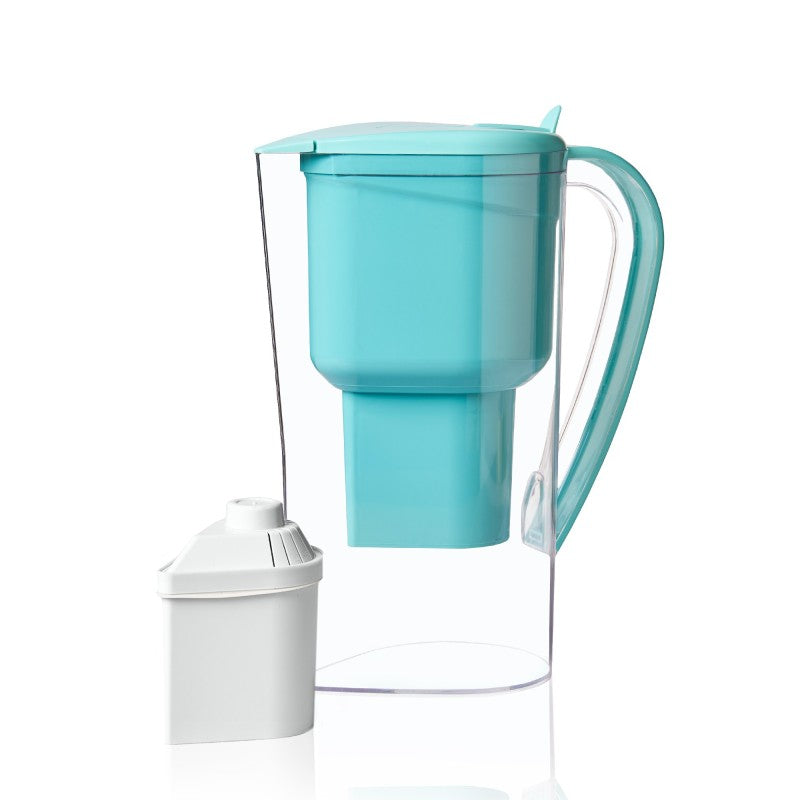
The standard Alkanatur Pitcher is the white-filter version of the maker’s 2.5-liter pitcher. Its North American product listing offers turquoise, green and pink body finishes under the same standard-filter product. The manufacturer image archived for this review shows the turquoise body and white cartridge as a studio rendering; it does not show the green or pink finish. The listing describes a BPA-free plastic pitcher, not a glass vessel. No reliable exterior dimensions or empty weight were found in the exact product information, so measure your refrigerator shelf rather than treating the picture as a fit check.
Alkanatur lists 2.5 L as the vessel capacity. That is not a cup rating for ready-to-pour filtered water, and the maker does not give a separate filtered-reservoir volume on this product page. The package description lists one standard white filter and one BPA-free bottle. This is a gravity pour-through system: the company estimates about four minutes for one liter to pass through. That figure is a manufacturer estimate, not an independent timing test. If you want water at a button or a quick first glass during a busy meal, this is not an electric dispenser.
What the white filter is designed to change
The product page describes a coconut-carbon and bioceramic filter without ion-exchange resin. It says the standard cartridge adds magnesium at 18 mg per liter and lists an alkaline pH range of 8.5–9.5. These are manufacturer feature statements; the actual result can depend on the input water. The page also advertises “up to 99%” removal for a broad list of compounds, but the inspected material did not provide a named contaminant challenge table with influent values, conditions and exact reduction results for this pitcher-and-filter combination. I have therefore not treated those broad claims as proof of lead, fluoride, PFAS or microbial reduction. If a contaminant result is the reason you are shopping, use a performance sheet for the exact cartridge and ask the maker for test conditions rather than relying on an umbrella percentage.
The maker rates the filter at 400 liters and describes a three-to-four-month lifespan. Its product page pairs 400 L with 110 gallons, while its care article says approximately 105 U.S. gallons; converting 400 liters directly gives about 105.7 U.S. gallons. Compare the underlying 400-liter limit, not the rounded 110-gallon figure. Manufacturer timing advice is not perfectly aligned: the exact North American listing says 3–4 months, the North American FAQ says 400 L or five months maximum and separately gives a general three-month replacement recommendation, and the North American care article describes 3–4 months. A generic 2025 Alkanatur Drops Jug manual linked on the company’s EU product page says 400 L or six months maximum. That PDF is not cross-referenced to this U.S. listing or package revision. Follow the leaflet with your exact unit; until the package bridge is documented, the earlier North American three-month recommendation is the conservative time cue rather than the longer ceilings.
Startup has a deliberate break-in routine
Alkanatur’s FAQ gives a more involved first setup than simply dropping a cartridge into a reservoir. Wash the pitcher parts and upper reservoir with soap and a soft sponge first. To activate the filter, submerge it with its small outlet opening facing upward until the air bubbles stop; the North American FAQ offers a 20-minute hold-down soak. The separate 2025 Drops Jug manual linked from an official EU product page specifies 15 minutes. Both describe the hole-up activation and three initial cycles, but the manual does not identify a U.S. SKU or package revision. Follow the leaflet supplied with your unit if its soak timing differs. Seat it squarely in the reservoir, fill and filter three rounds, and use those first rounds for plants. The company recommends drinking from the fourth filtration for its preferred taste. Rinse the cartridge with water only; do not use soap or other cleaner on it.
For regular care, the FAQ recommends weekly disassembly and washing of the pitcher, reservoir and lid. Hand-washing is the recommended routine, though the maker says a low-temperature dishwasher cycle is allowed. In hard-water areas, it describes cleaning the pitcher with warm water and vinegar after removing the filter. Its storage guidance is unusually specific: replace room-temperature water within 24 hours and refrigerated water within 48 hours; store the filter in a refrigerator for absences over three days, and drain, bag and freeze it for absences longer than a week. Follow the current maker FAQ for the details and safe handling.
Read the certificate for what it actually covers
Alkanatur links a 2025 UNE 149101 certificate for a tested Alkanatur Drops pitcher batch. The six-page document is an independent certificate of compliance and includes water-output results. The report is not a before-and-after contaminant challenge table that establishes a reduction percentage for this exact standard cartridge. Its cover identifies the Drops pitcher batch, not a separate white-filter SKU, and the document is an unofficial English translation of the Spanish original. This is not an NSF/ANSI certification, and it does not establish microbial treatment. Use already potable water and do not use this pitcher to make unsafe or unknown-quality water safe.
Choose the standard route only if its mineral addition suits you
The standard filter makes most sense when you specifically want the manufacturer’s 18 mg/L magnesium-addition feature and are comfortable with the included claims being manufacturer statements rather than independently reproduced results here. The green low-magnesium version is listed at 4 mg/L and is positioned for a milder taste or mineral sensitivity; the gray zeolite version uses clinoptilolite and is positioned around water with higher heavy-metal concerns. Those options share the pitcher body, but they are not interchangeable evidence about what a particular cartridge has proved. The maker says the filters fit the same pitcher; replacement-filter SKUs and exact filter color still matter when you reorder.
Consider a different pitcher when a verified result for lead, fluoride or microbes is essential, when you need a measured refrigerator footprint, or when you want a stated filtered-output volume rather than the 2.5-liter vessel figure. The capacity selector can identify this exact 2.5-liter listing, and the filter-route selector separates the three Alkanatur cartridges; neither replaces a local water report or a full performance record.
Compare the low-magnesium version · Compare the zeolite version · How the three filter choices differ · Alkanatur standard pitcher listing · Alkanatur setup and care FAQ · Alkanatur Drops user manual · Alkanatur filter-replacement guidance
Key details at a glance
| Listed tank capacity | 2.5 L |
|---|---|
| Included filter | Alkanatur standard |
| Stated filter capacity | 105.7 gal |
| Made without BPA | Yes |
| What the filter is documented to reduce | The exact page advertises up-to-99% reduction for a broad list including chlorine, PFAS, fluoride, trihalomethanes, nitrates, heavy metals, microplastics and excess calcium. No exact-model challenge conditions, influent/effluent table or named lead result was found in the inspected materials; these claims are not encoded as verified performance. The inspected UNE certificate reports batch compliance/output results, not an influent-to-effluent challenge table for this filter version; no broad advertised removal percentage is encoded as exact performance. |
| Use and care | Gravity pour-through for treated, already potable tap water. Not a disinfection device or a substitute for exact contaminant-specific performance data. |
| Pitcher material | Manufacturer describes a BPA-free plastic pitcher body; resin grade, external dimensions and empty weight were not specified in inspected product sources. |
| Button-controlled electric dispensing | No |
| Stainless-steel body | No |
| Glass water reservoir | No |
| Mineral-boost feature | Yes |
Use the exact model’s instructions for operating limits, supplied equipment and version differences.
Sources for this assessment
- Exact Alkanatur product page
- Exact native Alkanatur product record
- Alkanatur official pitcher FAQ
- Alkanatur official filter-replacement guidance
- Alkanatur official certificate library
- UNE 149101:2025 Certificate of Testing Compliance, batch 7/25
- Alkanatur article describing UNE testing
- Alkanatur exact pitcher and filter image
- Official Alkanatur Drops Jug multilingual user manual (2025 copyright)
- Alkanatur EU Drops Jug page hosting the manual

Check the exact filter setup before you shop.
Capacity, filter type and the written reduction claims belong to the pitcher-and-cartridge combination, not just the pitcher shape.