
Your needs, this model
Does it fit your priorities?
Would the 2.5-liter Alkanatur pitcher work if its filter runs by gravity rather than a button dispenser?
The exact listing is 2.5 L and the maker estimates about four minutes per liter by gravity. This route is not powered dispensing.
Explore this need in the finder →Is this specific Alkanatur cartridge the feature you want rather than one of its sibling filters?
The green low-magnesium filter is described as adding magnesium at 4 mg/L, with a milder taste and lower antioxidant potential; the maker also lists pH 8.5–9.5. The three listings share the pitcher body but have distinct filter identities.
Explore this need in the finder →Would you use this cartridge when an exact lead-reduction result is not established?
No named lead result was established for this exact configuration. It may fit a filter preference if lead evidence is not essential; it is not a match when a lead result is required.
Explore this need in the finder →The filter, not the pitcher shell, is the meaningful difference
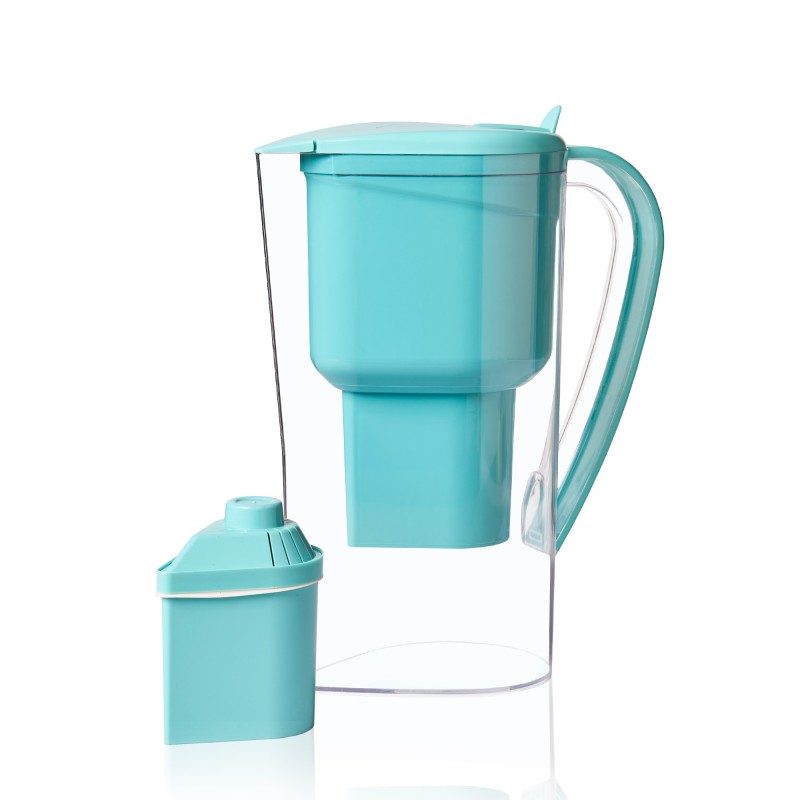
Alkanatur’s Low Magnesium Emission Pitcher uses the same basic 2.5-liter plastic vessel as its standard and zeolite siblings, but includes a green low-magnesium cartridge. The product listing offers turquoise, green and pink pitcher finishes; the exact image shows the turquoise body with green filter, not each finish. The manufacturer identifies the vessel as BPA-free plastic, but the inspected listing does not state a resin grade, empty weight or exterior measurements. If this needs to fit a particular refrigerator shelf, measure the opening and ask for dimensions instead of guessing from the photo.
The listing’s 2.5 L is the pitcher’s stated capacity. It does not tell you how many cups are already filtered after a refill, and no separate usable filtered-chamber figure is published on the product page. The box description includes a green filter and a BPA-free bottle. Filtering is gravity-driven, with the maker estimating about four minutes per liter. That is a manufacturer estimate rather than a timed result from an independent test. Expect to plan ahead when filling several glasses; there is no pump or on-demand dispensing button.
Four milligrams per liter is the point of this route
The green filter page states that it adds magnesium at 4 mg per liter, compared with 18 mg/L for the standard white filter. Alkanatur recommends this version for areas with hard water, for people who are sensitive to minerals, or for someone transitioning from bottled water. The company calls the flavor milder and says the lower-magnesium version has lower antioxidant potential. That is a product-feature distinction, not a medical indication or a guarantee that the pitcher softens hard water. Do not read “for hard water” as proof that it removes water hardness; the page does not give a measured hardness-reduction result for this version.
The maker also describes the green cartridge as alkalizing to pH 8.5–9.5, with coconut carbon and bioceramics and no ion-exchange resin. Those remain maker-described characteristics that can depend on source water. The page advertises “up to 99%” removal across a long list, but the inspected product materials do not provide an exact challenge-test table with the conditions and reductions behind each named contaminant for this pitcher and green filter. Therefore a lead, fluoride, PFAS or microbial requirement should not be considered met from the general percentage alone. The matching route records the exact green filter identity but leaves these pollutant results unknown rather than using a broad claim to satisfy an essential condition.
Capacity and filter life need careful translation
Alkanatur lists 400 liters for the cartridge and describes a three-to-four-month life. The product page labels that 400 L as 110 gallons, while a care article says about 105 U.S. gallons. A straight unit conversion yields approximately 105.7 U.S. gallons, so the gallon field here uses the liter rating rather than the rounded 110-gallon marketing equivalence. At a 100-gallon minimum the converted rating qualifies; at 110 gallons it does not. Time guidance varies: the North American product page says 3–4 months; the North American FAQ says 400 L or five months maximum and gives a general three-month replacement recommendation; the care article describes 3–4 months. A generic 2025 Alkanatur Drops Jug manual linked on the company’s EU product page says 400 L or six months maximum, but does not identify this U.S. filter/pitcher SKU or package revision. Follow the leaflet included with your own unit; pending an exact crosswalk, the earlier North American three-month direction is the conservative cue rather than a longer maximum.
Alkanatur says its pitcher can use each of the company’s three filter versions. That means you can change from the green filter to the standard or zeolite route, but the filtering preference, cartridge color and replacement purchase all change. Check the replacement listing carefully: the green filter has its own single-filter product page and is not identified merely by the pitcher’s plastic color.
Follow the written setup before drinking from it
The maker’s FAQ asks users to wash the pitcher and reservoir with soap and a soft sponge, then activate a new cartridge by submerging it with the small outlet hole up until air bubbles stop, or by following the North American FAQ’s 20-minute held-down soak. A generic 2025 Alkanatur Drops Jug manual linked from an official EU product page instead gives 15 minutes. It does not identify this U.S. SKU or package revision; follow your enclosed leaflet for the soak duration. Press the filter into the reservoir until seated, refill and filter three rounds, and use those initial rounds for plants; the company recommends beginning to drink from the fourth round for its preferred taste. The cartridge itself should be rinsed with water only. Do not wash it with soap or household cleaning products.
For routine care, the FAQ recommends a weekly wash of the disassembled pitcher, reservoir and lid. Handwashing is the preferred method; the maker allows a low-temperature dishwasher cycle. In hard-water areas it recommends warm water and vinegar for the pitcher after removing the filter. It also says to refresh room-temperature water within 24 hours and refrigerated water within 48 hours. For longer absences, the FAQ describes refrigerated storage after three days and draining, bagging and freezing after a week; consult the current FAQ for the complete sequence before relying on that storage method.
What the compliance certificate does not establish
The company links a UNE 149101:2025 certificate for an Alkanatur Drops pitcher batch. The independently issued document covers compliance and reports sampled output results; it does not present an influent-versus-effluent contaminant challenge table that validates the green cartridge’s advertised reduction list. The certificate does not name the green-filter configuration, is not NSF/ANSI certification and does not establish disinfection. Treat the green filter as a mineral/taste preference for already-potable tap water, not as a substitute for a water test, a contaminant-specific certified system or public-health treatment advice.
This version is the better of the three Alkanatur routes if you want the maker’s lower 4 mg/L magnesium addition and accept its broad but not fully substantiated here removal language. Choose the white standard route if you prefer the listed 18 mg/L addition; choose the gray zeolite route only if you are considering its qualitative material and heavy-metal positioning, not because a specific lead reduction is established. For any essential contaminant need, compare a system whose exact cartridge has a full, named performance record.
Compare the standard filter · Compare the zeolite filter · Alkanatur filter-choice guide · Alkanatur low-magnesium pitcher listing · Alkanatur setup and care FAQ · Alkanatur Drops user manual
Key details at a glance
| Listed tank capacity | 2.5 L |
|---|---|
| Included filter | Alkanatur low magnesium |
| Stated filter capacity | 105.7 gal |
| Made without BPA | Yes |
| What the filter is documented to reduce | The exact page advertises up-to-99% reduction for a broad list including chlorine, PFAS, fluoride, trihalomethanes, nitrates, heavy metals, microplastics and excess calcium. No exact-model challenge conditions, influent/effluent table or named lead result was found in the inspected materials; these claims are not encoded as verified performance. The inspected UNE certificate reports batch compliance/output results, not an influent-to-effluent challenge table for this filter version; no broad advertised removal percentage is encoded as exact performance. |
| Use and care | Gravity pour-through for treated, already potable tap water. Not a disinfection device or a substitute for exact contaminant-specific performance data. |
| Pitcher material | Manufacturer describes a BPA-free plastic pitcher body; resin grade, external dimensions and empty weight were not specified in inspected product sources. |
| Button-controlled electric dispensing | No |
| Stainless-steel body | No |
| Glass water reservoir | No |
| Mineral-boost feature | Yes |
Use the exact model’s instructions for operating limits, supplied equipment and version differences.
Sources for this assessment
- Exact Alkanatur product page
- Exact native Alkanatur product record
- Alkanatur official pitcher FAQ
- Alkanatur official filter-replacement guidance
- Alkanatur official certificate library
- UNE 149101:2025 Certificate of Testing Compliance, batch 7/25
- Alkanatur article describing UNE testing
- Alkanatur exact pitcher and filter image
- Official Alkanatur Drops Jug multilingual user manual (2025 copyright)
- Alkanatur EU Drops Jug page hosting the manual

Check the exact filter setup before you shop.
Capacity, filter type and the written reduction claims belong to the pitcher-and-cartridge combination, not just the pitcher shape.