
Your needs, this model
Does it fit your priorities?
Do you need a listed six-cup capacity for serving or refrigerator-fit planning?
Philips lists only a 1.5 L filtered-water tank, not a cup count or exterior dimensions; a six-cup serving or fit requirement is unconfirmed.
Explore this need in the finder →Is a bacteria, virus or cyst reduction result essential?
The exact AWP2920/10 leaflet lists bacteria removal as N/A and supplies no virus or cyst result; it cannot satisfy that essential need.
Explore this need in the finder →Must filtered water be dispensed by a powered button rather than a manual pour?
This is a gravity-fed pour-through pitcher, not a powered dispensing system.
Explore this need in the finder →Must the shortlist be limited to a currently documented US offer and local filter-support route?
The reviewed Philips sources do not establish a current US offer or matching local support route for this regional configuration; it remains reference-only.
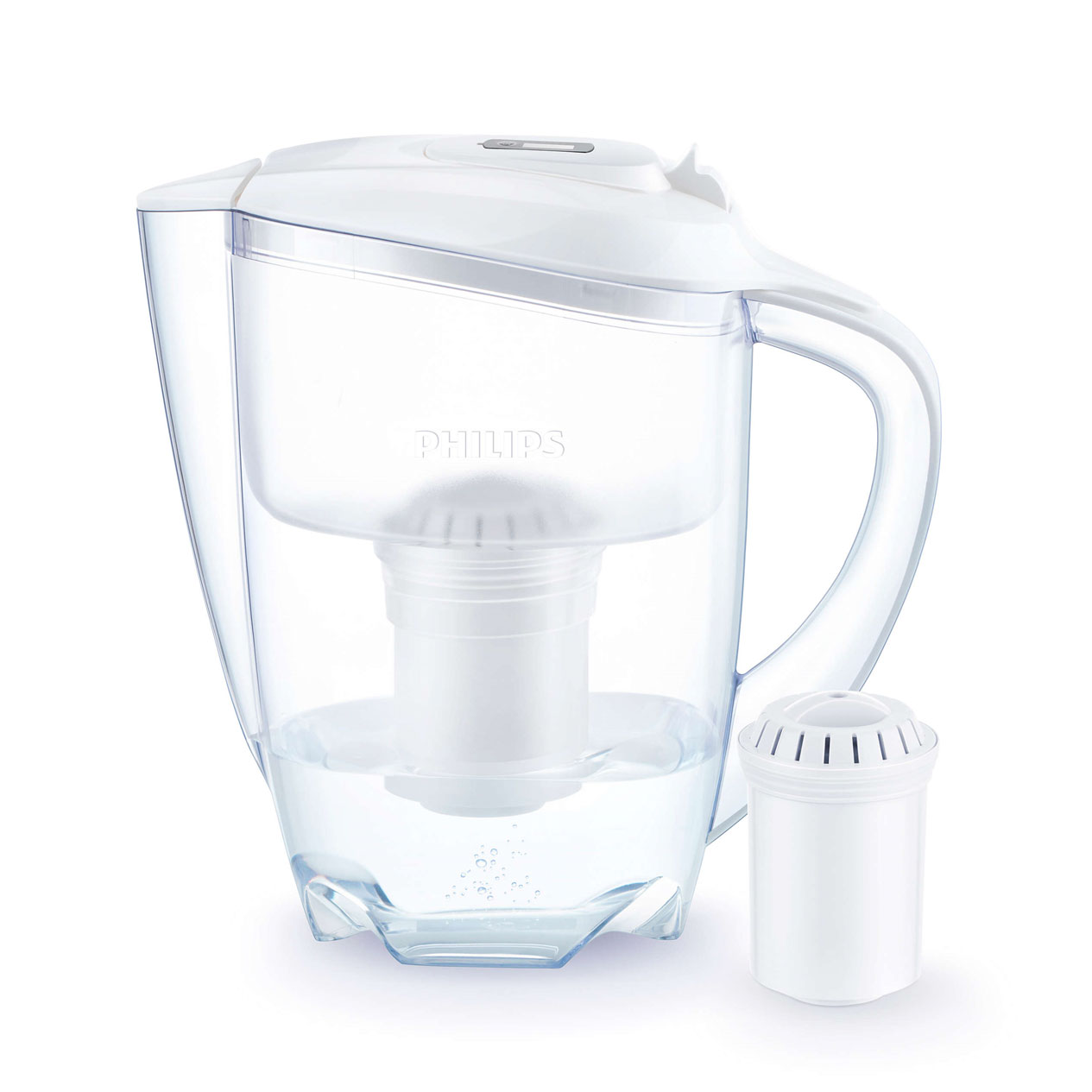
Explore this need in the finder →The Philips AWP2920/10 is a gravity-fed pitcher with a white lid, a digital filter timer and the AWP200/AWP201 one-piece cartridge route. Philips’ exact /10 leaflet gives the filtered-water tank as 1.5 L, the flow rate as 0.25 L/min and the rated filtration capacity as 200 L. The exact model leaflet is dated October 2023 and records EAN 4897099301745. This is useful documentation for identifying an existing pitcher, not proof of a current US offer: Philips UK marks its page discontinued, and the current Philips US pitcher directory lists different models.
A reminder, not a usage meter
The AWP2920/10’s clearest daily feature is its timer. Philips describes a digital reminder for replacing the filter; the associated user manual explains a 60-day countdown and recommends changing the cartridge at least every 60 days. The screen is calendar-based. It does not count liters, detect a lead result, measure flow, or tell you whether an individual cartridge has reached its rated capacity. Treat 200 L and the 60-day schedule as separate limits, rather than choosing whichever is more convenient. If a household filters water quickly, a date-only reminder cannot tell that the liter rating has already been reached. If use is light, a slowly advancing volume does not erase the calendar guidance.
Compared with Philips AWP2915/10 and AWP2918/10, which the family manual identifies as no-timer models, AWP2920/10 adds a visible reminder while retaining the listed AWP200/AWP201 filter route and basic flow and tank figures. The exact leaflets do not establish that its filter lasts longer or that filtration is faster. AWP2921 is the dark-blue-lid timer sibling; AWP2920/10 is shown with a white lid. Similar shells are not enough to identify replacement cartridges, so check the complete code on the pitcher and the matching leaflet.
What the leaflet claims—and what it does not
The specification describes four stages: non-woven fabric, granular activated carbon, ion-exchange resin, then another non-woven layer. Philips reports up to 99% reduction of chlorine and soluble lead under laboratory conditions and says soluble-lead reduction remains 88% at end of filter life. It also lists reductions for pesticides, VOCs, chemicals and microplastics, plus water-hardness reduction. These are manufacturer-stated results, not measurements from this review or a guarantee for every local water supply. The leaflet names Bureau Veritas testing but does not provide a full challenge table with influent concentration, conditions and complete certification scope. If one contaminant is decisive, ask for the exact supporting test for the pitcher-and-cartridge configuration rather than relying on a headline percentage.
The leaflet explicitly marks bacteria removal N/A. It gives no basis for treating this as disinfection or as a solution for water from an unknown source. Philips specifies mains tap water, 5–38 °C input and atmospheric pressure from 0 to 1 bar. That makes the AWP2920/10 a tap-water taste and reduction pitcher, not an emergency purifier. A household that needs a bacteria, virus or cyst result should reject it as an essential-fit candidate.
Capacity means the filtered tank, not the whole vessel
The listed 1.5 L is the filtered-water tank capacity. Philips does not give a cup-count capacity, exterior dimensions, shelf clearance or full raw-water fill volume in this leaflet. A cup-count requirement, or a narrow refrigerator shelf, therefore cannot be answered from the headline figure alone. It is a gravity batch system rather than an instant dispenser: 0.25 L/min is the manufacturer’s flow figure, but actual kitchen time depends on the setup and conditions. Keep some filtered water ready if several people will pour at once; repeated refilling is part of the routine.
The family user manual gives practical first-use instructions for the AWP2920/AWP2921 family: soak the new cartridge in clean water for 15 minutes, shake it gently, check the sealing ring, press it firmly into place, then fill and discard the first two filtered pitchers. It also says to remove the cartridge while cleaning, keep the pitcher out of the freezer and away from direct sun, and consume filtered water promptly. The manual says not to use unknown-source water or input above 38 °C. Follow the exact instructions packaged with the unit if they differ.
Do not confuse the two AWP2920 suffixes
There is a consequential suffix distinction. The 2023 AWP2920/10 leaflet names replacement cartridges AWP200/AWP201 and gives the 1.5 L tank and 200 L rating. A separate Hong Kong Philips AWP2920/03 leaflet, issued in January 2025, lists AWP220/AWP221/AWP222, a two-month interval and the same stated 0.25 L/min flow, but omits tank and liter-capacity figures. Philips’ Hong Kong support page also links a 2022 user manual whose base-model table lists AWP200/AWP201 for AWP2920. That document mismatch leaves the exact cartridge fit for /03 unresolved; do not transfer /10 specifications or buy either route by appearance. Check the label and current Philips support for the exact suffix.
For an existing AWP2920/10 owner, the exact model leaflet and family manual make the timer, AWP200/AWP201 route and operating limits legible. For a new US purchase, this review is reference-only: the UK exact page says discontinued, the current US directory does not list this /10, and these sources do not establish local US replacement-filter support. Compare a currently documented US model instead, or confirm supply and service for the exact pitcher before spending money.
Philips AWP2920/10 product leaflet · Philips UK AWP2920/10 page · Compare Philips AWP200/AWP201 pitcher variants
Key details at a glance
| Listed tank capacity | 1.5 L |
|---|---|
| Included filter | Philips AWP200/AWP201 GAC + ion-exchange cartridge |
| Stated filter capacity | 52.8 gal |
| Typical replacement interval | 2 months |
| Lead result in exact-filter test data | Yes |
| Reusable filter shell | No |
| What the filter is documented to reduce | The exact AWP2920/10 leaflet describes four-stage filtration with non-woven fabric, granular activated carbon, ion-exchange resin and another non-woven layer. Philips claims up to 99% chlorine and soluble-lead reduction in laboratory conditions, with 88% lead reduction at end of filter life; it lists pesticide, VOC, chemical, microplastic and water-hardness reduction. Bacteria removal is explicitly N/A. These are manufacturer claims; the leaflet is not a full challenge table or independent result. |
| Use and care | Municipal/mains tap water only, 5–38 °C input, atmospheric pressure 0–1 bar. The family manual warns against unknown-source water, hot input and freezing; store filtered water covered/cool and consume promptly. This is not microbial treatment. |
| Manufacturer dimensions as listed | No external dimensions, cup count or full raw-water fill volume is provided in the exact leaflet; 1.5 L is filtered-water tank capacity. |
| Microbial test result in exact filter data sheet | No |
| Replaceable filter inner core | No |
Use the exact model’s instructions for operating limits, supplied equipment and version differences.
Sources for this assessment
Check the exact filter setup before you shop.
Capacity, filter type and the written reduction claims belong to the pitcher-and-cartridge combination, not just the pitcher shape.