
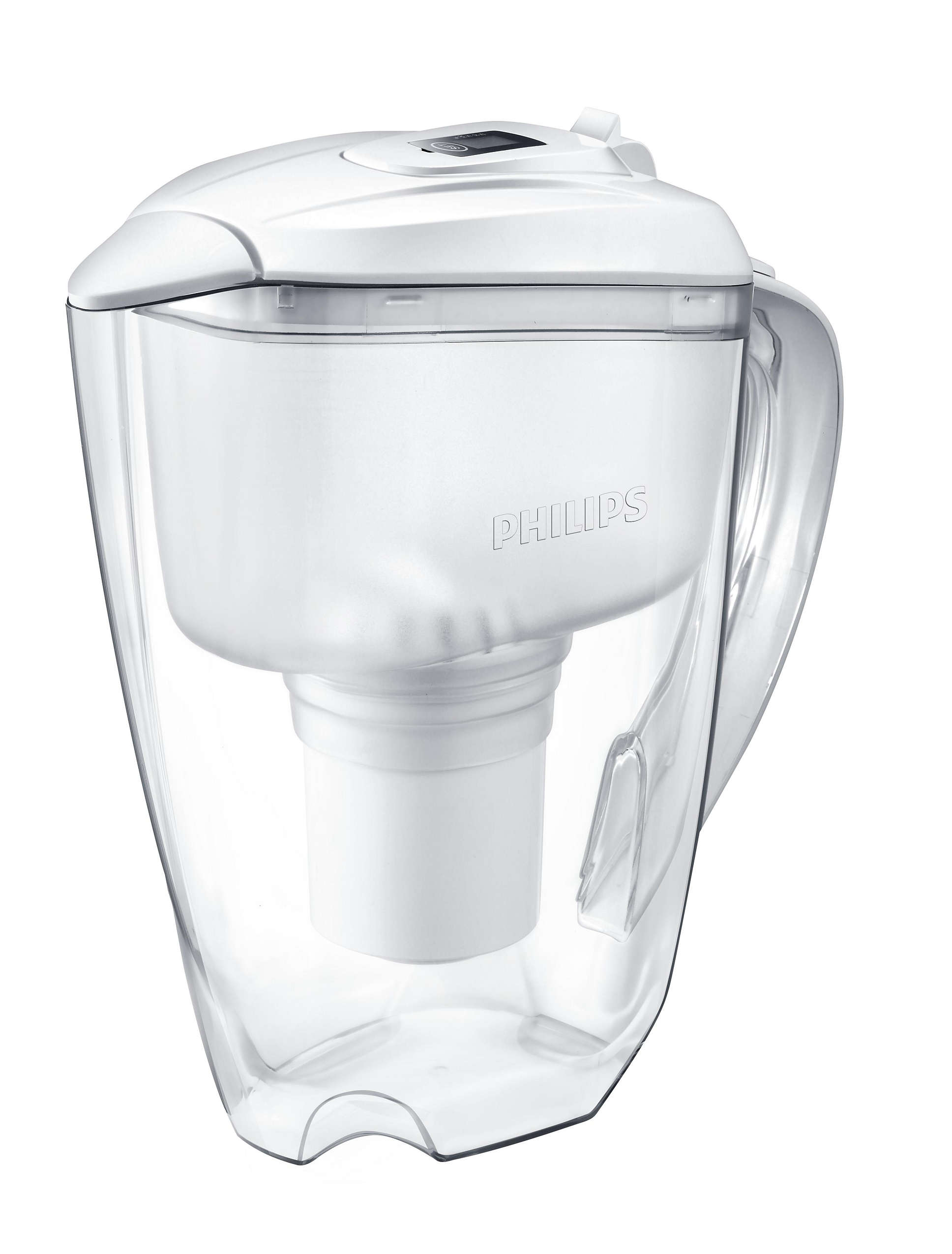
Your needs, this model
Does it fit your priorities?
Do you need a listed six-cup capacity for serving or refrigerator-fit planning?
Philips does not provide a cup count, filtered-tank capacity or exterior dimensions for this /03 variant in its exact 2025 leaflet; a six-cup fit is unconfirmed.
Explore this need in the finder →Is a bacteria, virus or cyst reduction result essential?
The exact 2025 /03 leaflet supplies no microbial reduction result; unknown evidence cannot meet a bacteria, virus or cyst requirement.
Explore this need in the finder →Must filtered water be dispensed by a powered button rather than a manual pour?
This is a gravity-fed pour-through pitcher, not a powered dispensing system.
Explore this need in the finder →Must the shortlist be limited to a currently documented US offer and local filter-support route?
The reviewed Philips sources do not establish a current US offer or matching local support route for this regional configuration; it remains reference-only.
Explore this need in the finder →Philips AWP2920/03 is a gravity pitcher listed on Philips Hong Kong’s product site and documented in a localized leaflet issued January 20, 2025. For its exact code and EAN, that suffix-specific leaflet lists AWP220/AWP221/AWP222 as replacement cartridges. It gives a two-month filter interval and 0.25 L/min flow, but does not state the filtered-tank volume, full vessel capacity or rated filter liters. The exact Hong Kong support page also links a 2022 family manual whose table names AWP200/AWP201 for unsuffixed AWP2920. The later exact-code leaflet is the clearest documented route for this /03 configuration; the older family manual does not establish whether its route applies to a past revision of that suffix. Do not treat the two cartridge families as interchangeable.
A further Philips source adds context without closing that gap: its AWP201/10 cartridge page and November 2023 leaflet list AWP2920 among compatible base-model codes, but neither attaches a slash suffix or EAN to that compatibility entry. That makes AWP201 a documented family-level route, not proof that it fits the exact EAN above. For a pitcher whose label or included cartridge says AWP201, verify the complete model revision with Philips rather than using this generic list to overrule the newer suffix-specific sheet.
A familiar number is not an exact fit guarantee
The pitcher is labeled AWP2920/03 on Philips’ Hong Kong product page and on the 2025 leaflet, whose EAN is 4897099300557. The leaflet describes a timer, dust-resistant spout and ergonomic handle, and its replacement-filter specification lists the three AWP220-series codes. The support page also links a 2022 family manual whose base-model table gives AWP200/AWP201 for AWP2920. A separate AWP201/10 cartridge page and its November 2023 Philips leaflet repeat AWP2920 in a compatible-model list, but only as a base model, not as AWP2920/03 or its EAN. For an exact EAN 4897099300557 unit, AWP220/AWP221/AWP222 is the route published by the later suffix-specific sheet. The broader AWP201 listing still does not say whether it applies to this suffix, a former /03 revision, or a different family variant, nor does it explain why the two routes differ. Read the full suffix and the cartridge code supplied with the unit; do not infer an exact fit from a shared base number or similar body shape.
This model is different from AWP2920/10, not a cosmetic suffix swap. The /10 exact leaflet gives the AWP200/AWP201 route, a 1.5 L filtered-water tank and 200 L capacity. The 2025 /03 sheet instead lists AWP220/AWP221/AWP222 and gives no tank volume or liter rating. In a recommendation that requires a known pitcher size or filter life in liters, those omissions matter. Its two-month schedule is a calendar replacement interval, not a rated volume and not evidence that AWP200/201 fits.
Use limits and modest performance evidence
The exact /03 leaflet specifies municipal tap water at 5–38 °C and atmospheric input pressure from 0 to 1 bar. It presents the unit as microfiltration with GAC and ion-exchange resin and claims reductions for VOCs, herbicide and water hardness, alongside up to 99% chlorine and soluble-lead reduction under laboratory conditions. Philips says soluble-lead reduction remains 88% at the end of filter life. Those are manufacturer claims; the short localized sheet does not give a full contaminant table with challenge concentrations, test conditions and a certification scope. Do not treat the headline as a promise for an individual tap or a reason to use this pitcher with unknown-source water.
The 2025 leaflet does not provide a bacteria, virus or cyst result. Absence of a table is not proof of a particular reduction, and there is no evidence here for microbial treatment. If microbial protection is essential, do not count this as a fit. A separate Philips manual linked on the product-support pages says the AWP2920 family is intended for municipal tap water, warns against hot input above 38 °C, and provides first-use and cleaning directions. Its replacement-code table is family-level and predates the exact 2025 suffix leaflet. It is useful for general water and care limits, but does not prove AWP200/AWP201 compatibility with the EAN-specific /03 configuration or provide preparation steps for the newer AWP220 route; follow the supplied cartridge instructions for that detail.
Plan the household routine around unknown capacity
At 0.25 L/min, this is still a gravity-fed batch filter rather than powered dispensing. The water needs time to pass through the cartridge, and a single batch can only be sized if the actual pitcher fill markings or a verified local specification supply that missing detail. The 2025 leaflet gives no filtered-tank capacity, cup count, exterior size or refrigerator-fit measurements. Do not convert a neighboring model’s 1.5 L filtered-tank figure into an AWP2920/03 fact. If a household needs six cups ready at once, a shelf dimension or a known rated volume before purchase, this evidence cannot answer that condition. A different model with explicit capacity data is a safer comparison.
The timer is a useful calendar prompt, not a usage sensor. Philips calls it a replacement reminder, and this localized leaflet pairs it with a two-month replacement interval. It does not count liters or measure contaminants. Keep the replacement date visible, and do not stretch the schedule because the cartridge looks clean. The linked user manual describes soaking a new cartridge, seating the seal carefully and discarding the first two pitchers; because the replacement-code discrepancy remains, verify current instructions supplied for the exact /03 before putting a cartridge into service.
Reference only in a US shortlist
Philips’ Hong Kong page and official leaflet establish that AWP2920/03 exists as a regional configuration; they do not establish a US sale or US replacement support. The current US Philips pitcher directory captured for this project lists other models. AWP2920/03 therefore remains a model-identification reference and is excluded from US buying recommendations. The 2025 suffix-specific leaflet gives an identifiable replacement route for its EAN, but the linked 2022 family manual leaves the revision history unexplained. An owner should check the full label and follow the exact-code leaflet; if the unit came with older AWP200/AWP201 instructions, confirm the revision with Philips rather than mixing cartridge families. A shopper should choose a US-supported product with a local parts route and stated capacity rather than treating this Hong Kong configuration as a domestic offer.
Philips AWP2920/03 localized leaflet · Philips Hong Kong AWP2920/03 support · Philips AWP201/10 cartridge compatibility page · Compare AWP2920/10, a distinct suffix and filter route
Key details at a glance
| Typical replacement interval | 2 months |
|---|---|
| Lead result in exact-filter test data | Yes |
| Reusable filter shell | No |
| What the filter is documented to reduce | The 2025 exact /03 leaflet describes a multi-stage GAC and ion-exchange microfiltration route and claims reductions for VOCs, herbicide and water hardness, plus up to 99% chlorine and soluble lead under laboratory conditions; soluble-lead reduction is stated as 88% at end of filter life. The localized sheet contains no bacteria, virus or cyst result and gives no detailed challenge table. These are manufacturer claims, not independent testing. |
| Use and care | The exact 2025 leaflet lists AWP220/AWP221/AWP222 and specifies municipal tap water at 5–38 °C and atmospheric input pressure 0–1 bar. The linked 2022 family manual names AWP200/AWP201 for unsuffixed AWP2920 but does not establish which revision the generic table covers. |
| Manufacturer dimensions as listed | The 2025 exact /03 leaflet gives no cup capacity, filtered-tank volume or external dimensions. Do not transfer the /10 leaflet figures. |
| Replaceable filter inner core | No |
Use the exact model’s instructions for operating limits, supplied equipment and version differences.
Sources for this assessment
- Philips AWP2920/03 localized product leaflet, issue 2025-01-20
- Philips AWP2920/03 2025 exact leaflet embedded product rendering
- Philips Hong Kong AWP2920/03 product page
- Philips Hong Kong AWP2920/03 support page
- Philips pitcher family user manual linked from AWP2920/03 support
- Philips US Water Pitchers directory, current four-result page
- Philips Hong Kong AWP201/10 filter product page
- Philips Hong Kong AWP201/10 support page
- Philips AWP201/10 localized product leaflet, issue 2023-11-01
Check the exact filter setup before you shop.
Capacity, filter type and the written reduction claims belong to the pitcher-and-cartridge combination, not just the pitcher shape.