
Your needs, this model
Does it fit your priorities?
Is a data-sheet fluoride reduction result essential to you?
The current Pure XP PDS lists a 99.2% fluoride reduction result under its stated test conditions; the Nano XP PDS does not list a fluoride result.
Explore this need in the finder →Do you want an XP filter whose inner core can be replaced while the housing is reused?
Epic describes the current XP design as a reusable outer housing with a replaceable inner cartridge; confirm you have the required housing before buying the cartridge-only SKU.
Explore this need in the finder →Can you accept choosing a pitcher without a confirmed cup capacity or exact shelf height?
The current Pure XP product page does not state a cup capacity or labeled dimensions, so those limits are not confirmed for this exact configuration.
Explore this need in the finder →Start with the exact XP package
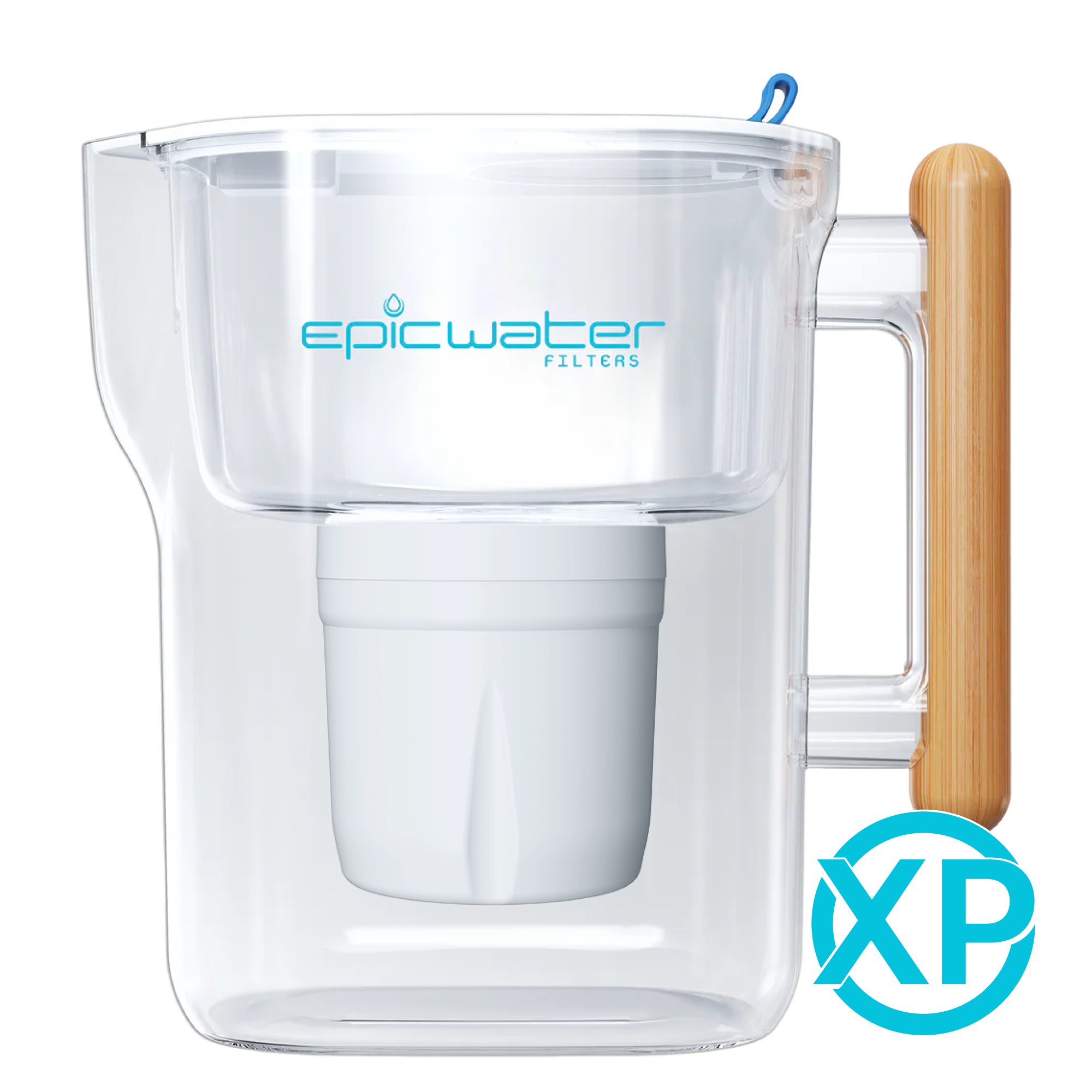
Epic’s current US catalogue lists the Pure XP Water Filter Pitcher in Bamboo and Blue finishes, with package SKUs EW-PTCH-PXP2-WHT and EW-PTCH-PXP-BLU. The finish changes the handle color, not the filter route. Both listings are gravity-fed pitchers supplied with an installed Pure XP filter. This review is about those pitcher packages—not the visually similar Pure XP dispenser, which is a separate, much larger spigot system, and not an older Epic Pure cartridge generation.
The current product page does not give a dependable cup-capacity or refrigerator-dimension figure for this pitcher. I would not assume the Nano XP’s published ten-cup size or its dimensions transfer just because the housings look closely related. If a ten-cup minimum or a precise shelf-height limit is essential, the Pure XP page does not establish that fit. Measure the space and ask Epic to confirm the exact current pitcher before ordering; an attractive studio image is not a dimensional drawing.
Pure XP’s distinguishing cartridge is documented in a current data sheet
The Pure XP filter uses Epic’s CoreXchange design: the outer housing stays in use while the inner filter core is replaced. Epic says this can reduce plastic per refill, but that is a manufacturer comparison rather than an independently measured lifetime-waste result. The manufacturer’s current replacement listing separates a cased filter from a replacement cartridge. Confirm that you have the housing before ordering the core-only part, and match the package to the Pure XP family rather than guessing from the shape of an older Epic filter.
The August 2026 Pure XP performance sheet identifies a gravity-pitcher filter, a 100-gallon rated capacity and an operating-water range of 38–85°F. It reports testing under NSF/ANSI 42, 53, P231 and 401. Epic separately lists NSF certification to 42 and NSF/ANSI/CAN 372; being tested to other standards is not the same claim as being certified to each of them. The sheet lists a 99.2% fluoride result and results for PFOA/PFOS and other PFAS, bacteria, virus, cyst, lead, chlorine and many additional substances under its stated laboratory conditions. For lead, the sheet distinguishes soluble and particulate tests: the reported reductions are not one interchangeable blanket number. Read the individual contaminant, test condition and capacity table rather than relying on a headline such as “70+.”
Those are manufacturer-published laboratory results for the filter, not a test of your household water and not a promise about every concentration, filter age or misuse condition. The organism results do not make this pitcher a field disinfection device. Start with your utility report or an appropriate private-well test, and do not use any pour-through pitcher to make unknown or unsafe water safe.
Plan for the wait and the replacement routine
Epic’s setup instructions say to check that the silicone gasket is in place, hand-wash the pitcher and filter parts with mild detergent, rinse, fit the filter securely and discard the first two pitcherfuls after installation. Use cold input water. The data sheet’s temperature range is a useful concrete boundary; Epic also warns against hot water, freezing the filter and salt water. Keep the filter wet as the manufacturer directs. The lid timer is a 90-day reminder, not a sensor that measures gallons or tests contaminant performance. The 100-gallon rating and the manufacturer’s approximate three-to-four-month routine are separate limits to manage together, with shorter life possible depending on use and water quality.
Epic’s Pure XP page gives a typical saturated full-pitcher time of about 10–15 minutes, but its technical text elsewhere describes contact times that can run much longer, and its support page says to contact support if a fill exceeds 30 minutes. I would not treat filtration speed as a guaranteed specification. Let a fresh cartridge saturate, refill ahead of when you need water, and follow the current included instructions if flow is unusually slow.
Who should choose it—and who should look elsewhere?
The Pure XP suits a shopper who wants the current Pure filter’s specific documented reductions—including fluoride results—alongside a replaceable inner core and is willing to refill a gravity pitcher, keep track of two discard fills and replace the filter at its rated limit. Choose the finish that fits your kitchen; the filtration evidence does not change with color. The home page’s broad claims should not substitute for reading the exact Pure XP sheet.
If a verified ten-cup vessel rating matters, the Nano XP is the Epic pitcher with that figure on its current product page, although its dimensions still have unlabeled axes. If fluoride performance is the priority, Pure XP is the clearer Epic route: the Nano page’s overview says its filter does not reduce fluoride, another section mentions fluoride reduction, and the current Nano data sheet does not list a fluoride result. That source conflict is not a reliable basis for selecting either fluoride removal or fluoride retention. A separate alternative such as LifeStraw Home Essential 7-Cup uses a different two-filter architecture and a smaller published size; compare its separate stage limits rather than assuming it is interchangeable with an Epic cartridge. For a fully documented Pure filter configuration, inspect the manufacturer testing page and the linked Pure XP performance sheet before you buy.
Key details at a glance
| Included filter | Epic Pure XP |
|---|---|
| Stated filter capacity | 100 gal |
| Lead result in exact-filter test data | Yes |
| Manufacturer dimensions as listed | No exact Pure XP pitcher dimensions are stated in the current product-page text captured for this review. |
| Pitcher material | Epic describes food-grade BPA/BPS-free materials; the exact current Pure XP pitcher page does not identify the pitcher resin by name. |
| Microbial test result in exact filter data sheet | Yes |
| Fluoride result in exact-filter test data | Yes |
| Replaceable filter inner core | Yes |
Use the exact model’s instructions for operating limits, supplied equipment and version differences.
Sources for this assessment
- Epic Water Filters US pitchers and dispensers collection
- Epic Pure XP Water Filter Pitcher exact US product page
- Epic Pure XP Water Filter Pitcher native product record with finish SKUs
- Epic Pure XP Filter August 2026 Performance Data Sheet
- Epic pitcher and dispenser filter setup and care guidance
- Epic filter testing and certification document index
Check the exact filter setup before you shop.
Capacity, filter type and the written reduction claims belong to the pitcher-and-cartridge combination, not just the pitcher shape.