
Your needs, this model
Does it fit your priorities?
Is the listed 7-cup pitcher capacity the size you need?
The 7-cup label is the whole vessel; it is not the filtered volume immediately ready after one reservoir fill.
Explore this need in the finder →Do you want LifeStraw Home’s paired membrane and carbon + ion-exchange filter route?
This pitcher includes both elements, with distinct claimed reductions and separate replacement intervals.
Explore this need in the finder →Is a documented bacteria-and-parasite reduction claim essential?
The LifeStraw Home test sheet reports these reductions under its stated conditions; this does not make unsafe or unknown water an acceptable input.
Explore this need in the finder →Can you accept the shorter filter stage reaching its stated limit at 40 gallons or two months?
The carbon + ion-exchange element has the shortest replacement interval at 40 gallons or two months; the membrane has a separate 264-gallon / up-to-one-year limit.
Explore this need in the finder →Would a listed height of 11.3 inches fit your refrigerator shelf?
The Essential guide lists 11.3 inches high; the 10-cup body uses a wider handle-side footprint than the 7-cup body.
Explore this need in the finder →The compact Essential pitcher, not a generic Home model
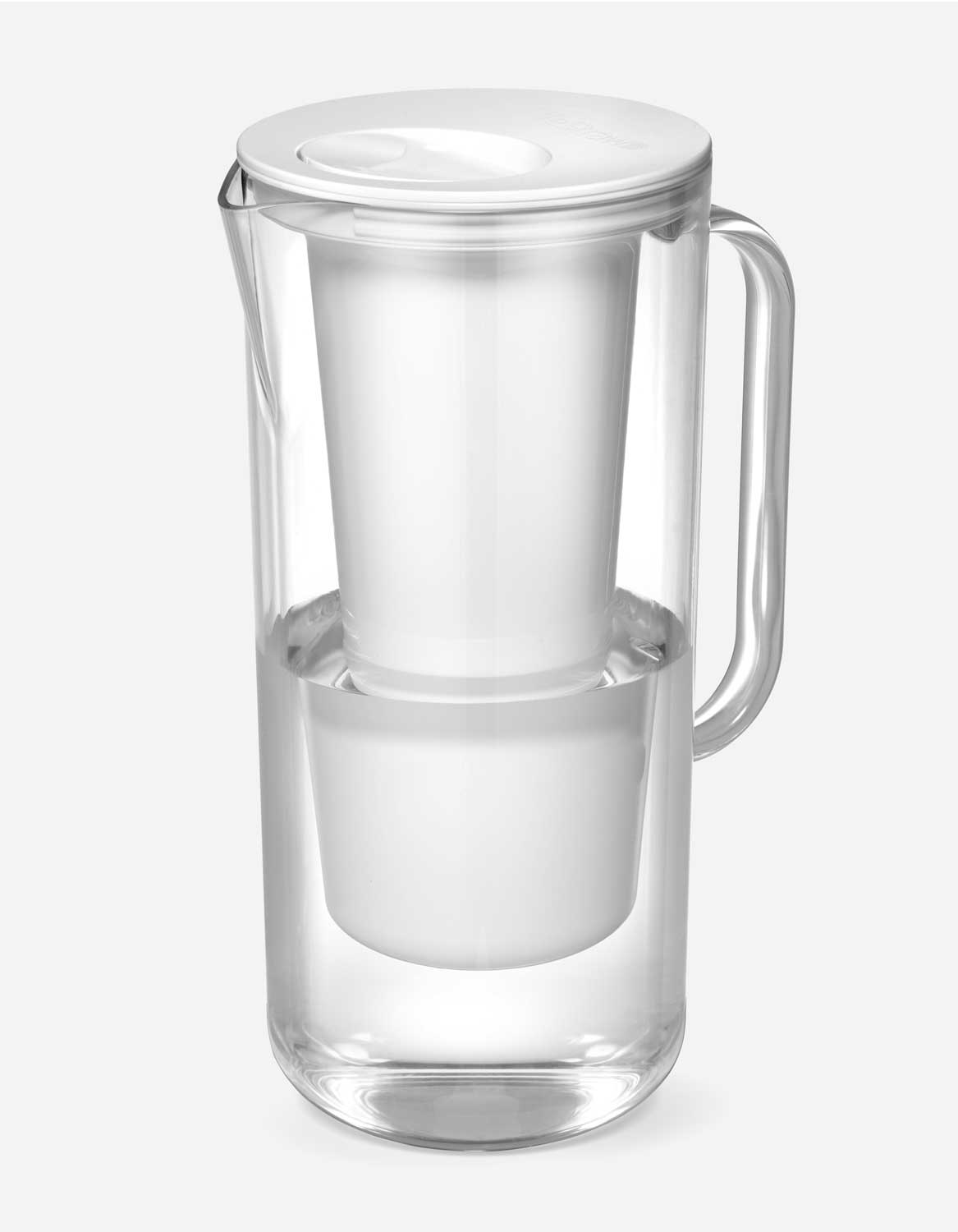
LifeStraw’s Home Essential 7-Cup Plastic is the smaller current plastic Home pitcher, with the supplied membrane and activated carbon + ion-exchange elements. Its White, Sea Blue and Wisteria variants carry SKUs LHEP7CWHTWW, LHEP7CSBLWW and LHEP7CWISWW; color does not change the filter system. Seven cups is whole-vessel capacity, not one filtered batch.
This size suits a small refrigerator or a household willing to refill more often than with the 10-cup body. LifeStraw lists an 11.3-inch height, 7.2-inch width with the handle (5.2 inches without it) and 1.4 pounds empty. Check the actual shelf lip and door bin; “fridge-friendly” is not a fit guarantee.
The pitcher collection also lists Teacher’s Pet (7-Cup White plus a six-month carbon-filter pack), Home and Away (two 7-Cup Essentials), and Off-campus Kit (10-Cup Sea Blue plus two Go Series Glass bottles). These are package choices, not new pitcher/filter designs.
Two filter stages do different jobs
The Essential setup combines a 0.2-micron membrane microfilter with an activated-carbon and ion-exchange filter. LifeStraw’s current Home Essential data sheet reports membrane reduction of bacteria and parasites under its stated test protocols, and reports reduction of microplastics. The second stage is the part associated with the chemical and metal claims: the manufacturer’s sheet reports, among other results, 98.9% lead reduction at its challenge concentration and an effluent maximum of 0.01 micrograms per liter for combined PFOA/PFOS under the listed tests. These are test results for the system and specified conditions, not a prediction of your tap-water result. Match the exact substance and test conditions to a water report; do not turn a broad “30-plus” claim into a promise about every contaminant.
The two elements have separate lives. LifeStraw rates the membrane for up to 264 gallons or one year and the carbon/ion-exchange stage for 40 gallons or two months. The more frequent carbon change is the routine that drives this model’s 40-gallon minimum rating. Actual use depends on the source water, and the product manual says performance depends on following maintenance directions. A printed year is not a reason to leave a carbon filter in beyond its stated volume or time limit.
Safe use and setup are part of the purchase
Although its membrane has a bacteria-and-parasite reduction claim, the Home Essential is a household pitcher, not a stand-alone answer for unsafe or unknown water. Keep to ordinary potable household water; LifeStraw warns against industrial chemicals, brackish water and seawater. Its documents discuss laboratory removal testing, but they also warn that hygienic handling, a clean pitcher and timely filter replacement matter because water can be recontaminated after it passes through the filter. If your source is not considered potable, follow public-health advice for treatment rather than relying on this pitcher. The manual also specifies cold water only and a maximum filtration efficiency of two gallons of daily use.
For first use, the linked Essential manual calls for rinsing the carbon filter under cold running tap water for one minute, washing the pitcher and housing with mild detergent, keeping soap off the membrane, fitting the elements and running one batch through before discarding it. The newer support FAQ says the filters arrive pre-installed, while the manual still describes installation; check the actual box and confirm that the carbon is seated after its rinse. Filter flow can be slow at first. The current Essential guide says it should improve after the first few batches, then gives a post-break-in range of roughly one-third to one cup per minute; flow falls as the membrane approaches end of life.
The trade: lighter one-piece plastic, with a tighter daily ceiling
The body is BPA-free SMMA plastic, and LifeStraw describes its one-piece construction as having no welded seam. It is lighter than the glass model and the current help guide lists it as dishwasher-tested, but its linked user manual says to hand-wash the pitcher and housing. To avoid risking damage while the instructions disagree, hand-wash the body and housing with the filters removed unless the directions in your exact package clearly authorize dishwasher cleaning. The same help guide says clear plastic can scratch; use a soft sponge or bottle brush. It also says no silicone base is compatible and replacement body parts are not currently offered, so a damaged pitcher may require replacing the whole body.
Choose the 10-cup Essential instead if an additional three cups of listed vessel capacity are worth its wider handle-side footprint; it has the same 11.3-inch height and the same two filter stages, so it is not a faster filter. The 7-cup Glass keeps the seven-cup size and same filter schedule but replaces the plastic body with hand-blown borosilicate glass and adds a silicone base; its dimensions are not axis-labeled, so it is a poor choice when a strict shelf-height number is essential. Compare the Brita and PUR models if a simpler single cartridge, a different change interval or a narrower set of claims fits your water and habits better.
In the finder, selecting seven cups retains this model alongside the seven-cup glass and other seven-cup systems; selecting LifeStraw’s dual-stage route narrows that to the Home family. Requiring the manufacturer’s bacteria-and-parasite reduction claim narrows it further to LifeStraw’s three reviewed pitcher configurations, but it never makes unsafe water an acceptable input. A strict height limit can be checked against 11.3 inches. A requirement for more than 40 gallons before any filter-stage change excludes this setup, even though the membrane itself has a longer separate rating. Skip this model if you need more than two gallons a day, a replaceable pitcher body part, glass-only construction, or an unambiguous dishwasher instruction.
Key details at a glance
| Listed pitcher capacity | 7 cups |
|---|---|
| Included filter | LifeStraw Home paired membrane + carbon/ion-exchange stages |
| Stated filter capacity | 40 gal |
| Typical replacement interval | 2 months |
| Lead result in exact-filter test data | Yes |
| Height | 11.3 in |
| Width | 7.2 in |
| Empty weight | 1.4 lb |
| Reusable filter shell | No |
| Made without BPA | Yes |
| What the filter is documented to reduce | LifeStraw Home uses two distinct elements: its membrane microfilter is stated to reduce bacteria, parasites and microplastics under the manufacturer’s specific test protocols; its activated carbon + ion-exchange element is stated to reduce chlorine, lead, PFAS and other named substances. The current Essential data sheet reports independent lab results for the Home system (including 98.9% lead reduction and 0.01 µg/L maximum PFOA+PFOS effluent under stated challenge tests); the glass product page lists WQA-certified reductions for selected NSF/ANSI 42, 53 and 401 claims. These are not individual tap-water tests or a guarantee for every contaminant. |
| Use and care | Use with potable household water and cold water only. The Essential manual says maximum filtration efficiency is for up to 2 gallons of daily use; it warns against industrial chemicals, brackish water and sea water. Laboratory reduction claims do not make unknown or unsafe water safe. Replace the carbon + ion-exchange stage at 40 gallons or 2 months, and the membrane at up to 264 gallons or 1 year; actual performance depends on maintenance and water. |
| Manufacturer dimensions as listed | Height 11.3 in; width 7.2 in with handle and 5.2 in without; the guide does not label a third length axis. |
| Pitcher material | BPA-free SMMA plastic body; one-piece construction, no welded seam per current support guide |
| Microbial test result in exact filter data sheet | Yes |
| Membrane filter rated capacity | 264 gal |
| Manual-stated daily use limit | 2 gal/day |
| Width without handle | 5.2 in |
Use the exact model’s instructions for operating limits, supplied equipment and version differences.
Sources for this assessment
- LifeStraw US LifeStraw Home Water Filter Pitchers collection, products feed page 1
- LifeStraw US Home collection, products feed page 1
- LifeStraw Home Essential 7-Cup Plastic exact product page
- LifeStraw Home Essential pitcher product guide and care FAQ
- LifeStraw Home Essential pitcher user manual
- LifeStraw Home Essential performance data sheet
- LifeStraw Home series performance data sheet; cover identifies the Home Glass 7-Cup system and WQA-certified white colorway
Check the exact filter setup before you shop.
Capacity, filter type and the written reduction claims belong to the pitcher-and-cartridge combination, not just the pitcher shape.