
Your needs, this model
Does it fit your priorities?
Would a 22-cup listed gravity pitcher with the legacy ZeroWater five-stage route suit your batch size?
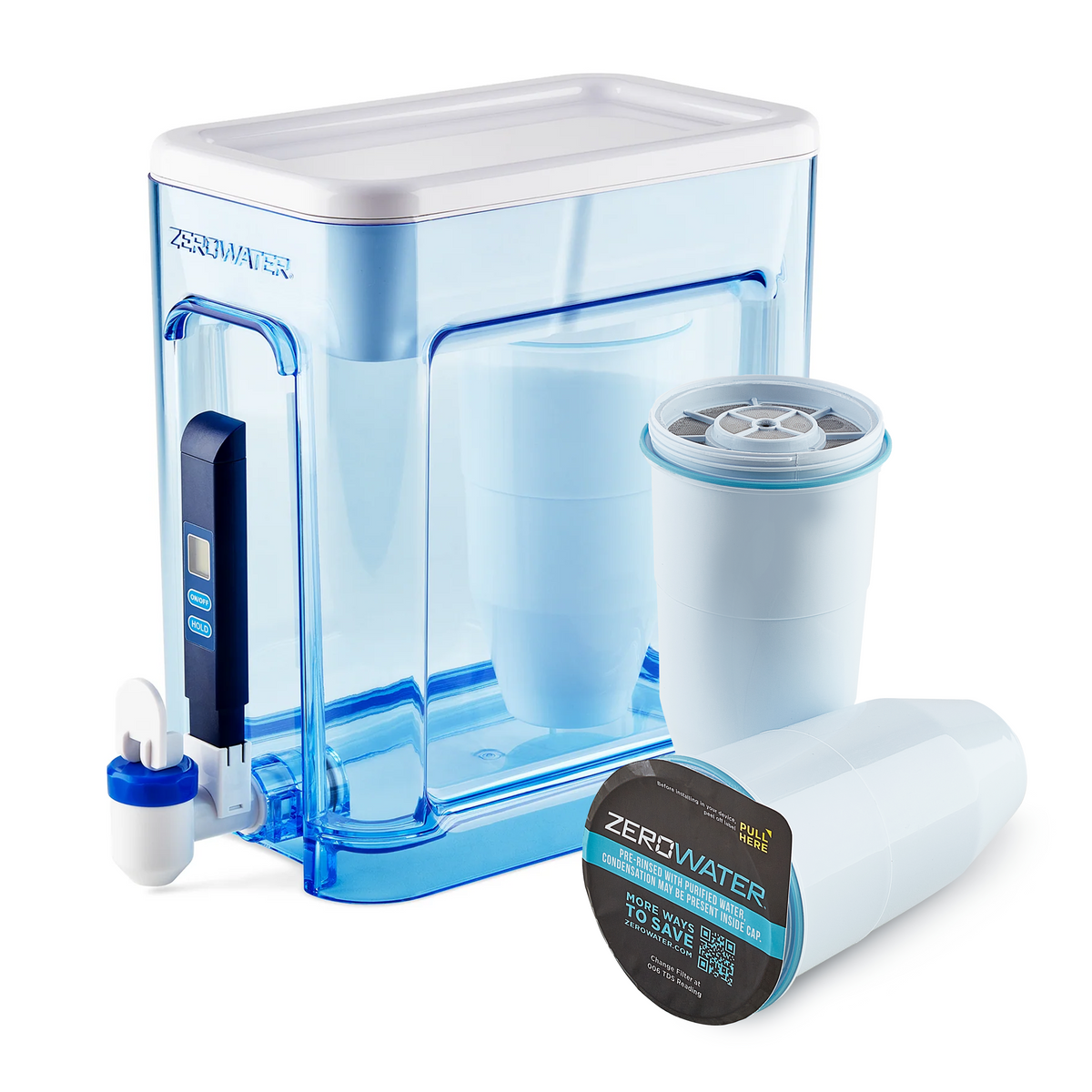
The exact retail listing identifies a 22-Cup Ready-Read Pitcher + 2 Filters, model ZD22RRB3. The number is the total vessel capacity, not the filtered volume immediately available after each refill.
Explore this need in the finder →Do you specifically want a built-in serving spigot rather than a pitcher you lift and pour?
This package has a built-in side spigot. A no-spigot/open-pour answer is a different serving setup; the general gravity answer does not by itself distinguish the two styles.
Explore this need in the finder →Would a Ready-Read meter docked at the serving spigot, removable for a reading in another glass, fit your routine?
The maker describes an integrated Ready-Read meter at the spigot and its FAQ says the meter can be removed to test another glass. The source does not describe a second handheld meter. TDS is not a contaminant-specific safety test.
Explore this need in the finder →Do you want the exact package with two additional five-stage replacement filters?
The page lists three ZeroWater five-stage filters in total: one supplied with the pitcher and two more. This identifies package contents, not the service life of each cartridge.
Explore this need in the finder →Is a lead-reduction claim in the exact product listing important to your choice?
The exact product page lists an IAPMO/NSF 53 lead-reduction claim, alongside other named claims. Read a current full performance record for the challenge conditions; this does not prove a result for your tap water.
Explore this need in the finder →Is a published 15-gallon system-capacity rating a non-negotiable minimum?
ZeroWater FAQ states that its five-stage filter and compatible pitchers are system-certified for 15 gallons; the exact page identifies ZD22RRB3 as a five-stage pitcher. The exact code is not printed in the family PDS table, so retain the model-code bridge as unresolved for replacement parts. The 15-gallon figure is the maker-listed capacity rating, not a guaranteed household filter life; actual life depends on tap-water TDS and use.
Explore this need in the finder →Start with the exact name and code
ZeroWater’s U.S. product page calls this the “22 Cup Ready-Read Pitcher + 2 Filters,” gives model number ZD22RRB3, and describes a blue plastic vessel with a built-in spigot and an integrated TDS meter. The page lists three ZeroWater five-stage filters in the box: the installed filter and two additional cartridges. It also sits on ZeroWater’s older five-stage route, not the newer Culligan-with-ZeroWater top-drop ZEROF01 route.
There is a model-code wrinkle worth keeping visible when buying replacement parts. The exact retail page prints ZD22RRB3, while the family quick guide and performance sheet list a Ready-Read format as ZD-022-RR. The guide places ZD-022-RR under “dispenser models,” but no source prints a direct retail-SKU crosswalk. Keep the paper instructions supplied with the unit and verify replacement-part compatibility rather than treating the two codes as interchangeable.
A gravity reservoir changes how you serve it
The large listed capacity is useful if several people refill glasses throughout the day and you would rather open a tap than lift and tip a full vessel. Water moves through a five-stage cartridge by gravity; the side spigot lets you dispense from the lower reservoir. This is not a powered pump or an instant tap-water filter. It needs counter or refrigerator space for a reservoir-format body, a nearby place to fill it, and enough clearance to reach the lid and install the spigot. The listed outside measurements are 10.412 by 5.54 by 11.349 inches, but the maker does not label those axes. Do not treat the last number as a verified height or assume the footprint will fit a refrigerator door shelf.
“22 cups” is the maker’s total vessel capacity, not a guarantee that 22 cups of filtered water are ready immediately after filling. If your household needs a quick glass while a batch is still filtering, compare the 12-cup Ready-Pour format separately; its page specifically describes dispensing while the reservoir continues to filter. Ready-Read here refers to the meter arrangement, not the Ready-Pour feature.
What the meter and the filter evidence do—and do not—say
The exact page lists IAPMO certification to reduce lead, chromium, mercury and PFOA/PFOS under NSF/ANSI 53 and chlorine taste and odor under NSF/ANSI 42. Those are maker-listed, named claim categories for this product page; they are not a test of your tap water or a promise that every compound is removed. Check a current performance sheet for the tested challenge levels and conditions before making a contaminant-specific decision. The meter docks at the Ready-Read spigot and can be removed to test another glass; the FAQ does not describe a second separate meter. TDS is not a lead, PFAS, microbial or overall water-safety test.
ZeroWater’s FAQ says its five-stage filter and compatible pitchers are IAPMO R&T system-certified under NSF/ANSI 42 and 53 for a 15-gallon capacity. The exact product page calls ZD22RRB3 a five-stage pitcher and lists three filters, so the published compatible-pitcher system rating is relevant; the family performance sheet’s model table still uses ZD-022-RR rather than printing this retail code. Keep that code mismatch visible when checking replacement parts. Fifteen gallons is a rated capacity, not a promise that every cartridge lasts the same amount in every home: the maker says filter life depends on tap-water TDS and use, and recommends replacement when filtered-water TDS reaches 006. A 20-gallon minimum is not met. Use potable water only; this is not disinfection for microbiologically unsafe or unknown-quality water.
Setup and maintenance are part of the choice
The manufacturer’s FAQ answers setup for the exact 22-cup Ready-Read: remove the packaging, wash the device with mild soap and water, then push the spigot into the front until it locks. The same FAQ recommends hand-washing the device rather than putting it in a dishwasher and says the filters do not need soaking or priming. A separate family quick guide labeled ZD-022-RR shows the cartridge twist-in and says to discard the first two reservoir fills; because the exact SKU-to-guide-code crosswalk is not printed, use the package’s paper instructions for those model-specific first-use steps.
The 5.81-pound listed weight excludes the two additional filters. Once filled, a 22-cup reservoir is heavy enough that a fixed counter location and spigot serving can be more comfortable than moving it to pour. That is a practical benefit only if the tap is easy for everyone in the household to reach and the counter can support the filled vessel. If you plan to refrigerate it, measure the actual opening and think about how the spigot affects shelf clearance; the maker’s unlabeled dimension string is not enough to settle that fit question.
Who should compare it—and what to choose instead
This package makes sense for someone who wants a larger manually filled ZeroWater five-stage setup, a built-in serving tap, an integrated TDS display, a maker-listed 15-gallon compatible-pitcher system rating and two extra filters in the same package. It is a weaker choice if you need an ordinary open-pour pitcher, a verified axis-specific height, a smaller batch, a guaranteed personal replacement schedule based only on gallons, or a microbial claim. If you only need to pour from a smaller vessel, compare the 12-cup Ready-Pour model. If you are shopping for the newer Culligan with ZeroWater top-drop cartridge, verify ZEROF01 compatibility instead of assuming its filter fits this legacy-format kit.
Availability also needs a fresh check: the live ZeroWater category page marked this exact kit “Out of Stock,” while the exact product page still displayed an “Add to Cart” control when checked. Its product listing is therefore retained as a current configuration, but stock messaging is inconsistent across the maker’s own pages. Check the exact ZD22RRB3 offer and replacement-filter instructions before buying. The model belongs in a comparison because ZeroWater itself calls it a pitcher; its side spigot and the unresolved guide-code bridge should remain visible tradeoffs rather than reasons to hide it or overstate what is known.
Key details at a glance
| Listed pitcher capacity | 22 cups |
|---|---|
| Included filter | Legacy ZeroWater five-stage, bottom-thread cartridge |
| Stated filter capacity | 15 gal |
| Lead result in exact-filter test data | Yes |
| Empty weight | 5.81 lb |
| Reusable filter shell | No |
| What the filter is documented to reduce | The exact product page identifies ZD22RRB3 as a five-stage pitcher and lists three filters. ZeroWater FAQ says the five-stage filter and compatible pitchers are IAPMO R&T system-certified under NSF/ANSI 42 and 53 for a 15-gallon capacity. The page names lead, chromium, mercury and PFOA/PFOS under NSF/ANSI 53 and chlorine taste and odor under NSF/ANSI 42, but gives no exact challenge-condition percentages. The PDS model table uses ZD-022-RR rather than the retail code, so the family-code crosswalk remains unverified; the compatible-pitcher rating is retained as a system capacity, not a guarantee of cartridge life in a particular home. |
| Use and care | Use potable tap water only; do not use microbiologically unsafe or unknown-quality water without disinfection. A TDS display reports dissolved solids, not the presence or absence of lead, PFAS, microbes or all unsafe substances. The maker rates the compatible five-stage pitcher system at 15 gallons but says actual filter life varies with water use and tap-water TDS; its FAQ recommends replacement when filtered-water TDS reaches 006. This is not a household-specific lifespan guarantee. |
| Separate TDS meter included | No |
| Manufacturer dimensions as listed | 10.412 x 5.54 x 11.349 in; exact manufacturer page does not label the measurement axes |
| Pitcher material | Blue plastic |
Use the exact model’s instructions for operating limits, supplied equipment and version differences.
Sources for this assessment
- ZeroWater 22 Cup Ready-Read Pitcher + 2 Filters exact US product page
- ZeroWater US Pitchers & Dispensers directory, page 1
- ZeroWater 10/23 English-French family quick guide
- ZeroWater five-stage family performance sheet, 2026-04-22 edition
- ZeroWater official exact 22 Cup Ready-Read product image
- ZeroWater current U.S. FAQ: exact 22-cup Ready-Read setup and five-stage system rating

Check the exact filter setup before you shop.
Capacity, filter type and the written reduction claims belong to the pitcher-and-cartridge combination, not just the pitcher shape.