
Your needs, this model
Does it fit your priorities?
Would you use the PT-72C-A's maker-listed PF-AL alkaline/mineral-feature route?
This describes Waterdrop's feature positioning only; it is not proof of health benefit or a fixed pH result.
Explore this need in the finder →Is a seven-cup glass-body gravity pitcher the size and form you want?
The seven-cup figure is the entire vessel rating; the pitcher has a glass exterior and plastic inner liner.
Explore this need in the finder →Is an exact, tested lead-reduction result essential?
No exact PT-72C-A/PF-AL performance table or matching NSF result was located, so a hard lead condition does not match this model.
Explore this need in the finder →Same seven-cup glass form, different cartridge choice
Waterdrop’s PT-72C-A is a seven-cup, gravity-fed pitcher with the maker’s alkaline/mineral-feature WD-PF-AL cartridge route. Retail pages show a clear/off-white model code BL-WD-PT-72C-A and a clear bundle WD-PT-72C-A-1AST with an extra PF-AL filter. The blue PT-72B-A-1AST appears to be the same functional route in another finish. Those package suffixes affect color and spare-filter contents; they do not turn it into the standard PT-72W filter configuration. Before ordering a refill, match the printed WD-PF-AL code.
“Glass” describes the outer body. The exact listing also describes a plastic inner liner and plastic lid/reservoir components, so it should not be read as an all-glass water path. The system is a manual pour-through pitcher; no pump or powered dispense button is involved. Its seven-cup rating applies to the full vessel, not necessarily the amount of ready-filtered water in one top-reservoir load.
What the alkaline label does—and does not—say
Waterdrop positions WD-PF-AL as an alkaline/mineral feature filter. That product distinction matters if you deliberately want the maker’s mineral-addition feature, but it is not a health promise. I do not translate phrases such as “better hydration” or “boosts energy” into medical outcomes, and the exact PT-72C-A manual does not guarantee a fixed output pH for every source water. If you need a measured pH, test the finished water with an appropriate meter and interpret the result with your water conditions in mind; do not buy the pitcher because a marketing feature promises a particular body effect.
There is also a useful difference from the clear PT-72W: its standard replacement route is PF01A-P, while this alkaline model uses WD-PF-AL. The manufacturer’s generic PF-AL replacement page now contains inconsistent service-life information: it says over three months or 100 gallons in one section, but its specification panel says 300 gallons and nine months. The exact PT-72C-A manual is more conservative and lists 100 gallons (378 liters) or two months. This review and the finder use the exact-model manual limit; do not extend the pitcher’s schedule because a general replacement page suggests a longer cycle.
Do not infer a contaminant result from the feature or stage count
The manual says the product does not reduce TDS and warns that TDS is not a proper measure of its filtered-water quality. Retail listings describe six filtration stages and list assorted contaminants, but I did not locate a model-matched PT-72C-A/PF-AL performance table or exact NSF directory entry that supports a specific lead result. A mineral or alkaline feature is not a contaminant reduction claim. The matcher therefore treats lead and microbial outcomes as unknown: if a verified lead result or microorganism claim is essential, choose a model whose exact cartridge sheet documents that requirement rather than relying on the PT-72C-A headline.
The manual limits use to cold tap water at 41–100°F (5–38°C), says not to use water that is microbiologically unsafe or unknown quality, and says the pitcher cannot filter liquids other than tap water. This is a taste/feature choice for ordinary potable tap water, not a purification or disinfection plan. The “glass” body also does not remove the plastic liner from the physical water path, which may be decisive for shoppers trying to minimize contact with plastic.
A manual routine, not an automatic reminder
At setup, wash your hands and soak the new cartridge in cold tap water for ten minutes. Hand-wash the pitcher, lid and reservoir with mild detergent, seat the filter tightly, fill with cold tap water and discard the first two filtered pitchers. Turn the lid dial to the starting month and replace at the two-month point or 100 gallons, whichever comes first. The dial records a date; it does not monitor gallons or test water quality. The manual says to hand-wash only, avoid abrasive cleaners and the dishwasher, and keep the cartridge from freezing. Store it cool or in the refrigerator away from direct sunlight.
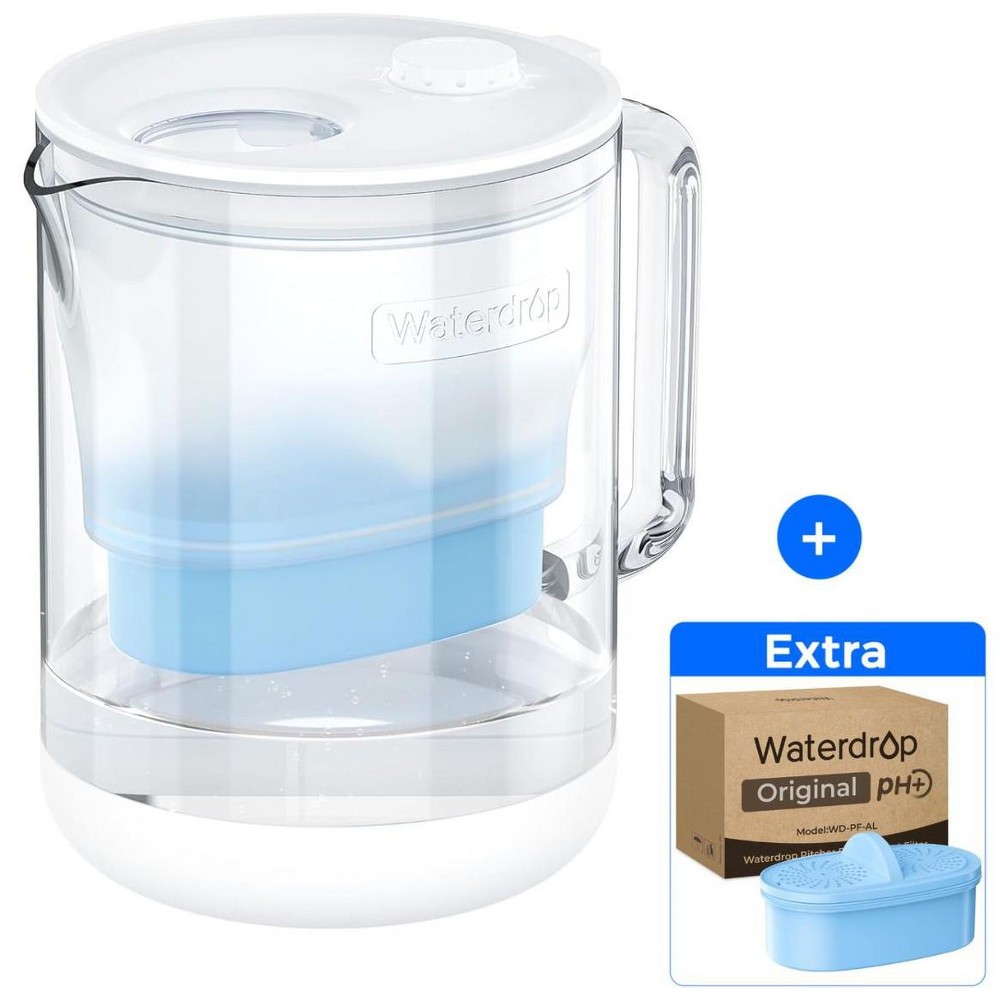
The manual lists 8.11 × 6.06 × 8.43 inches but does not clearly identify each axis, and retailer pages publish differently ordered dimensions. I leave height, width and depth unmatched rather than guessing which number will fit a refrigerator shelf. Measure the pitcher and lid clearance before you buy. The image depicts the clear/white PT-72C-A with its blue PF-AL spare-filter box; it is retailer-hosted product art, not an in-use photograph.
Choose this one only if its feature fits your actual need
The PT-72C-A is a reasonable comparison for someone who wants a compact glass-bodied Waterdrop pitcher, values its maker-listed alkaline/mineral feature, and accepts a plastic liner, hand washing and a conservative two-month cartridge schedule. The PT-72W shares the seven-cup glass form but uses the standard route and does not advertise the PF-AL feature. Waterdrop’s PT-05 and PT-07 are conventional plastic-body alternatives with larger/smaller capacity options and their own WD-PF-01A Plus filter route; check those exact model manuals and performance documents separately rather than assuming the PT-72 cartridge claims transfer. A different manufacturer's pitcher may be a better fit if validated contaminant reductions, dishwasher-safe components or more documented capacity is your primary requirement.
Finder choices reflect that split: the seven-cup and glass-body answers narrow the shape, while selecting WD-PF-AL plus the maker-listed alkaline feature distinguishes this model from PT-72W. Requiring a hard lead result excludes it, as does asking for a cartridge capacity above the exact manual’s 100 gallons. That is intentional; an unknown result should not pass an essential need.
Evidence trail: Exact-model use and limits were checked against the WD-PT-72C-A manual page, its exact Lowes model listing, and Waterdrop’s WD-PF-AL replacement page. The manual’s 100-gallon/two-month instruction takes precedence over the replacement page’s inconsistent general ratings.
Key details at a glance
| Listed pitcher capacity | 7 cups |
|---|---|
| Included filter | Waterdrop WD-PF-AL alkaline-feature pitcher filter |
| Stated filter capacity | 100 gal |
| Typical replacement interval | 2 months |
| Reusable filter shell | No |
| What the filter is documented to reduce | The exact model manual lists WD-PT-72C-A and states 100 gallons/378 L or two months; it says TDS is not meaningfully reduced. Waterdrop's WD-PF-AL replacement page conflicts between 100 gallons/over 3 months and 300 gallons/9 months; this assessment uses the exact-model manual's conservative 100-gallon/two-month limit. No exact lead or microbial result was substantiated. |
| Use and care | Use cold tap water only, 41-100 F (5-38 C). Do not use microbiologically unsafe or unknown-quality water; the manual limits the pitcher to tap water. |
| Manufacturer dimensions as listed | The exact model manual lists 8.11 x 6.06 x 8.43 inches but does not reliably label axes; a retailer lists conflicting height/order; no dimension is hard-matched. |
| Pitcher material | Glass pitcher body with plastic inner liner, lid and upper reservoir parts; exact plastic resin and BPA status are not established by the exact manual. |
| Glass water reservoir | Yes |
| Manufacturer-listed feature note | Waterdrop labels WD-PF-AL as its alkaline/mineral feature filter. No health outcome or exact pH guarantee is inferred; local input water can affect output. |
| Mineral-boost feature | Yes |
Use the exact model’s instructions for operating limits, supplied equipment and version differences.
Sources for this assessment
- Waterdrop PT-72C-A 7-cup alkaline glass pitcher, model BL-WD-PT-72C-A
- Waterdrop PT-72C-A Glass Alkaline Pitcher, Clear, extra PF-AL filter
- Waterdrop WD-PT-72C-A User Manual (6-page manual transcription)
- Waterdrop WD-PF-AL replacement alkaline filter product page
- Waterdrop US Pitcher & Dispenser collection, current recheck
- Waterdrop PT-72C-A Clear product image with extra PF-AL
- NSF Drinking Water Treatment Units listing search for Waterdrop pitcher and filter codes
Check the exact filter setup before you shop.
Capacity, filter type and the written reduction claims belong to the pitcher-and-cartridge combination, not just the pitcher shape.