
Your needs, this model
Does it fit your priorities?
Is an 8-cup whole-vessel size workable?
The manufacturer lists a 64-ounce pitcher, equal to 8 US cups total; the filtered volume immediately available after each fill is smaller.
Explore this need in the finder →Do you specifically want the single Seychelle RAD filter route?
The exact current package lists one RAD cartridge. Its product page and linked manual disagree on gallon life, and the page does not supply an exact current SKU performance table.
Explore this need in the finder →Do you require a confirmed lead reduction result in exact-filter performance data?
No exact model-specific performance table for the current 1-40401-W pitcher was located; the general RAD claims do not establish a verified exact lead result.
Explore this need in the finder →What the 1-40401-W package actually is
Seychelle lists model 1-40401-W as its 64-ounce Radiological Water Pitcher. The current product page says the package includes one filter cartridge; the native product record confirms that exact SKU and shows the offer available when checked. Sixty-four ounces converts to eight US cups for the whole vessel, not eight cups of filtered water ready after a single reservoir fill. The product page does not break down the upper and lower chambers, so do not plan a serving volume from the overall capacity alone.
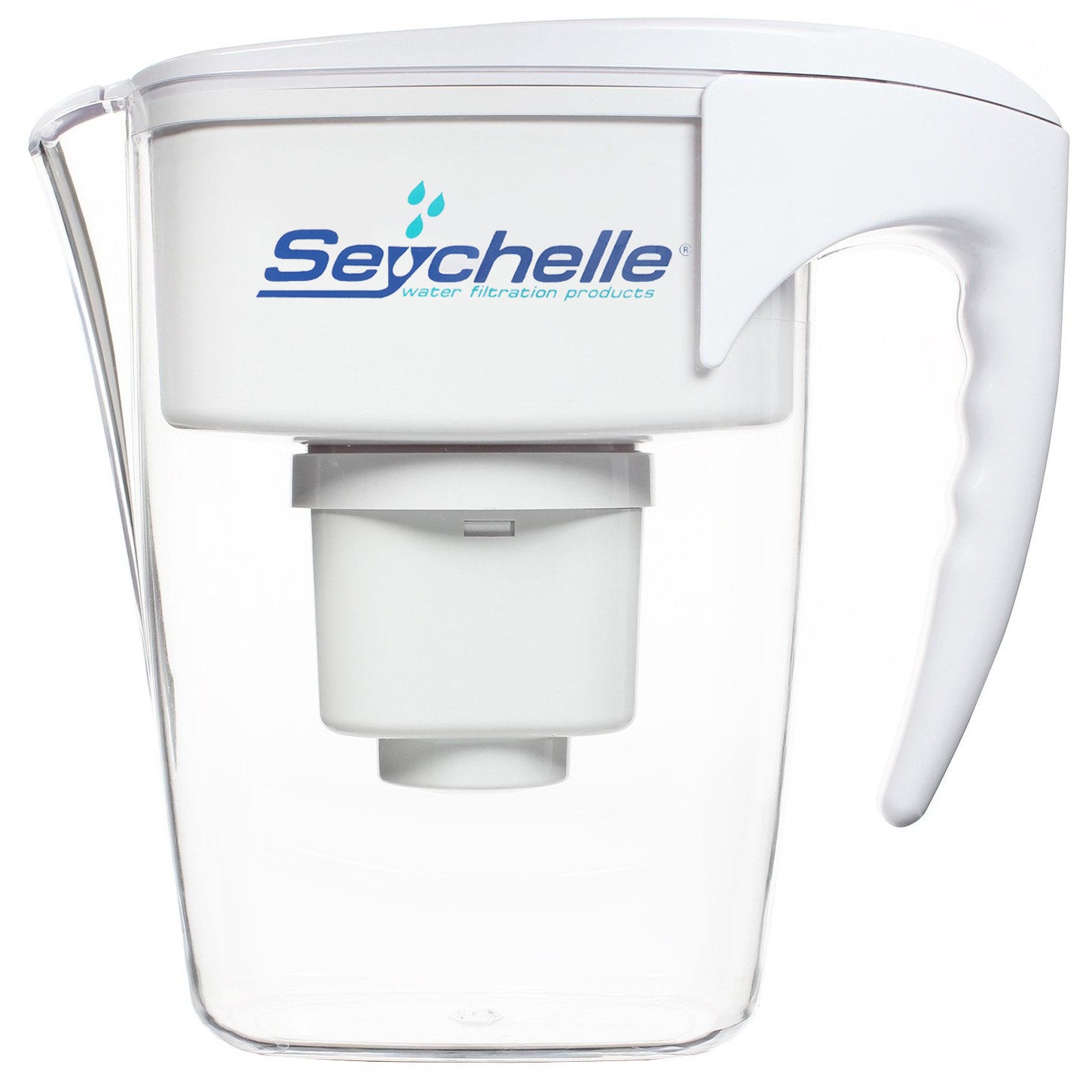
The distinctive choice is the RAD-named cartridge, not a different electric or dispensing system. It remains a manual gravity pitcher, so fill the reservoir and allow water to pass through. The body shown in Seychelle's studio product image is clear with a white lid and a single central cartridge. The photo is a product rendering, not proof of dimensions, weight or performance.
How to read the radiological claim cautiously
The manufacturer’s current page describes broad contaminant categories for its RAD line and says the filter is tested to NSF/ANSI Standards 42 and 53 by Broward Testing Laboratory. “Tested to” is not the same thing as NSF certification. The broad page list is not an analyte-specific performance sheet for the current 1-40401-W SKU: it does not give the named source water, test protocol, starting concentration, capacity endpoint and percent reduction for each substance. The Seychelle product-test page links a radiological report package, but the archived report identifies pitcher and bottle sample portions without this current model number. I do not treat that as a current-SKU verification or an emergency-use direction.
That distinction matters more here than it does for an ordinary taste-and-odor filter. If your concern is uranium, gross alpha/beta, lead, PFAS or another named contaminant, compare the full test conditions with a water report or lab test and follow public-health advice. A pitcher cannot be presumed to turn unknown or microbiologically unsafe water into safe water. The page directs use with chlorinated municipal water and excludes salt water. It does not make a general promise for well water, emergency use, or an untested source.
A material filter-life conflict
The current 1-40401-W page and native listing state up to 150 gallons. The RAD manual linked from the manufacturer's setup page identifies itself as a Gen 1 RAD pitcher manual and says up to 100 gallons. Another official Gen 1 pitcher manual says 150 gallons for the regular and RAD versions, but it does not identify SKU 1-40401-W. The linked flushing sheet says filter life is approximately six months depending on water use and quality. Those documents may describe a different generation or cartridge revision; available first-party material does not bridge them. For that reason, this review does not promise 100 or 150 gallons, nor convert either number to a household calendar interval.
Setup is also more involved than simply dropping in a cartridge: the RAD quick-start sheet shows a red flushing disk and directs a low-pressure, four-to-five-minute flush. The current pitcher page links those directions, but the supporting manual uses the older Gen 1 name. Check the instructions supplied with the exact purchase rather than assuming all Seychelle filters share one flush procedure. The manufacturer says to wash the pitcher parts with mild soap and not to wash the filter.
Who should compare it—and when another route is better
This is worth comparing if you specifically want the manufacturer's RAD-labeled, single-cartridge 64-ounce system and will verify the exact claim relevant to your water. It is not the right answer just because the word “radiological” or a very high general reduction phrase sounds reassuring. If your essential need is a documented lead result or a quantified radionuclide limit for the precise cartridge, the current model documentation reviewed here leaves that need unconfirmed. In the finder, a route preference can return this configuration; an essential lead or service-life threshold should not.
A separate official offer, the Radiological Bundle (SKU 1-80401), lists one 64-ounce Radiological Water Pitcher and four 28-ounce Radiological Flip Top Bottles. The bundle page links its pitcher component to the current 64-ounce RAD pitcher page, so this is a larger package route rather than another pitcher design. Seychelle says each item includes one cartridge; do not count the four bottle cartridges as replacements for the pitcher cartridge or transfer bottle performance claims to the pitcher. This package makes more sense if the household also wants individual carry bottles; a pitcher-only purchase avoids those extras. The bundle does not resolve the pitcher’s 100-versus-150-gallon documentation conflict.
The Seychelle Gen 2 regular and pH2O pitchers also hold 64 ounces, but use a pair of different cartridges and have a separate Gen 2 manual. Their stated 150-gallon capacity and pH feature should not be transferred to the RAD model. Compare a PUR, Brita, Clearly Filtered, Epic or LifeStraw pitcher only by the exact body-and-filter combination and its own performance record. A different brand name or adjacent model is no substitute for the data you need.
Before buying, confirm the printed model number, current cartridge code, expected filter-life measure and supplied manual with the seller. The official page provides no axis-labeled dimensions or weight, so measure the storage space yourself rather than using the eight-cup capacity as a proxy for refrigerator fit. This assessment is about a current manufacturer listing; it is not a lab test, a health recommendation or a claim that the named filter makes unsafe water drinkable.
Key details at a glance
| Listed pitcher capacity | 8 cups |
|---|---|
| Included filter | Seychelle rad single |
| Reusable filter shell | No |
| What the filter is documented to reduce | Seychelle lists tests to NSF/ANSI 42 and 53 by Broward Testing Laboratory and broad RAD-filter categories, but its product-test page links a 2011 sample report without this current SKU and no exact 1-40401-W contaminant table was identified. This is not an NSF certification claim. |
| Use and care | Use is limited by the manufacturer to chlorinated municipal water; do not use with salt water. Manual identity is Gen 1 without the current SKU; do not treat this filter pitcher as a substitute for public-health emergency guidance or a verified treatment plan. |
Use the exact model’s instructions for operating limits, supplied equipment and version differences.
Sources for this assessment
- Exact Seychelle US pitcher product page
- Exact Seychelle native product record and variant SKU
- 64 oz RAD pitcher manual linked by setup page; document identifies Gen 1, not the 1-40401-W code
- RAD pitcher quick-start and flushing instructions
- Exact product page featured image bytes
- Seychelle official product-test-data index
- Seychelle RAD Testing 4825 scanned laboratory report package
- Radiological Bundle SKU1-80401 current first-party package listing; pitcher component links to current 64oz RAD page

Check the exact filter setup before you shop.
Capacity, filter type and the written reduction claims belong to the pitcher-and-cartridge combination, not just the pitcher shape.