
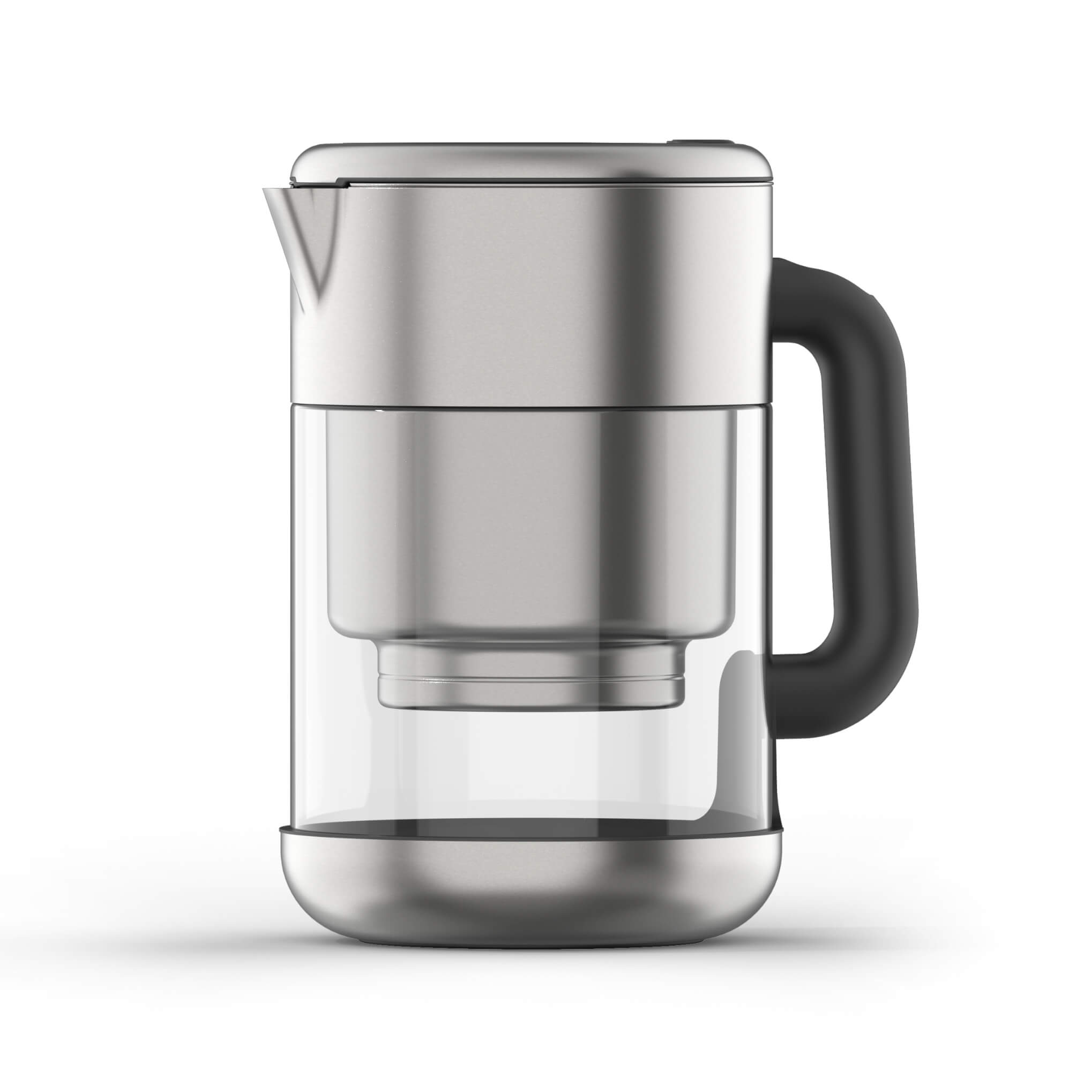
Your needs, this model
Does it fit your priorities?
Would the Rorra's thirteen-cup total capacity work if only seven cups are in the filtered chamber?
Rorra specifies 13 cups total: 7 cups filtered and 6 cups unfiltered when completely filled. It takes about ten minutes for the maker-estimated 48-ounce batch to filter, so the headline capacity is not all ready to pour at once.
Explore this need in the finder →Does a documented Enfinity lead-test route matter more than a generic contaminant promise?
Rorra publishes lead results for its shared Countertop System + Filtered Pitcher test grouping and says Enfinity Gravity Filter is shared between them. The linked NSF report identifies the Countertop System and expressly is not certification; do not read the result as a standalone pitcher NSF listing.
Explore this need in the finder →Is a gravity pitcher preferable to a powered dispenser, even with an electronic reminder?
The product's water flow is gravity-fed. Its rechargeable electronics power only the performance indicator; Rorra says no plug is needed for filtration and includes a magnetic charging cable for the reminder.
Explore this need in the finder →Can this exact pitcher fit beneath a ten-inch shelf, and is its reservoir actually glass?
Rorra lists 10 inches tall and a 6-inch diameter, and specifies borosilicate glass with 316L stainless steel. Measure the lid-removal path: the listed height does not provide extra clearance.
Explore this need in the finder →A thirteen-cup label hides a seven-cup filtered chamber
Rorra's exact listing calls this a 13-cup pitcher, but its FAQ explains the useful split: 7 cups of filtered water and 6 cups of unfiltered water when filled to capacity. The incoming reservoir sits above the filtered chamber, so that headline is not thirteen ready-to-pour cups. Rorra estimates about ten minutes to filter 6 cups (48 ounces). This is a manual gravity system, not an electric dispenser that fills a glass on demand. If a household empties the filtered chamber quickly, the time between refills matters as much as the total listed size.
The body materials and footprint are a more unusual combination than the standard plastic pour-through pitcher. Rorra lists borosilicate glass and 316L stainless steel, with dimensions of 10 inches tall by 6 inches in diameter. It says the vessel weighs about 4 pounds empty and roughly 7 pounds with one fill. Those are maker specifications rather than independent measurements. The height is convenient for a refrigerator only if you can also lift the top reservoir for filling; measure the lid-removal path and shelf depth rather than relying on a product image. A glass vessel may suit a buyer avoiding a plastic pitcher body, but it is less forgiving if dropped, and the dimension listing does not identify a separate width/length axis or lid clearance.
The indicator charges; the water still flows by gravity
The built-in performance indicator is rechargeable, which can be easy to misunderstand from the word “powered.” Rorra describes a gravity-fed filter and says no plug is needed for filtering. The internal battery runs the reminder, not a pump. The box listing includes a magnetic charging cable; the manufacturer says a charge should last about six months, and recommends charging during filter changes. The light is described as changing from white to yellow with roughly ten days of filter life remaining. It is a maintenance cue, not a water-quality sensor, and it does not replace the stated cartridge schedule.
Read the Enfinity test tables as test evidence, not certification
Rorra's published page groups results under “Countertop System + Filtered Pitcher Testing.” It reports 99.6% lead reduction under NSF/ANSI 53 and 99.58% Total PFAS for seven named compounds at 200 gallons. The table also reports 97.3% results at 200 gallons for 0.5–1.0 micron particulate reduction under NSF/ANSI 42 and a microplastics test under NSF/ANSI 401. The exact product listing says the pitcher and countertop system share Enfinity Gravity Filter. These are useful maker-published test results for stated targets, not guarantees about your tap.
There is an important boundary: the linked NSF lead report identifies the tested product as the Rorra Countertop System, and the linked IAPMO PFAS report names model SYS-CS-001-X, not the pitcher purchase SKU. Those reports also say their results relate to tested samples; the NSF report explicitly states it does not represent NSF certification or authorization to use the NSF mark. Rorra's test-results page separately says its products are not yet formally certified or listed by NSF. So this is not the right fit if a formal NSF listing for the exact pitcher is essential. Nor does the inspected pitcher/system table document bacteria, virus or cyst reduction. Use already-potable water; do not use this pitcher as disinfection for an unsafe or unknown source.
There are two clocks for cartridge ownership
The manufacturer describes the Enfinity Gravity Filter as designed for 200 gallons and separately recommends replacement every 90 days. Treat those as two pieces of guidance, not permission to keep a filter for longer simply because one of the limits has not been reached. Rorra sells the replacement as the Enfinity Gravity Filter, SKU FIL-CS-001, and says the same filter fits its Countertop System. The pitcher itself is listed with one filter, a magnetic cable, a reservoir-removal tool and a user manual.
Purchase options also change the upkeep commitment. The one-time pitcher-only offer includes one filter, but its exact page says future enrollment in the filter subscription program will be required to maintain efficacy. The subscription option lists deliveries every 90 days; the product page I checked displayed $65 per shipment, so confirm current pricing and terms before ordering. These are not two filtration versions, but the recurring supply plan is material to the total cost of owning the system.
Care instructions are the part to confirm before the first fill
Rorra's exact product page lists a user manual in the box. Its Product Resources page labels both a Filtered Pitcher setup tutorial and a filter-change tutorial, but I inspected the footage and it shows the powered countertop system, not this glass pitcher; I would not use it as a pitcher-care manual. The public page supplies no full written pitcher instructions, so exact first-flush, cleaning and dishwasher guidance remain unconfirmed. Do not assume dishwasher safety from the materials; follow the included booklet or ask Rorra for its current revision before buying.
This pitcher suits someone who values a gravity format, the listed glass/316L materials, a moderate seven-cup filtered batch and a clearly described replacement route—and who will follow the 90-day routine and handle a heavier glass vessel carefully. It is less suited to a user who wants a large volume ready immediately, a no-charge reminder, established public dishwasher/care instructions or formal certification of the exact pitcher. Compare the smaller Hydros glass pitcher if a compact form and simpler chlorine/particle evidence are enough; compare Santevia's MINA if its distinct included fluoride-filter route matters more. Check each exact cartridge rather than carrying one model's claims across a brand family.
Measure total capacity and refrigerator clearance · Read filter claims and certifications carefully · Rorra Filtered Pitcher product page · Rorra test-results page · Rorra Product Resources · Linked NSF lead test report · Linked IAPMO PFAS report
Key details at a glance
| Listed pitcher capacity | 13 cups |
|---|---|
| Included filter | Rorra enfinity gravity |
| Stated filter capacity | 200 gal |
| Typical replacement interval | 3 months |
| Lead result in exact-filter test data | Yes |
| Height | 10 in |
| Empty weight | 4 lb |
| Reusable filter shell | No |
| What the filter is documented to reduce | Rorra's shared Countertop System + Filtered Pitcher page reports 99.6% lead reduction under NSF/ANSI 53 at 200 gallons, 99.58% Total PFAS reduction for seven named compounds at 200 gallons, and 97.3% results at 200 gallons for 0.5–1.0 micron Particulate Class I (NSF/ANSI 42) and a microplastics test (NSF/ANSI 401). The linked lead report identifies Rorra Countertop System and the IAPMO PFAS report names SYS-CS-001-X; Rorra says the Enfinity Gravity Filter is common to pitcher and countertop system. Treat these as manufacturer-published shared-filter/system results, not a standalone pitcher certification, a guarantee for a home's tap or evidence of microbial reduction. |
| Use and care | A gravity pour-through pitcher for tap water; use only water that is already suitable to drink. No microbial-reduction result is documented in the reviewed Rorra pitcher/system table, and no pitcher filter should be used to treat microbiologically unsafe or unknown-quality water without appropriate disinfection/public-health guidance. |
| Separate TDS meter included | No |
| Manufacturer dimensions as listed | 10 inches tall x 6 inches diameter per the exact Rorra product specification; the source does not label independent length and width axes or provide lid-removal clearance. |
| Pitcher material | Rorra lists borosilicate glass and 316L stainless steel for the Filtered Pitcher body. The maker also says no plastic touches filtered water; the inspected listing does not enumerate every seal, lid or internal material, so the broad no-plastic claim is attributed to Rorra rather than independently verified. |
| Microbial test result in exact filter data sheet | No |
| Button-controlled electric dispensing | No |
| Stainless-steel body | Yes |
| Glass water reservoir | Yes |
Use the exact model’s instructions for operating limits, supplied equipment and version differences.
Sources for this assessment
- Rorra official US all-products native feed, page 1
- Rorra official US all-products native feed, page 2
- Rorra Filtered Pitcher exact current product page
- Rorra Filtered Pitcher exact native product record
- Rorra Enfinity Gravity Filter exact replacement product page
- Rorra product resources page: Filtered Pitcher setup and filter-change tutorial sections
- Rorra published Countertop System + Filtered Pitcher test-results page
- NSF lead test report linked by Rorra (Rorra Countertop System, NSF/ANSI 53)
- IAPMO Total PFAS test report linked by Rorra (model SYS-CS-001-X)
Check the exact filter setup before you shop.
Capacity, filter type and the written reduction claims belong to the pitcher-and-cartridge combination, not just the pitcher shape.