
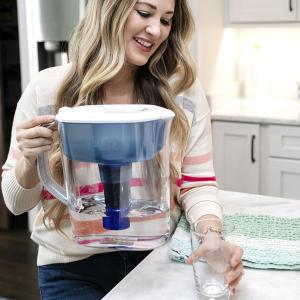
Your needs, this model
Does it fit your priorities?
Do you need the earlier eleven-cup PLUS version identified by PPT110?
PUR's 2023 guide names PPT110X and the current support listing groups PPT110 with the newer PPT111 family. This record is the older eleven-cup code path; check the molded or printed model on the pitcher.
Explore this need in the finder →Is the older CRF-950Z PLUS cartridge the filter route you want to identify?
The 2023 PUR sheet names CRF-950Z as the PLUS filter for PPT110X. Do not infer that a PLUS label alone means the same claim set as current PPF951K.
Explore this need in the finder →Can you use this earlier PLUS model when a lead-reduction result is not essential?
Yes, for a need that fits the CRF-950Z sheet's named results. The 2023 sheet does not list lead for this exact filter, so a lead requirement must reject it.
Explore this need in the finder →The older eleven-cup PLUS configuration
PUR’s 2023 quick-start guide and performance data sheet identify PPT110X as a PLUS pitcher model, and the current PUR support page groups PPT110 with the newer PPT111 under its eleven-cup PLUS listing. That makes the old model useful to identify for owners and careful comparison, but it does not erase the model-number change. The current sales page names PPT111; the older documents name PPT110. Check the code on the pitcher and the replacement cartridge separately instead of assuming that all products carrying the PLUS badge share one exact bill of materials.
The larger listed capacity can reduce how often a household has to refill compared with a seven-cup body, but “eleven cups” is the total pitcher capacity, not the volume of filtered water ready at once. The upper reservoir takes space and needs time to drain through the filter. No exact PPT110 dimensions or measured flow rate were established here, so this review cannot promise it will fit a particular refrigerator shelf or refill at a particular speed. Measure the actual unit and think about how many people will wait for the reservoir to finish.
Keep the CRF-950Z claim set attached to its own paperwork
The older guide names PUR PLUS CRF-950Z as the included filter; it also names PPF900Z as a separately sold filter certified with that system. The 24 July 2023 PUR performance data sheet lists PPT110X among covered pitcher models. Its CRF-950Z column records selected taste-and-odor, particle, zinc, health-effects and emerging-compound reductions under the conditions printed in the sheet, including a 99.8% microplastics result. It does not list a lead result for this filter. The newer PPF951K sheet has a different filter name and a lead result; do not carry that result over to the older CRF-950Z package.
That distinction matters more than the size difference if you are choosing a filter for a specific water concern. A PDS describes a limited set of test claims, not every possible substance or your household’s actual water. PUR’s guide says the pitcher does not filter microbes and warns against using it to purify microbiologically unsafe or unknown-quality water without adequate disinfection. If lead reduction is essential, this PPT110/CRF-950Z record does not satisfy that requirement based on the retrieved sheet. Check local water information and seek appropriate public-health or water-treatment advice rather than relying on a generic brand name.
Follow the PLUS preparation sequence
The maker’s quick-start guide for the older family says to soak the filter in cold water for 15 minutes, then rinse it for 10 seconds. Install the filter into the reservoir and twist until it locks. The guide says to remove the electronic filter light from the underside of the lid before washing and to reset it for 10 seconds until it flashes green. After use, the indicator flashes green with pours and turns red when the filter should be replaced. The guide gives up to 40 gallons or two months; use the earlier limit and do not interpret the light as an actual gallons counter or a test of water quality.
The documented operating range is 34–82°F and the input is cool tap water. Keep the cartridge out of hot water, and follow the shipped manual if it differs from an online copy. The presence of a light does not remove the need to track replacement timing, seat the cartridge securely or clean the pitcher components as directed. The manual’s removal step is a useful reminder not to put an electronic lid module through a wash cycle simply because the plastic body can be washed.
How to decide whether PPT110 is the right reference
This older model is a useful fit for someone who already has an eleven-cup PUR PLUS pitcher marked PPT110 and needs the correct filter code, preparation steps or limits of its older performance sheet. It is less useful as a blind purchase target: the current product listing uses PPT111, and the current support page does not establish that every PPT110 body, finish or cartridge bundle is identical to the newer item. A separate legacy code, CR1110, appears in the same quick-start guide and 2023 data sheet, but those documents do not settle all of its body and lifecycle details; do not use PPT110 measurements or images as proof of CR1110 identity.
In the finder, an eleven-cup choice plus PUR PLUS and an explicit earlier-model selection can include PPT110 for comparison. A standard PUR filter choice should remove it, and a lead-essential choice should also reject it because the named CRF-950Z sheet has no lead result. The current PPT111 is the closer same-size comparison if you need the later PPF951K claim set; the smaller PPT710 is the older PLUS alternative if a seven-cup vessel is preferable. A basic CR-1100 family is another size comparator, but it uses the standard-filter path. Match the exact pitcher and cartridge codes each time; capacity, filter claim, setup routine and the current manual are separate decisions.
Key details at a glance
| Listed pitcher capacity | 11 cups |
|---|---|
| Included filter | PUR PLUS |
| Stated filter capacity | 40 gal |
| Typical replacement interval | 2 months |
| Lead result in exact-filter test data | No |
| Reusable filter shell | No |
| What the filter is documented to reduce | PUR's 24 July 2023 CRF-950Z sheet lists specific taste/odor, particulate, zinc, health-effects and emerging-compound results under its stated challenge conditions, including a 99.8% microplastics result. It does not list a lead result. Do not transfer the later PPF951K sheet's lead result to this CRF-950Z configuration. PUR states the system does not filter microbes. |
| Use and care | Use cool/cold tap water within the guide's 34–82°F range. The named CRF-950Z cartridge is limited to 40 gallons or up to two months, whichever comes first; the system is not intended to purify microbiologically unsafe or unknown-quality water without disinfection. |
Use the exact model’s instructions for operating limits, supplied equipment and version differences.
Sources for this assessment
Check the exact filter setup before you shop.
Capacity, filter type and the written reduction claims belong to the pitcher-and-cartridge combination, not just the pitcher shape.