
Your needs, this model
Does it fit your priorities?
Do you want a large manually filled reservoir that dispenses at a button instead of waiting for gravity filtration?
The Philips is a powered pump-outlet format, rated at 1 L/min with a 3 L tank. It needs a USB-C charge and does not pour water through a gravity cartridge.
Explore this need in the finder →Is a specific tested lead-reduction result essential for the water you plan to use?
The exact US Philips leaflet names microplastic reduction in its filtration-performance field. The exact US sources do not give a lead result, so it cannot meet a lead-essential requirement on this evidence.
Explore this need in the finder →Would you prefer a simple gravity pitcher that works without a rechargeable pump?
This Philips route requires button-controlled powered dispensing; choosing gravity should lead to a different operating plan.
Explore this need in the finder →Do you need a documented filter-life floor of at least 30 US gallons?
Philips specifies 100 L, about 26.4 US gallons, or 30 days, whichever comes first. A 30-gallon floor is above that stated volume limit.
Explore this need in the finder →One tank, two package codes, and a different way to pour
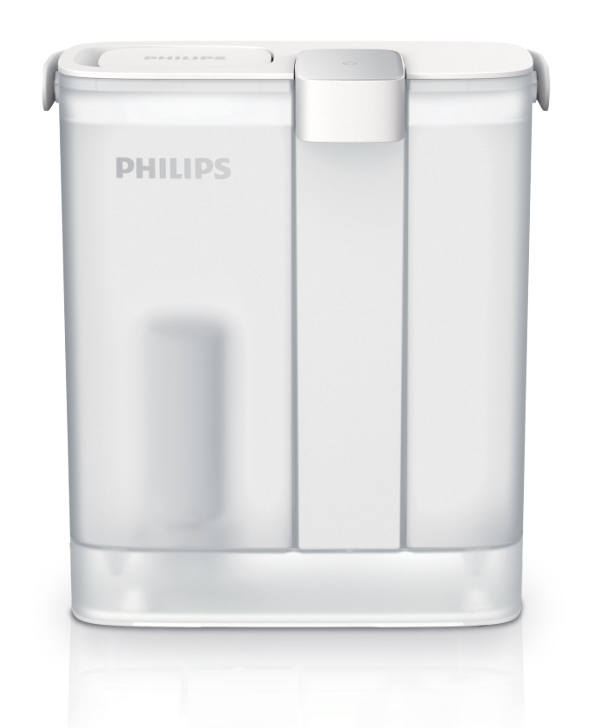
Philips calls this the Micro X-Clean filtration Powered Pitcher. The exact base configuration is AWP2980WH/37 and the separately listed AWP2980WH3/37 is a package variant with three AWP225 cartridges. Both use the same white tank, pump, button outlet and single-cartridge operating route; the 3 suffix changes the number of replacement cartridges in the box, not the tank size or what the filter claims to reduce. The base box includes one AWP225. Choose the three-filter bundle only if its extra cartridges are useful to you; it does not mean three filters fit at once.
The 3.0-liter tank is the defining practical difference from a small gravity pitcher. Philips lists the effective reservoir as 3 L and says the format fits most refrigerator doors, while the accompanying leaflet gives body dimensions in length × width × height order: 233 × 152 × 263 mm. That is about 9.2 × 6.0 × 10.4 inches in the same order. These are the manufacturer’s listed dimensions, not a guarantee of fit: check the shelf lip, door bin and clearance needed to remove and refill the tank. Philips does not list this model in US cups, so this assessment does not convert its liter capacity into a cup-based configuration.
Powered dispensing changes the routine
This is manually filled but not gravity-fed. A rechargeable 1,800 mAh lithium battery powers the button outlet; the leaflet specifies USB Type-C charging, 5 V and 6 W, and a nominal 1 L/min flow rate. The output is not an independent lab measurement, and actual dispensing still depends on charge, water level and the manufacturer’s instructions. The trade is a charge-and-button routine instead of a passive pitcher that can be poured without electronics.
First use is more involved than washing and filling. Philips says to wash the tank, charge the device, check the cartridge seal, install the AWP225 and discard 3 L of tap water in two 1.5 L flushes. The manual describes a double-click to start, a click to stop and an automatic stop after one minute. A low water level prevents dispensing. Use the manufacturer’s municipal tap water only, within the specified 2–38°C range. Philips warns against unknown-quality or microbiologically unsafe source water; the powered pump does not make this a disinfection system.
Keep the filtration claims narrow
The current US product page advertises chlorine and microplastics reduction. The exact US commercial leaflet’s filtration-performance field specifically names microplastic reduction. It does not provide a contaminant-by-contaminant performance table, test percentages, challenge conditions or an exact lead-reduction result. Therefore the product can be considered for its stated tap-water use and the listed reduction language, but it is not a match for someone who needs documented lead, bacteria, virus or cyst results from this exact cartridge-and-pitcher configuration. A claim elsewhere on a Philips page about protecting kitchen appliances from scale does not supply a quantified water-softening test here.
That distinction matters more than the “instant” label. This arrangement is a powered dispenser with an AWP225 cartridge, not a multi-stage countertop treatment unit and not a reason to use water that a local utility or health authority considers unsafe. If you have a contaminant concern, identify the specific contaminant in your water report and compare it with an exact product performance sheet. If the Philips literature does not document that result, choose another operating plan with a relevant exact test record instead of treating taste or a broad feature list as evidence.
Budget for the short filter interval
The exact series manual gives a replacement limit of 100 L or 30 days, whichever comes first. One hundred liters is roughly 26.4 US gallons; this site uses that conversion only to compare service-volume floors, not to turn the tank into a cup-rated pitcher. The on-device reminder considers use and time. After fitting a fresh cartridge, the manual says to reset the filter indicator by holding the button for eight seconds. The booklet also calls for a 3 L flush after more than five idle days and cartridge replacement after more than 15 idle days. Store a spare sealed cartridge as Philips directs and do not stretch its interval because the water still tastes acceptable.
Clean the reservoir and wipe the lid as instructed. The unit is not dishwasher safe and must not be immersed. The manual also says to use filtered water within 24 hours; if your household fills water that sits longer, a different storage routine may suit you better. Body resin and BPA status are not identified in the exact US listing and manual, so do not infer them from the white finish or another Philips product.
When Philips fits—and when to compare another pitcher
This model suits a household with municipal tap water, room for a 3 L vessel, and a preference for pump dispensing over gravity drip. The one-cartridge package asks for a replacement about monthly at the stated time ceiling; the three-cartridge package reduces how often you need to order, not how often you change filters. A Brita or PUR gravity pitcher may be simpler if you want a no-charge pour-through setup. A model with a fully documented contaminant table is the better comparison if lead or another specific test result is essential. Those are different needs, not a claim that one brand reduces more contaminants than another.
In the finder, select the Philips AWP225 route and electric dispensing to see this system. Raising the minimum filter capacity to 30 gallons removes it because its exact manual limit converts to about 26.4 gallons; requiring a lead result also removes it because the exact US record does not state one. Asking for gravity dispensing or a cup-listed size will not be satisfied by this powered, liter-specified model. Those boundaries keep the package comparison useful: the AWP2980WH3/37 can share the review because the filter route is unchanged, but the remaining requirements still have to fit its single documented operating plan.
Key details at a glance
| Listed tank capacity | 3 L |
|---|---|
| Included filter | Philips Micro X-Clean Instant AWP225 |
| Stated filter capacity | 26.4 gal |
| Typical replacement interval | 1 months |
| Height | 10.35 in |
| Width | 5.98 in |
| Length | 9.17 in |
| Reusable filter shell | No |
| What the filter is documented to reduce | Philips’s exact US product page lists chlorine and microplastics reduction. Its US leaflet’s filtration-performance field specifically lists microplastic reduction, but provides no contaminant-by-contaminant test table, percentages, challenge conditions, or lead result. Do not treat general marketing copy as proof of a lead, microbial, or other named exact-filter result. |
| Use and care | Philips specifies municipal tap water only, 2–38°C, and excludes unknown-quality or microbiologically unsafe source water. This is a powered tap-water pitcher-format device, not a purifier for untreated or unsafe sources. Do not use filtered output more than 24 hours after filtering; follow the manual flush/replacement directions after idle periods. |
| Manufacturer dimensions as listed | 233 × 152 × 263 mm (L × W × H in Philips order; conversions are approximately 9.17 × 5.98 × 10.35 inches). |
| Button-controlled electric dispensing | Yes |
| Rechargeable battery | 1800 mAh |
Use the exact model’s instructions for operating limits, supplied equipment and version differences.
Sources for this assessment
- Philips US Water Pitchers category (four visible products, 1–4 of 4)
- Philips Micro X-Clean filtration Powered Pitcher AWP2980WH/37
- Philips Micro X-Clean filtration Powered Pitcher AWP2980WH3/37
- Philips AWP2980WH/37 localized commercial leaflet, Version 1.1.2
- Philips AWP2980WH3/37 localized commercial leaflet, Version 1.1.1
- Philips AWP2980WH series user manual; English instruction pages 1–7; models include AWP2980WH/37 and AWP2980WH3/37
- Philips support/manuals page for AWP2980WH/37
- Philips support/manuals page for AWP2980WH3/37
Check the exact filter setup before you shop.
Capacity, filter type and the written reduction claims belong to the pitcher-and-cartridge combination, not just the pitcher shape.