
Your needs, this model
Does it fit your priorities?
Do you need a listed cup capacity to plan servings or refrigerator fit?
Philips gives 1.5 L for the filtered-water tank, not an exact cup-count capacity or external dimensions. A cup-based requirement is therefore not confirmed for this model.
Explore this need in the finder →Is a documented bacteria, virus or cyst result essential?
The leaflet markets up to 99.9% bacteria reduction under laboratory conditions, but the reviewed source does not name organisms and challenge conditions in a full performance data sheet. That evidence does not satisfy an essential test-result requirement.
Explore this need in the finder →Is an exact soluble-lead result essential?
The exact AWP2970/03 leaflet lists soluble-lead reduction as not applicable, so this configuration does not meet a lead-result requirement.
Explore this need in the finder →Do you require rechargeable, button-controlled electric dispensing?
No. AWP2970/03 is a gravity-fed pour-through pitcher; its digital display is a replacement-date reminder, not an electric outlet.
Explore this need in the finder →Philips AWP2970/03 is the timer-equipped member of a documented hollow-fiber pitcher family. Its exact Philips leaflet identifies the AWP260/AWP261 one-piece cartridge, a 1.5-liter filtered-water tank, 0.15 L/min listed flow and a 200-liter filter-capacity rating. A multilingual pitcher manual names AWP2970 among the covered models and explains the basic replacement timer. The matching leaflet is enough to identify this exact code, but a US-specific offer and filter-support channel are not established here; treat this page as an owner reference, not a US purchase recommendation.
The timer is the differentiator, not a filter sensor
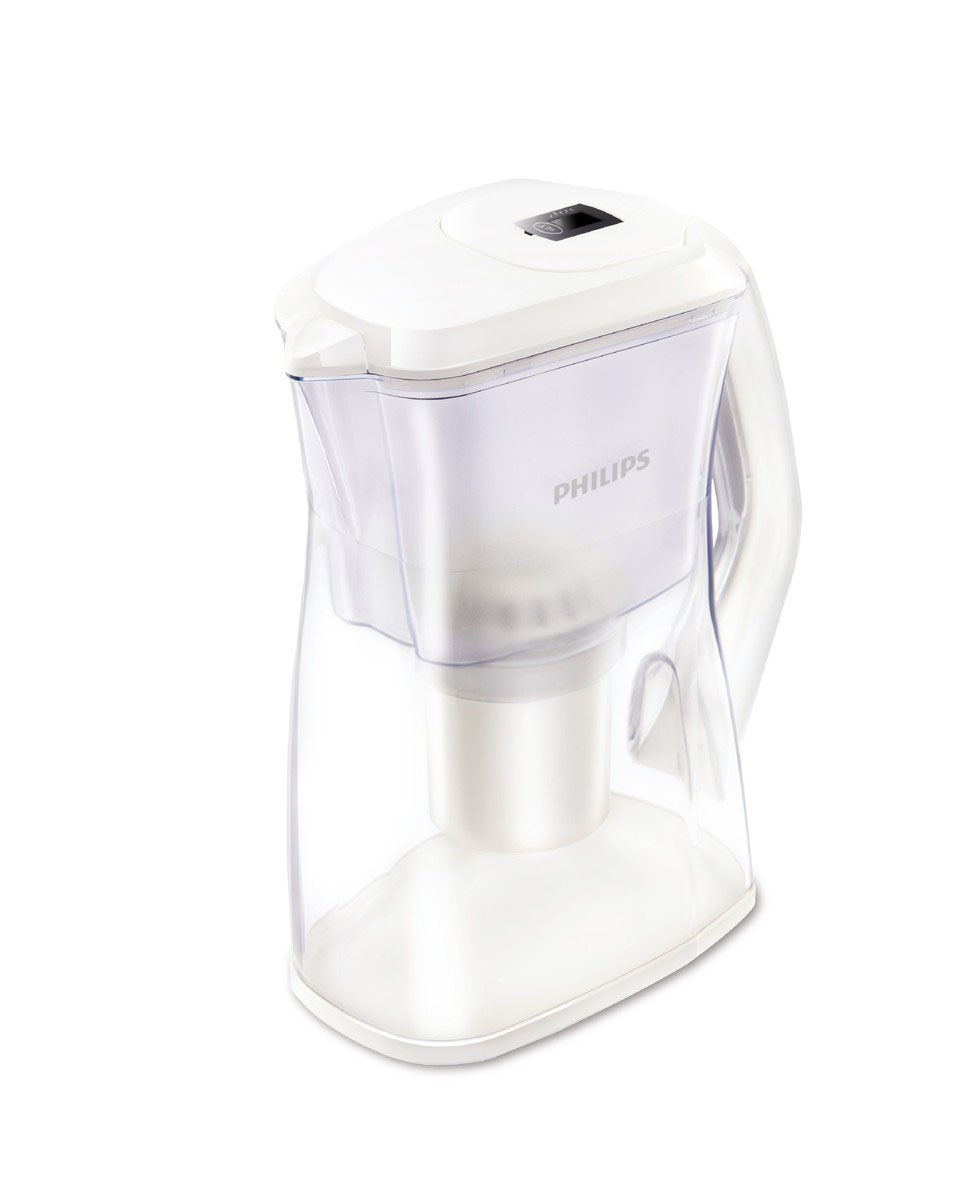
Compared with AWP2950/03, the AWP2970/03 adds a small digital countdown on the lid. Philips describes it as a reminder to replace the cartridge. The family manual describes a 60-day timer, including activation and reset steps. That can help if you forget when a new filter went in, but the booklet does not describe a sensor that measures filtered liters, flow restriction or water quality. Do not read the countdown as a real-time condition monitor.
The filter's separately stated volume capacity is 200 liters. Treat that as its own manufacturer rating, not something the timer verifies. A household using the pitcher heavily could approach the volume rating before the calendar display reaches zero; a low-use household may reach the 60-day recommendation before using 200 liters. Philips' manual recommends changing at least every 60 days, while the leaflet lists the volume. Track use and follow both exact instructions rather than assuming one resets or replaces the other. The timer is useful for remembering a date, not for extending service life.
What the pitcher and cartridge actually do
The AWP2970/03 leaflet names a three-stage ultrafiltration system using non-woven fabric, granular activated carbon and a hollow-fiber membrane. It lists AWP260/AWP261 as the replacement-cartridge family and states a 0.15 L/min flow rate. Philips gives 1.5 liters as the filtered-water tank capacity; the page does not state a total cup capacity or exterior dimensions. That finished-water volume is modest for a household filling several bottles at once, and the 0.15 L/min figure makes the gravity fill a wait-and-store routine rather than an instant pour.
Philips' leaflet markets reduction of particles down to 0.01 micron, chlorine, pesticides and chemicals, and advertises up to 99.9% bacteria reduction in laboratory conditions while retaining beneficial minerals. It also marks soluble-lead reduction and water-hardness reduction as not applicable. The product document reviewed here does not supply a full performance table naming challenge organisms, concentrations, conditions and certification scope. Treat the bacterial figure as a manufacturer leaflet claim, not as a blanket assurance about every source water or a reason to use it in place of disinfection. The specified input is municipal tap water; the manual warns against water from an unknown source.
Setup and maintenance are still manual
The family manual's first-use sequence is worth checking before the first fill: soak a new cartridge in clean water for 15 minutes, shake it lightly, remove it and shake it for 15–30 seconds, seat the sealing ring and press the cartridge firmly into place. Philips then instructs users to fill the pitcher and discard the first two filtered loads. This is not an unusual burden, but it is part of the operating plan; the timer does not replace correct preparation.
For routine care, the instructions say to hand-wash the pitcher rather than use a dishwasher, avoid freezing, keep the filtered water away from direct sun, and use it within 24 hours. Philips lists municipal tap water at 5–38 °C and 0–1 bar atmospheric pressure. The timer is a useful reminder for someone who wants a date prompt on the vessel. It is less helpful if you expect automatic volume tracking, a capacity display or an indicator that tests when the water needs treatment.
Choose between documented siblings carefully
If an existing pitcher is marked AWP2970/03, verify the AWP260/AWP261 cartridge code rather than purchasing an AWP200/AWP201 insert just because another Philips model looks similar. AWP2950/03 shares the hollow-fiber cartridge family and the same listed 1.5-liter, 200-liter and 0.15 L/min figures, but its leaflet and family manual identify it as the no-timer sibling. The timer-bearing AWP2970 is more convenient for calendar tracking; it is not shown as a higher-capacity or faster version.
Do not confuse this model with Philips' current US AWP2980WH/37 powered pitcher. That product uses AWP225 and button-controlled dispensing, not the AWP260/AWP261 gravity route. If you are comparing a new US purchase, use the current exact product listing and filter support rather than assuming that a /03 leaflet, a similar pitcher outline or a Philips brand label establishes local availability. The reviewed source set does not establish a US-specific offer for AWP2970/03.
For an owner, the helpful takeaway is simple: the timer records a calendar reminder, while the cartridge's stated 200-liter limit and the manual's 60-day schedule remain separate replacement boundaries. If exact-filter availability, a lead result, or a fully specified microbial test is essential, the records here leave those needs unmet. The model is useful to identify and operate according to its manual; it is not evidence for a current US shortlist or for treating unsafe water.
Key details at a glance
| Listed tank capacity | 1.5 L |
|---|---|
| Included filter | Philips awp260 261 hollow fiber |
| Stated filter capacity | 52.8 gal |
| Typical replacement interval | 2 months |
| Lead result in exact-filter test data | No |
| Reusable filter shell | No |
| What the filter is documented to reduce | Philips' exact leaflet describes three-stage ultrafiltration using non-woven fabric, granular activated carbon and a hollow-fiber membrane. It markets particle reduction down to 0.01 micron and up to 99.9% bacteria reduction under laboratory conditions, plus chlorine, pesticide and chemical reduction while retaining minerals. The leaflet does not provide organism-specific test conditions or a full performance table; those claims are not treated as a documented essential microbial result. It explicitly marks soluble-lead and water-hardness reduction as not applicable. |
| Use and care | Use municipal tap water only, within the Philips-listed 5–38 °C input range and atmospheric 0–1 bar pressure. The family manual warns against unknown-source water, dishwasher cleaning and freezing, and advises using filtered water within 24 hours away from direct sunlight. This is not a treatment route for microbiologically unsafe source water. |
| Manufacturer dimensions as listed | Philips' exact leaflet gives a 1.5 L filtered-water tank, not a cup count or external dimensions. |
| Replaceable filter inner core | No |
Use the exact model’s instructions for operating limits, supplied equipment and version differences.
Sources for this assessment
Check the exact filter setup before you shop.
Capacity, filter type and the written reduction claims belong to the pitcher-and-cartridge combination, not just the pitcher shape.