
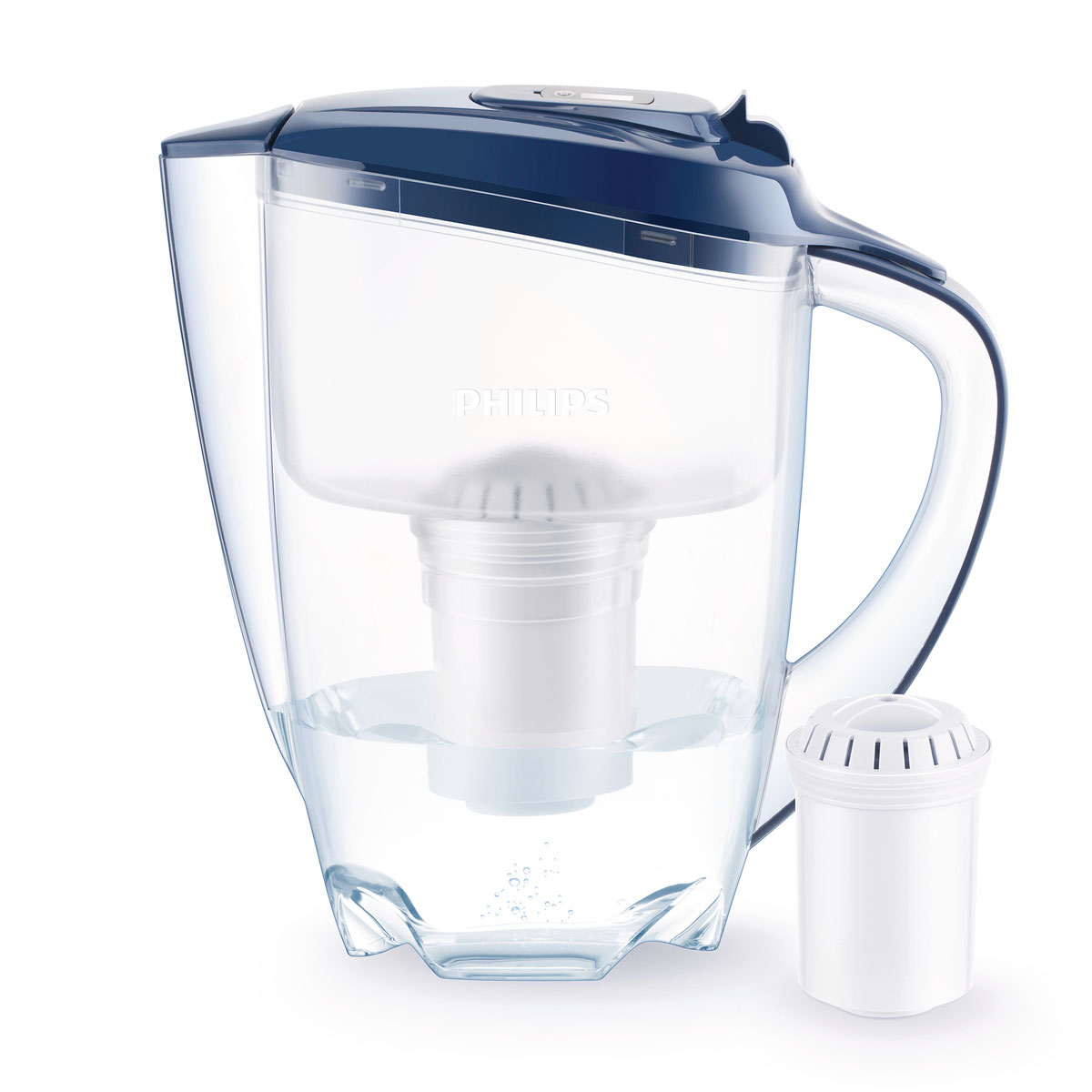
Your needs, this model
Does it fit your priorities?
Do you need a listed cup count for servings or refrigerator-fit planning?
Philips lists 1.5 L of filtered-water tank, not a cup count or outside dimensions; those requirements are not confirmed.
Explore this need in the finder →Is a bacteria, virus or cyst result essential?
The exact AWP2922/10 leaflet lists bacteria removal N/A and does not document a virus or cyst result.
Explore this need in the finder →Do you require powered dispensing instead of a manual pour?
The digital timer is only a reminder; AWP2922/10 remains a gravity-fed pitcher without powered dispensing.
Explore this need in the finder →Must you be able to buy a currently documented US model and local filter supply?
A US offer and local AWP200/AWP201 support path were not established by the reviewed sources; this reference cannot satisfy a current US purchase requirement.
Explore this need in the finder →The Philips AWP2922/10 is a gravity-fed pitcher that adds a digital replacement reminder to the AWP200/AWP201 microfiltration family. Its exact Philips leaflet highlights that timer and an ergonomic handle, while listing the same basic system figures found on the AWP2915/10 and AWP2918/10 leaflets: a 1.5-liter filtered-water tank, 0.25 L/min flow and a 200-liter one-piece cartridge rating. The shared family manual provides the 60-day replacement guidance. This is a useful exact-model reference for someone identifying a timer-lid pitcher, but the reviewed evidence does not establish a US-specific offer or local US support route. It is not included as a US purchase recommendation.
The reminder helps with dates, not measured use
The visible digital timer is the AWP2922/10’s clearest everyday difference from AWP2915/10 and AWP2918/10. Philips describes it as a reminder to replace the filter; the family manual describes the 60-day schedule and activation/reset steps. It can reduce the chance of forgetting when a cartridge went in. It does not measure liters filtered, pressure, the amount of lead in water or cartridge performance. If the household empties the tank several times a day, a countdown is not a usage meter. Conversely, if use is light, the manufacturer’s time guidance still applies even when the 200-liter rating has not been reached.
Keep the two service limits distinct: 200 L is the leaflet’s volume rating; every 60 days is the manual’s calendar recommendation. Use the exact cartridge instructions and replace at the appropriate boundary, rather than treating the screen as permission to exceed the rated use. The AWP200/AWP201 filter is one piece and is discarded after service; the pitcher does not have a reusable shell to refill.
Filter route and stated results
Philips describes a four-stage path with non-woven fabric, granular activated carbon, ion-exchange resin and another non-woven layer. The listed replacement cartridges are AWP200/AWP201. Philips states up to 99% reduction of chlorine and soluble lead under laboratory conditions and says the lead reduction remains 88% at the end of filter life. Its leaflet also lists pesticides, VOCs, chemicals, microplastics and water-hardness reduction. Those are maker-reported claims tied to the exact product family, not independent results for every household. The leaflet points to Bureau Veritas testing but does not present a full table of challenge conditions, influent levels, test methods and certification scope. If a particular contaminant result is essential, compare the exact supporting record rather than assuming the headline percentage applies to your water.
One limit is explicit: bacteria removal is listed as not applicable. This is not a purifier for water from an unknown source. Philips specifies municipal tap water, 5–38 °C input and atmospheric pressure of 0–1 bar. The filter is not presented as a universal disinfection route, and broad claims about microfiltration should not override the source-water restrictions.
A compact tank still means batch filtration
Philips gives 1.5 liters for the filtered-water tank. It does not give a cup count, total vessel volume, exterior measurements or fridge-fit dimensions in the reviewed leaflet. The tank number is the filtered side, not a promise that the full two-chamber vessel accepts exactly that much raw water at once. This distinction matters if you want multiple servings ready together or have a narrow refrigerator shelf. The 0.25 L/min figure is a specified flow rate, but actual household fill time can vary; think of it as a gravity-filtering reservoir that needs time between refills, rather than an instant tap.
The AWP2922’s highlighted ergonomic handle may be useful when carrying a filled pitcher, and its dust-resistant spout is intended to keep dust from entering through the outlet. Those details do not resolve the unknown vessel material or guarantee that it is dishwasher safe. Use the family manual’s care instructions: prepare a new cartridge as directed, discard the first two filtered loads, remove the filter while washing, avoid freezing and use the filtered water within 24 hours away from direct sunlight.
Choosing among AWP200-family codes
Compared with the AWP2915/10 and AWP2918/10, the AWP2922/10 adds the timer and emphasizes its handle; the official leaflets do not list a higher tank capacity, faster flow or different AWP200/AWP201 cartridge. AWP2915 and AWP2918 are identified as no-timer models in the shared family manual. If you already own an AWP2922/10, the timer is a practical reminder, not a reason to use another Philips filter family. In particular, AWP260/AWP261 is the separate hollow-fiber cartridge named for AWP2950/03 and AWP2970/03; similar pitcher shape does not prove cross-compatibility.
The AWP2922 code is most useful when checking the lid, reminder and cartridge instructions on an existing unit. For current US shopping, the current Philips US pitcher directory captured here lists other models, including the AWP2980WH/37 powered pitcher with AWP225. That is a different operating plan. The directory does not prove AWP2922 was never sold in the US, but the exact /10 leaflet alone does not establish a supported local buying route. Confirm current local availability and the filter code on the actual unit before purchasing replacement parts. Choose a current product whose exact US offer, fit and support are documented if your goal is a new US purchase; keep AWP2922/10 as a careful identification and operation reference.
Use the exact model’s instructions for operating limits, supplied equipment and version differences.Key details at a glance
Listed tank capacity 1.5 L Included filter Philips AWP200/AWP201 GAC + ion-exchange cartridge Stated filter capacity 52.8 gal Typical replacement interval 2 months Lead result in exact-filter test data Yes Reusable filter shell No What the filter is documented to reduce Philips' exact leaflet describes four-stage microfiltration with non-woven fabric, GAC, ion-exchange resin and another non-woven layer. It claims up to 99% chlorine and soluble-lead reduction under laboratory conditions and 88% lead reduction at the end of rated filter life, and also lists pesticides, VOCs, chemicals, microplastics and water-hardness reduction. The leaflet mentions BV testing but is not a complete model performance table with challenge conditions and certification scope. Bacteria removal is explicitly N/A. Treat these as manufacturer statements, not independent assurance for every source water. Use and care Use municipal tap water only, at 5–38 °C and atmospheric 0–1 bar input pressure. Family instructions warn against water of unknown source, hot input and freezing; consume filtered water within 24 hours away from sunlight and hand-clean the vessel as directed. The pitcher is not a microbial treatment system. Manufacturer dimensions as listed The exact leaflet gives 1.5 L for the filtered-water tank, not cup count or external dimensions. Microbial test result in exact filter data sheet No Replaceable filter inner core No Sources for this assessment
Check the exact filter setup before you shop.
Capacity, filter type and the written reduction claims belong to the pitcher-and-cartridge combination, not just the pitcher shape.