
Your needs, this model
Does it fit your priorities?
Do you need a listed six-cup capacity for serving or refrigerator-fit planning?
Philips lists a 1.5 L filtered-water tank but no cup count or exterior dimensions; a six-cup serving or fit requirement is unconfirmed.
Explore this need in the finder →Is a bacteria, virus or cyst reduction result essential?
The exact AWP2921 leaflets list bacteria removal as N/A and supply no virus or cyst result; these cannot meet that essential need.
Explore this need in the finder →Must filtered water be dispensed by a powered button rather than a manual pour?
This is a gravity-fed pour-through pitcher, not a powered dispensing system.
Explore this need in the finder →Must the shortlist be limited to a currently documented US offer and local filter-support route?
The reviewed Philips sources do not establish a current US offer or matching local support route for this regional configuration; it remains reference-only.
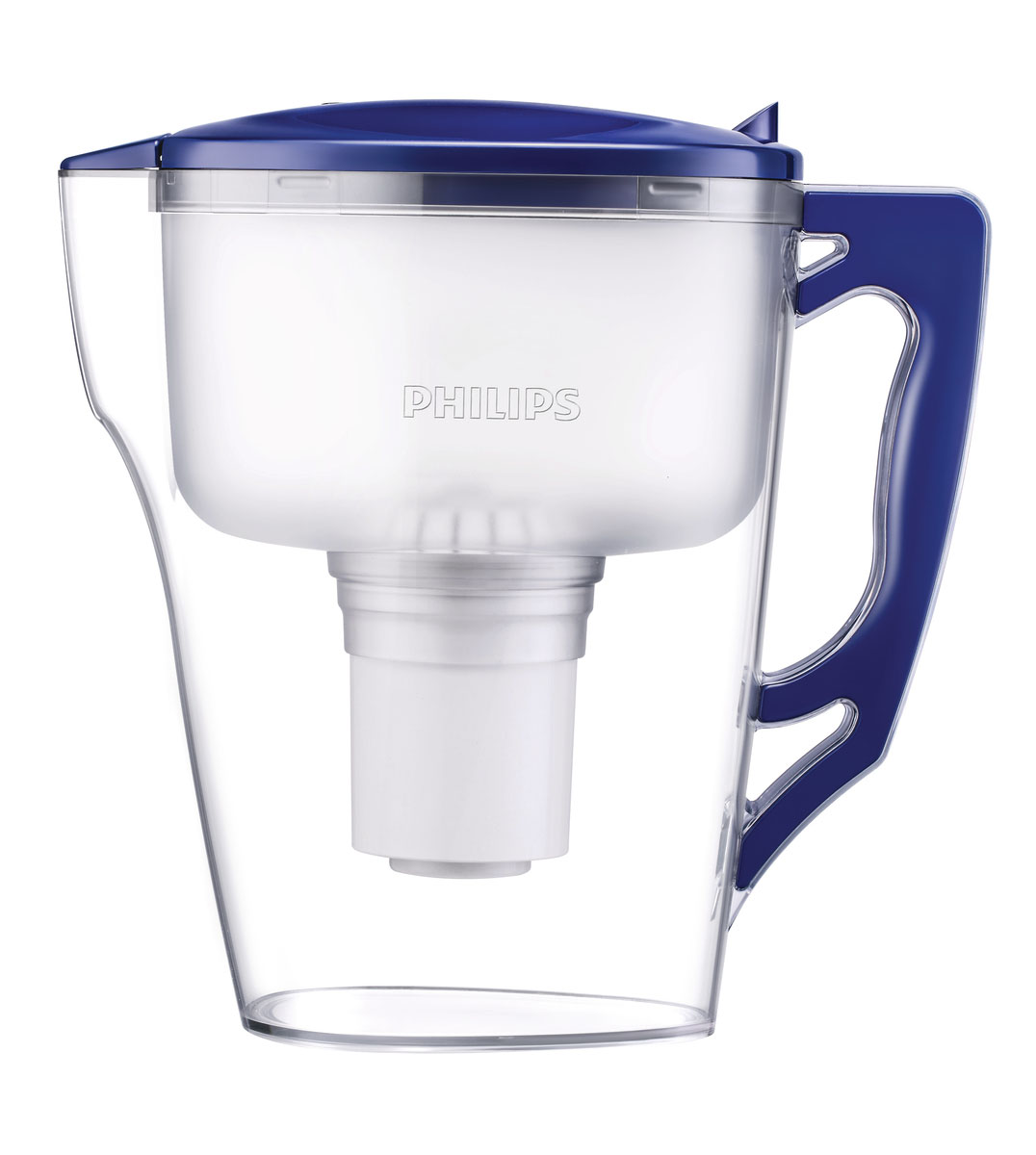
Explore this need in the finder →The Philips AWP2921/03 and AWP2921/11 are two documented suffix variants of a dark-blue-lid, timer-equipped gravity pitcher. The exact 2020 Philips leaflets give different EANs—4897099300069 for /03 and 4897099300045 for /11—while both specify the AWP200/AWP201 cartridge, a 1.5 L filtered-water tank, a 200 L rating and 0.25 L/min flow. Their main documented differences are the market suffix and package identifier, not a different filtration plan. Singapore’s /03 product page marks the model discontinued; the /11 leaflet is a Chilean-market document. Neither source establishes a US offer or local US filter support, so this combined review is for identification and operation, not a US buying recommendation.
Dark blue lid and a calendar reminder
The AWP2921’s standout everyday feature is its digital filter timer. The family manual calls it a 60-day countdown and recommends replacement at least every 60 days. It is a calendar reminder, not a meter of filtered volume or contaminant breakthrough. The leaflet’s 200 L rating and the manual’s time recommendation describe separate boundaries. Reset the timer when changing the cartridge and keep track of usage; the display cannot confirm that the liter rating has not already been reached.
Philips’ family manual identifies AWP2921 with a dark-blue lid and timer, in contrast to the white-lid AWP2920 with a timer and white-lid AWP2900 without one. The exact AWP2921/03 and /11 leaflets both depict the same blue-lid form, and their embedded product JPEG streams are identical. That supports a shared review for these two documented suffixes. It does not mean every Philips dark-blue pitcher uses the same filter: AWP2950 has a similar lid color but a different hollow-fiber cartridge family, AWP260/AWP261. Read the full code on the unit and match it to the exact leaflet before ordering a replacement.
What is inside and what the numbers mean
The leaflets describe four-stage microfiltration using non-woven fabric, granular activated carbon and ion-exchange resin followed by another non-woven layer. They list up to 99% reduction of chlorine and soluble lead under laboratory conditions, with soluble-lead reduction still at 88% at end of filter life. The sheets also list pesticide, VOC, chemical, microplastic and hardness-reduction claims. Those are Philips statements; the documents do not provide a complete contaminant-by-contaminant challenge table or independent measurements for your water. Ask for the exact test data if a specific substance drives the decision.
Bacteria removal is explicitly marked N/A in the exact AWP2921 leaflet. No virus or cyst performance is stated. This is not a disinfection device and is not intended for water from an unknown source. Philips specifies municipal tap water, input from 5 to 38 °C and atmospheric pressure of 0–1 bar. If microbial reduction is an essential need, this model cannot qualify on the evidence available.
Tank size is not a cup-count claim
The 1.5 L number is for filtered water in the lower tank, not a stated cup count or the total pitcher volume. The leaflet does not provide outside dimensions, shelf clearance or the volume of raw water that fits above the cartridge. A household that needs six servings at once, or has a fixed refrigerator shelf, should measure the actual pitcher or choose a model with a published cup capacity and dimensions. The 0.25 L/min flow figure also makes clear that filling is a gravity process; it is not an electric dispenser that delivers filtered water on demand. Plan ahead for refills rather than expecting instant output.
The family user manual provides useful setup steps: soak a new cartridge in clean water for 15 minutes, shake it gently, confirm the seal and press the cartridge into place, then fill and discard the first two pitchers. Keep the unit level, remove the cartridge before cleaning and do not put the pitcher in a dishwasher or freezer. Philips says to use municipal tap water only, avoid hot water above 38 °C and keep stored filtered water cool and covered. The manual warns that filtered water should be consumed promptly and kept refrigerated because removal of chlorine means bacteria can grow during storage. Follow any instructions supplied with the exact region’s product.
Choosing it for a real household
An existing owner who wants the timer, white/dark lid distinction and AWP200/AWP201 route can use the exact /03 or /11 leaflet to identify this configuration. A no-timer AWP2915/10 or AWP2918/10 has less reminder support; AWP2922/10 also uses the AWP200/AWP201 family but is a separate /10 code. The timer does not change the cartridge’s capacity or make filtration more extensive. If your highest priority is microbial protection, a verified cup count, a specific US cartridge source, or a power-dispensing button, the AWP2921 does not meet that need based on these documents.
For a new US purchase, keep both suffixes in the reference library only. Philips Singapore labels the AWP2921/03 discontinued, and the /11 source is a Chilean leaflet rather than a US offer. Philips’ current US pitcher directory does not list either variant. That absence does not prove the models were never sold in the US, but it leaves current local purchase and support unverified. Before using a stored unit, check its own suffix and filter packaging; before buying a replacement, confirm the code with Philips for that exact market variant.
Philips AWP2921/03 leaflet · Philips AWP2921/11 leaflet · Philips Singapore AWP2921/03 support
Key details at a glance
| Listed tank capacity | 1.5 L |
|---|---|
| Included filter | Philips AWP200/AWP201 GAC + ion-exchange cartridge |
| Stated filter capacity | 52.8 gal |
| Typical replacement interval | 2 months |
| Lead result in exact-filter test data | Yes |
| Reusable filter shell | No |
| What the filter is documented to reduce | Both exact AWP2921 suffix leaflets describe four-stage filtration with non-woven layers, granular activated carbon and ion-exchange resin. Philips claims up to 99% chlorine and soluble-lead reduction under laboratory conditions and 88% lead reduction at end of filter life; the leaflets list additional VOC, pesticide, chemical, microplastic and hardness claims. Bacteria removal is explicitly N/A. This is manufacturer-reported information, not independent performance testing. |
| Use and care | Municipal tap water only, 5–38 °C input and atmospheric pressure 0–1 bar. The family manual warns against unknown-source water, hot input and freezing and advises covered/refrigerated, prompt storage. It is not microbial treatment. |
| Manufacturer dimensions as listed | No external dimensions, cup count or full raw-water fill volume is provided in the exact leaflets; 1.5 L is filtered-water tank capacity. |
| Microbial test result in exact filter data sheet | No |
| Replaceable filter inner core | No |
Use the exact model’s instructions for operating limits, supplied equipment and version differences.
Sources for this assessment
- Philips AWP2921/03 Water filter pitcher product leaflet, issue 2020-08-23
- Philips AWP2921/11 Water filter pitcher product leaflet, issue 2020-08-23
- Philips Chile AWP2921/11 Spanish product leaflet
- Philips AWP2921/03 and /11 exact leaflet shared product rendering
- Philips Singapore AWP2921/03 product page
- Philips Singapore AWP2921/03 support page
- Philips pitcher family user manual listing AWP2921
- Philips US Water Pitchers directory, current four-result page
Check the exact filter setup before you shop.
Capacity, filter type and the written reduction claims belong to the pitcher-and-cartridge combination, not just the pitcher shape.