
Your needs, this model
Does it fit your priorities?
Is the listed 7-cup pitcher capacity the size you need?
The 7-cup label is the whole vessel; it is not the filtered volume immediately ready after one reservoir fill.
Explore this need in the finder →Do you want LifeStraw Home’s paired membrane and carbon + ion-exchange filter route?
This pitcher includes both elements, with distinct claimed reductions and separate replacement intervals.
Explore this need in the finder →Is a documented bacteria-and-parasite reduction claim essential?
The LifeStraw Home test sheet reports these reductions under its stated conditions; this does not make unsafe or unknown water an acceptable input.
Explore this need in the finder →Can you accept the shorter filter stage reaching its stated limit at 40 gallons or two months?
The carbon + ion-exchange element has the shortest replacement interval at 40 gallons or two months; the membrane has a separate 264-gallon / up-to-one-year limit.
Explore this need in the finder →Do you require an axis-labeled maximum shelf height?
LifeStraw lists 11.25 × 5.8 inches without labeling the axes, so a strict height limit cannot be confirmed from the product page.
Explore this need in the finder →A seven-cup glass body with the same two-filter schedule
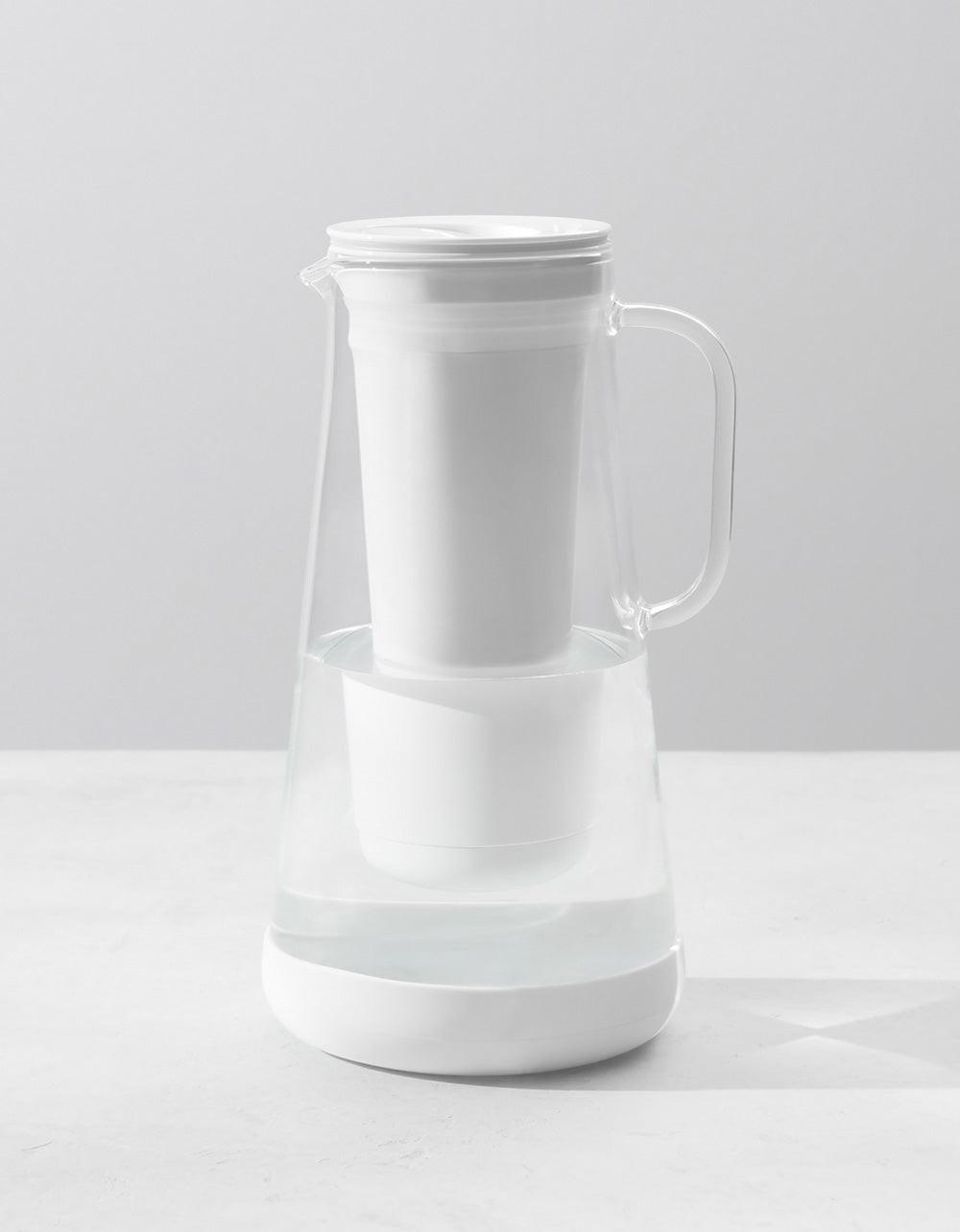
LifeStraw Home 7-Cup Glass pairs a hand-blown borosilicate pitcher with an included silicone base, easy-fill lid, filter housing, membrane microfilter and activated carbon plus ion-exchange filter. It is not a filter-free glass carafe: the white plastic filter housing, lid and filter components remain part of the assembly. The manufacturer currently lists seven color variants—White (LSH7GLWCAWW), Bubble (LSH7GLSPK21), Wisteria (LSH7GLWS41), Pebble (LSH7GLPB41), Stormy Blue (LSH7GLSSB21), Juniper (LSH7GLSTL21) and Terrazzo (LSH7GLTZ41). Several colors were marked unavailable in the manufacturer feed on the review date; they are color choices of the same seven-cup system, not separate filtration models.
This is the LifeStraw Home choice for someone who wants a glass main vessel and is content with a smaller listed capacity. The seven-cup label still refers to the entire pitcher, not seven cups of already-filtered water waiting beneath the upper chamber. The glass page lists dimensions as 11.25 by 5.8 inches but does not label either axis, and its stated weight appears as both 2 pounds 4 ounces and 1.8 kilograms—two different conversions. Those are meaningful omissions for a refrigerator shelf, a weight-sensitive user or anyone who must lift a full pitcher comfortably. Do not treat the first dimension as the confirmed height or use the weight field as a precise comparison; measure the actual model or ask LifeStraw to resolve the listing.
What the membrane and carbon stages are meant to do
LifeStraw’s membrane microfilter is listed at 0.2 microns and the exact product page reports reductions of bacteria, parasites and microplastics under manufacturer test conditions. The activated carbon and ion-exchange cartridge is the stage associated with reduction of chlorine, odors, lead, mercury, PFAS, pesticides, herbicides and other named chemicals. The product page says WQA certification applies to specific NSF/ANSI 42, 53 and 401 reductions and that the system meets the US EPA/NSF P231 standards for bacteria and parasite removal. Its linked Home performance sheet says the results were independently tested and ties them to challenge concentrations. Read the complete sheet for the particular contaminant that matters; a model’s claim list is not a household water test.
Both stages need attention, on different schedules. LifeStraw rates the membrane for up to 264 gallons or one year, and the carbon/ion-exchange element for 40 gallons or two months. The more frequent carbon replacement governs the practical 40-gallon service interval; the longer membrane rating does not mean the whole system runs unchanged for a year. The manufacturer’s support guide calls for a first filtered batch to be discarded, and its setup card explains that flow can improve during the first few batches as trapped air is displaced.
Safe use and ownership details
Do not mistake the P231 performance claim for permission to pour in untreated unsafe water. LifeStraw Home is intended for normal household use, and its manual warns against industrial chemicals, brackish water and seawater. It also warns that hygiene, cracked glass or plastic, failure to replace filters, and freezing a used membrane can undermine performance or damage the system. Store the pitcher in the refrigerator or on the counter for daily use, keep the housing and spout clean, and replace the two elements according to their own instructions. If water is not already considered potable, use an appropriate public-health treatment plan; this pitcher is not a substitute for disinfection advice.
Glass is the material advantage, but it changes how the pitcher should be handled: avoid drops and hard impacts, keep the silicone base fitted to protect the bottom, and remember that glass does not make the whole assembly plastic-free. The manual says to remove the housing before washing and not to use soap on the filter elements. Care directions are not entirely consistent: the detailed spec block says hand-wash the pitcher and housing, while the linked user manual and product FAQ say the glass pitcher can go in the dishwasher once the filter housing is removed, with the lid hand-washed. If dishwasher use is central to your choice, follow the current manual supplied with your exact color/SKU or confirm with LifeStraw; otherwise hand-wash the body and lid and rinse filters only with water.
When to choose the glass model over the Essential plastic
Compared with the Home Essential 7-Cup Plastic, the Glass keeps the seven-cup listed capacity and the same filter schedule but trades a one-piece SMMA body for borosilicate glass and an included silicone base. The Essential is about 1.4 pounds empty and has a published 11.3-inch height; it also has a 10-cup sibling and a current dishwasher-care FAQ that conflicts with its manual. The 10-cup Essential offers more whole-vessel capacity and lists a 11.3-inch height, although its handle-side width is larger. The glass page’s unlabeled measurements mean neither strict height nor depth fit can be confirmed from the written listing.
In the finder, choose seven cups and the LifeStraw dual-stage route to compare Glass with Essential 7-Cup Plastic; choosing the bacteria-and-parasite claim keeps the three LifeStraw pitcher models in play, not just glass. A minimum filter-stage service life above 40 gallons excludes this product because its carbon element reaches that limit first. Do not select a maximum shelf-height number expecting the glass listing to satisfy it: the axes are not identified. This model suits a shopper who values a glass vessel, accepts a two-part replacement routine and can handle a heavier, breakable body. Compare plastic Essential for a lighter form, or Brita/PUR if a different cartridge routine, simpler care or more fully specified fit information is the stronger need.
Key details at a glance
| Listed pitcher capacity | 7 cups |
|---|---|
| Included filter | LifeStraw Home paired membrane + carbon/ion-exchange stages |
| Stated filter capacity | 40 gal |
| Typical replacement interval | 2 months |
| Lead result in exact-filter test data | Yes |
| Reusable filter shell | No |
| Made without BPA | Yes |
| What the filter is documented to reduce | LifeStraw Home uses two distinct elements: its membrane microfilter is stated to reduce bacteria, parasites and microplastics under the manufacturer’s specific test protocols; its activated carbon + ion-exchange element is stated to reduce chlorine, lead, PFAS and other named substances. The current Essential data sheet reports independent lab results for the Home system (including 98.9% lead reduction and 0.01 µg/L maximum PFOA+PFOS effluent under stated challenge tests); the glass product page lists WQA-certified reductions for selected NSF/ANSI 42, 53 and 401 claims. These are not individual tap-water tests or a guarantee for every contaminant. |
| Use and care | Use in normal household conditions with potable water; the manufacturer’s current page reports performance only under its documented tests and its manual warns against industrial chemicals, brackish water and seawater. The P231 removal claim does not make the glass pitcher a substitute for public-health disinfection advice for unsafe or unknown-quality water. Replace carbon + ion exchange filter at 40 gallons or 2 months and membrane up to 264 gallons or 1 year. |
| Manufacturer dimensions as listed | 11.25 × 5.8 in; the exact page does not label the axes. It lists 2 lb 4 oz and 1.8 kg for weight, inconsistent conversions. |
| Pitcher material | Hand-blown borosilicate glass pitcher with silicone base and filter/lid components |
| Microbial test result in exact filter data sheet | Yes |
| Membrane filter rated capacity | 264 gal |
| Glass water reservoir | Yes |
Use the exact model’s instructions for operating limits, supplied equipment and version differences.
Sources for this assessment
- LifeStraw US LifeStraw Home Water Filter Pitchers collection, products feed page 1
- LifeStraw US Home collection, products feed page 1
- LifeStraw Home 7-Cup Glass exact product page and specifications
- LifeStraw Home pitcher product guide and setup instructions
- LifeStraw Home pitcher user manual for original glass model
- LifeStraw Home pitcher setup and cleaning instruction card
- LifeStraw Home pitcher performance data sheet linked from replacement filter listing
- LifeStraw Home series performance data sheet; cover identifies the Home Glass 7-Cup system and WQA-certified white colorway
Check the exact filter setup before you shop.
Capacity, filter type and the written reduction claims belong to the pitcher-and-cartridge combination, not just the pitcher shape.