
Your needs, this model
Does it fit your priorities?
Would a 7-cup / 56-ounce listed vessel be enough for your usual batch?
ZEROP07 is the 7-cup member of this line. The rating is total pitcher capacity, not a promise that one reservoir fill leaves 7 cups of filtered water ready immediately.
Explore this need in the finder →Do you need the newer Culligan top-drop filter rather than the older ZeroWater bottom-thread filter?
The new format is ZEROF01 for one replacement filter and is incompatible with older bottom-screw ZeroWater devices. Check the pitcher logo, lid and filter code before reordering.
Explore this need in the finder →Would an included TDS meter and a documented lead result change your shortlist?
ZEROP07 includes a removable meter with two AAA batteries, and its listed filter data includes a lead test result. A TDS reading does not identify lead or prove overall safety.
Explore this need in the finder →Is a 20-gallon rated filter capacity acceptable for your maintenance schedule?
The current exact performance sheet lists 20 gallons; the filter replacement cue is an orange light plus a meter reading of 6 or higher. Higher TDS can shorten use, so the meter is not a guaranteed life forecast.
Explore this need in the finder →What the ZEROP07 actually is
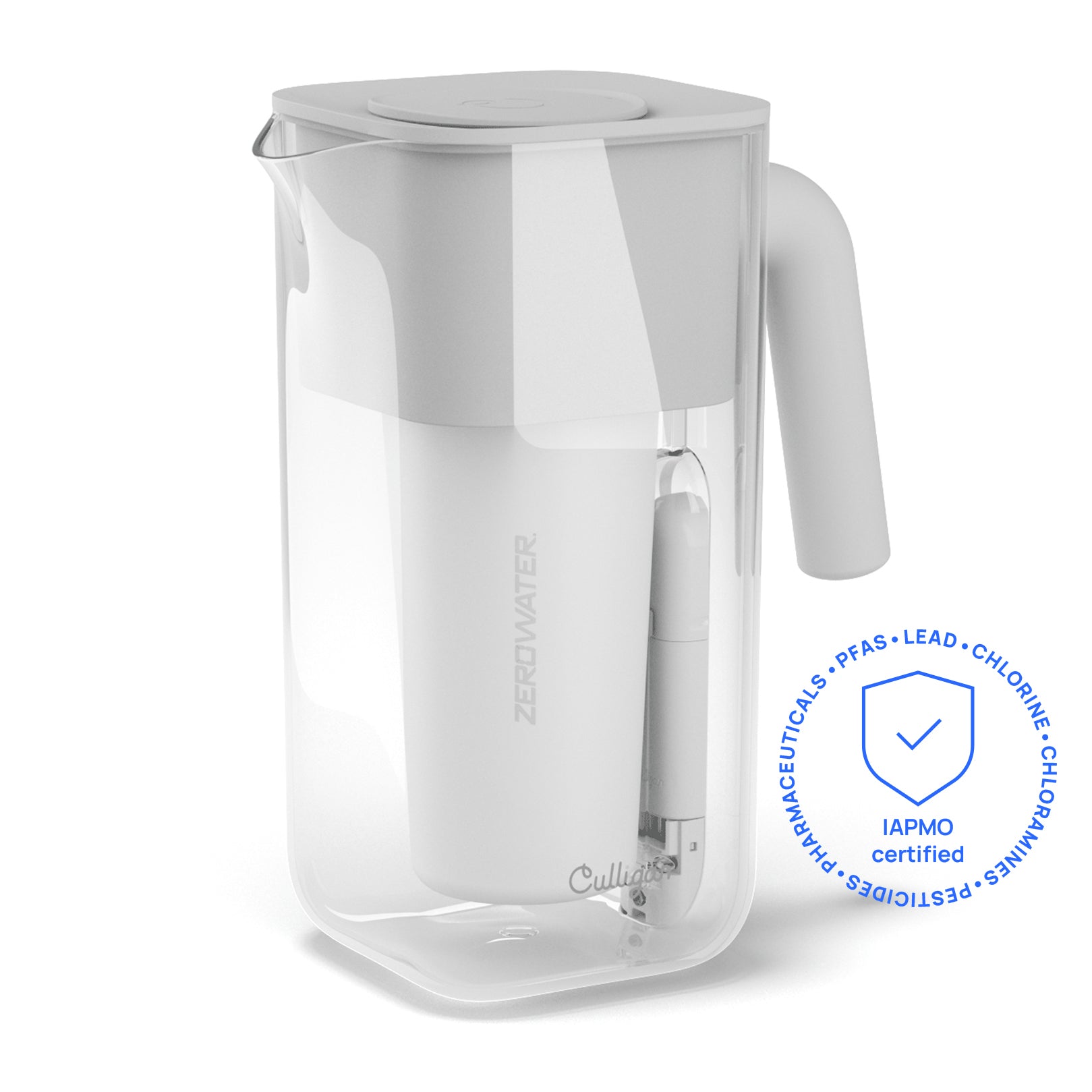
Culligan’s 7 Cup Pitcher with ZeroWater Technology is model ZEROP07, UPC 810136500332. It is a gravity-fed pitcher, not an electric dispenser: you pour tap water into the upper reservoir and let the filter feed the lower chamber. The standard package lists one new Culligan with ZeroWater Technology filter, a removable TDS meter and two AAA batteries. The included filter is the newer top-drop style, not the older ZeroWater cartridge that screws into the bottom of a reservoir.
This is the small vessel in the current 7-, 10- and 12-cup Culligan pitcher family. Its appeal is the modest listed size, not a different treatment recipe.
Capacity and fit: compact, but check the opening yourself
The product page lists 7 cups, or 56 ounces, a 3.5-pound empty weight and dimensions of 8.7 by 5 by 10.5 inches. Those dimensions are not labeled by axis. The manufacturer says it fits in most refrigerators, but an unlabeled measurement string cannot prove that the pitcher clears a particular shelf height or door bin. If a tight opening is essential, measure your space and ask for an axis-labeled drawing before you decide.
The capacity number is for the pitcher system, not seven cups of already-filtered water immediately after filling. The upper reservoir and filtered-water chamber share the vessel, so ready water at one moment can be less than the advertised total. Choose the 10-cup ZEROP10 for a middle size or the 12-cup ZEROP12 if two extra cups of listed vessel capacity matter more than the extra room it takes.
The new cartridge route is different from legacy ZeroWater
The model and lid details matter when buying replacement filters. Culligan identifies the newer cartridge as a top-drop design: it enters from the top of the upper reservoir and turns clockwise to lock. The one-filter replacement page identifies model ZEROF01; the family data sheet refers to ZEROFXX elements and notes that suffixes distinguish pack counts. Culligan’s compatibility page and this pitcher’s manual explicitly say the new filter is not compatible with earlier bottom-screw ZeroWater devices.
Do not shop only by the words “ZeroWater” or by how the filter looks in a thumbnail. If you already own a ZP-010 or a legacy Ready-Pour pitcher, verify the exact device and filter code; the redesigned Culligan cartridge does not fit those older vessels. Likewise, ZEROP07 is not an old ZeroWater body simply because the names share a technology label. Its sliding-lid layout, Culligan marking and top-installed filter identify the newer system.
Read the performance sheet as a test, not a promise about your tap
The current Culligan performance data sheet names ZEROP07 and tests the filter under NSF/ANSI 42, 53 and 401 protocols. Its table includes total PFAS, lead at two pH conditions, fluoride, chlorine and other named substances. For example, it reports average reductions of 99.7% for total PFAS, 98.9% and 98.8% for lead at pH 6.5 and 8.5, and 99.7% for fluoride. Those are the sheet’s laboratory results under its stated challenge conditions, not a measurement of your household supply or a guarantee for every contaminant that might be present.
The sheet says to use potable water and warns not to use microbiologically unsafe or unknown-quality water without proper disinfection before or after the system. A TDS reading cannot replace a water test: it measures aggregate dissolved solids, not lead, PFAS, bacteria or overall safety. This is a useful distinction if a specific contaminant is the reason you are shopping. Compare the named test result with a water report or appropriate test rather than treating a zero TDS reading as a safety certificate.
Meter and filter maintenance are part of the purchase
The meter is removable and stores in a dock on the pitcher. It is not a permanently lit display on the body. Culligan’s support instructions say the orange indicator and a reading of 6 or higher signal filter replacement. The performance sheet separately gives a 20-gallon rated capacity and recommends a change at that point. The support FAQ offers projected life ranges that vary with incoming TDS, including estimates above 20 gallons in some ranges, but those estimates do not raise the sheet’s conservative rated capacity used here for matching. Higher-TDS source water can use up a cartridge sooner, so do not treat a calendar guess as a guarantee.
Setup takes more than snapping in a cartridge. The manual says to wash the vessel with mild soap and warm water, rinse the filter exterior for about 30 seconds, drop it into the reservoir and turn it clockwise until it locks. Fill with cold or room-temperature water. The product is meant for potable water and the performance sheet lists a 40–90°F operating range. If it sits unused for more than seven days, the sheet directs the owner to dispense filtered water, hand-wash the device and flush one reservoir through the filter; resume normal use if the meter still reads zero.
How the questionnaire changes this recommendation
Choose seven cups and the new Culligan-with-ZeroWater filter route to isolate this size. A ten- or twelve-cup capacity answer removes it. Selecting the new filter format, requiring the included TDS meter or requiring a listed lead or fluoride result can keep it in the running; an essential bacteria, virus or cyst result cannot be confirmed from this sheet. A 20-gallon minimum fits its rated value, while a larger required capacity excludes it. A strict height limit also cannot be confirmed because the published measurements do not identify which side is height.
The ZEROP07 suits someone seeking a compact pitcher who accepts its 20-gallon rated filter. If your main goal is more water between fills, compare the ZEROP10 and ZEROP12; they add vessel capacity without changing the supported filter evidence. If you are matching an older screw-in ZeroWater device, do not choose this new pitcher just because the technology name looks familiar. Confirm the exact device and filter together.
Key details at a glance
| Listed pitcher capacity | 7 cups |
|---|---|
| Included filter | Culligan with ZeroWater top-drop ZEROF01 cartridge |
| Stated filter capacity | 20 gal |
| Lead result in exact-filter test data | Yes |
| Empty weight | 3.5 lb |
| Reusable filter shell | No |
| Made without BPA | Yes |
| What the filter is documented to reduce | The current manufacturer sheet explicitly names ZEROP07 and states testing to NSF/ANSI 42, 53 and 401. Its table lists average reductions for total PFAS (99.7%), lead at pH 6.5/8.5 (98.9%/98.8%), fluoride (99.7%), and named other substances. Results apply to the data-sheet challenge conditions, not a measurement of a household tap. It does not establish microbial safety or test every possible contaminant. |
| Use and care | For potable water only; the data sheet says not to use microbiologically unsafe or unknown-quality water without proper disinfection before or after filtration. Cold-water use; operating temperature listed as 40–90 F. Store only in that temperature range. |
| Separate TDS meter included | Yes |
| Manufacturer dimensions as listed | 8.7 x 5 x 10.5 in; exact manufacturer page does not label the axes |
| Pitcher material | Plastic; Culligan describes the pitcher family as BPA-free polypropylene and ABS |
| Stainless-steel body | No |
| Glass water reservoir | No |
| Fluoride result in exact-filter test data | Yes |
Use the exact model’s instructions for operating limits, supplied equipment and version differences.
Sources for this assessment
- Culligan 7 Cup Pitcher with ZeroWater Technology — exact model page
- Culligan ZeroWater pitcher and dispenser family manual; models include ZEROP07
- Culligan ZeroWater Technology Performance Data Sheet; exact models include ZEROP07
- Culligan with ZeroWater Technology replacement filter; one-filter model ZEROF01
- Culligan filter compatibility guide: new top-drop and legacy bottom-thread filters
- Culligan with ZeroWater Technology support and TDS-meter FAQ
- Culligan 7 Cup Pitcher with ZeroWater Technology official product image

Check the exact filter setup before you shop.
Capacity, filter type and the written reduction claims belong to the pitcher-and-cartridge combination, not just the pitcher shape.