
Your needs, this model
Does it fit your priorities?
Do you need the 12-cup / 96-ounce listed vessel rather than a smaller size?
ZEROP12 is the largest pitcher size in this documented family. The label is whole-vessel capacity, not immediately available filtered volume.
Explore this need in the finder →Are you matching the newer top-drop Culligan filter rather than a legacy ZeroWater filter?
This pitcher uses the new ZEROF01 top-drop format; Culligan says it is not compatible with older bottom-screw ZeroWater devices.
Explore this need in the finder →Would the exact lead and fluoride results plus a removable meter fit your needs?
The family data sheet lists lead and fluoride results for ZEROP12; the package includes a removable TDS meter. TDS does not identify a contaminant or certify safety.
Explore this need in the finder →Can a 20-gallon rated filter capacity meet your stated minimum?
The exact sheet names ZEROP12 and assigns a 20-gallon rated capacity to the family cartridge. The replacement meter cue is orange with a 6-or-higher reading.
Explore this need in the finder →The largest pitcher in this three-size family
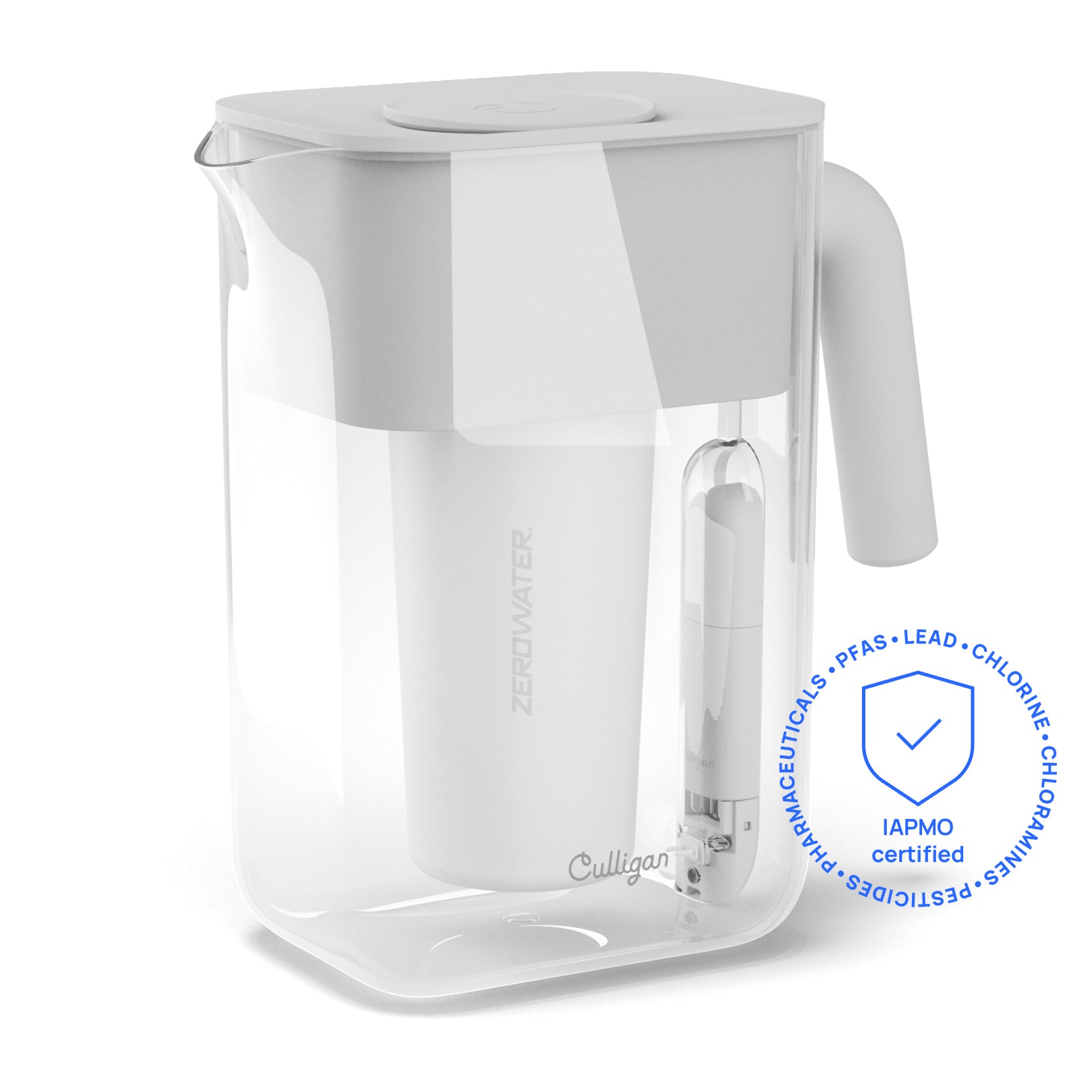
Culligan’s 12 Cup Pitcher with ZeroWater Technology is model ZEROP12, UPC 810136500455. The exact U.S. page lists a cool-gray pitcher, one current Culligan with ZeroWater Technology filter, a removable TDS meter and two AAA batteries. It is still a gravity-fed pitcher: pour into the upper reservoir and let water pass through the filter into the lower vessel. The “12 cups” figure refers to listed pitcher capacity, not a guaranteed twelve cups of finished water ready immediately after one reservoir fill.
Among this current 7-, 10- and 12-cup series, this is the largest nominal pitcher. The same filter and replacement routine apply to all three sizes. The 12-cup purchase makes sense when the larger listed vessel is the priority; there is no separate treatment advantage here over the smaller Culligan siblings.
Measure storage space rather than relying on a broad fit phrase
The product page lists 96 ounces, a 4.5-pound empty weight and dimensions of 10.3 by 5 by 10.5 inches. It describes the model as fridge-friendly, but the dimension string does not label its axes. If you have a shelf-height cap, measure the opening and ask for a manufacturer drawing with the vertical dimension identified. The model’s 10.5-inch dimension cannot safely be called its height without that information.
The larger pitcher also means a heavier vessel when full. That may be a reason to step down to the 10-cup model if you prefer lighter handling or have a narrower fridge location. Conversely, if the family currently refills a smaller vessel repeatedly, 12 cups can reduce the number of times the pitcher needs to be topped off. Remember that filtration takes time: the upper reservoir and filtered-water chamber share the pitcher, so a 96-ounce total label should not be mistaken for one ready-to-pour batch of fully treated water.
One new top-drop filter, not a legacy ZeroWater cartridge
The ZEROP12 package uses the current Culligan with ZeroWater Technology filter. The manual describes rinsing the outside of the cartridge shell for about 30 seconds, dropping it into the reservoir and twisting clockwise until it locks. The replacement page identifies the one-filter element as ZEROF01; the performance sheet’s family designation is ZEROFXX, with the final suffix corresponding to pack count.
Do not assume that this filter fits a pitcher with an older ZeroWater logo or a bottom-thread cartridge. Culligan’s compatibility page and the family manual specifically distinguish the newer top-drop design from legacy bottom-screw systems and say the cartridges are not interchangeable. If you are buying replacement media for equipment you already own, verify the pitcher’s exact model, logo and filter before buying.
Specific reduction data—and what it cannot tell you
The official current performance sheet names ZEROP12 and lists testing to NSF/ANSI 42, 53 and 401. It includes results for specific substances such as total PFAS, lead at pH 6.5 and 8.5, fluoride, chlorine and named emerging compounds. The sheet reports 99.7% average reduction for total PFAS, 98.9% and 98.8% for lead at the stated pH points and 99.7% for fluoride. These results describe the laboratory challenge conditions and the listed cartridge; they are not a sample test of your household water.
The included meter reads total dissolved solids. Culligan says an orange indicator combined with a reading of 6 or higher is the change-filter cue. That helps with the cartridge routine, but a TDS reading cannot identify lead, PFAS, pathogens or overall safety. The performance sheet is explicit that the system is for potable water and says not to use microbiologically unsafe or unknown-quality water without proper disinfection before or after filtration. For an exact contaminant concern, pair the manufacturer’s result with your local report or a suitable water test.
Replacement expectations and day-to-day care
The current PDS lists a 20-gallon rated capacity at 2 gallons per day and recommends changing the filter at that point. The support FAQ gives TDS-dependent expected-life estimates, some higher than the rated sheet value. For a conservative filter-capacity requirement, this assessment uses 20 gallons. Actual use varies with incoming water and how much the household filters; do not treat a higher estimate as a guaranteed service life. No fixed monthly replacement interval is established for the exact package.
Before use, hand-wash the vessel with mild dish soap and warm water, rinse the new filter’s outside shell, lock it into the reservoir and fill with cool or room-temperature water. The sheet lists an operating range of 40–90°F. If the pitcher has been idle for more than seven days, the instructions call for dispensing water, washing the pitcher and flushing one reservoir through the cartridge; continue normal use if the meter still reads zero. The pitcher is plastic; Culligan describes its pitcher family as BPA-free polypropylene and ABS.
How to compare it with the other two sizes
If capacity is the deciding factor, the finder can separate ZEROP12 from the 7-cup ZEROP07 and 10-cup ZEROP10 while keeping the new filter route the same. It can also require an included TDS meter, a data-sheet lead result or the listed fluoride result. A 20-gallon minimum includes the rated cartridge; a larger minimum does not. A microbial reduction requirement, a strict axis-specific height or dispensing during active reservoir filtration cannot be confirmed for this model from the reviewed exact documents.
The official Household Essentials bundle pairs the same 12-cup pitcher with additional filters. That is a package-size variation, not a distinct pitcher or a different performance sheet. Choose the base ZEROP12 if you only need the one-filter setup; compare the bundle if extra replacement filters arriving with the pitcher matter. If the 96-ounce capacity is not needed, the ZEROP10 has the same filter family in a smaller listed size. If a high-volume family routine requires much more than a pitcher, compare Culligan’s separate dispenser formats rather than assuming that an even larger pitcher exists.
Key details at a glance
| Listed pitcher capacity | 12 cups |
|---|---|
| Included filter | Culligan with ZeroWater top-drop ZEROF01 cartridge |
| Stated filter capacity | 20 gal |
| Lead result in exact-filter test data | Yes |
| Empty weight | 4.5 lb |
| Reusable filter shell | No |
| Made without BPA | Yes |
| What the filter is documented to reduce | The current manufacturer sheet explicitly names ZEROP07 and states testing to NSF/ANSI 42, 53 and 401. Its table lists average reductions for total PFAS (99.7%), lead at pH 6.5/8.5 (98.9%/98.8%), fluoride (99.7%), and named other substances. Results apply to the data-sheet challenge conditions, not a measurement of a household tap. It does not establish microbial safety or test every possible contaminant. |
| Use and care | For potable water only; the data sheet says not to use microbiologically unsafe or unknown-quality water without proper disinfection before or after filtration. Cold-water use; operating temperature listed as 40–90 F. Store only in that temperature range. |
| Separate TDS meter included | Yes |
| Manufacturer dimensions as listed | 10.3 x 5 x 10.5 in; exact manufacturer page does not label the axes |
| Pitcher material | Plastic; Culligan describes the pitcher family as BPA-free polypropylene and ABS |
| Stainless-steel body | No |
| Glass water reservoir | No |
| Fluoride result in exact-filter test data | Yes |
Use the exact model’s instructions for operating limits, supplied equipment and version differences.
Sources for this assessment
- Culligan 12 Cup Pitcher with ZeroWater Technology — exact model page
- Culligan ZeroWater pitcher and dispenser family manual; models include ZEROP07
- Culligan ZeroWater Technology Performance Data Sheet; exact models include ZEROP07
- Culligan with ZeroWater Technology replacement filter; one-filter model ZEROF01
- Culligan filter compatibility guide: new top-drop and legacy bottom-thread filters
- Culligan with ZeroWater Technology support and TDS-meter FAQ
- Culligan 12 Cup Pitcher with ZeroWater Technology official exact-size product image

Check the exact filter setup before you shop.
Capacity, filter type and the written reduction claims belong to the pitcher-and-cartridge combination, not just the pitcher shape.