
Your needs, this model
Does it fit your priorities?
Does a 10-cup / 80-ounce listed vessel meet your batch-size need?
ZEROP10 is the middle size in this line. The listed figure is total pitcher capacity, not the amount of filtered water ready immediately after one fill.
Explore this need in the finder →Do you need the Culligan top-drop filter rather than a legacy screw-in ZeroWater element?
The new family uses the ZEROF01 top-drop filter format; its official compatibility guide says it does not fit earlier bottom-thread ZeroWater devices.
Explore this need in the finder →Would an included TDS meter and documented lead result matter?
The package includes a removable TDS meter with two AAA batteries, and the exact family sheet lists a lead test result. A TDS value is not a lead test.
Explore this need in the finder →Is the conservatively rated 20-gallon filter capacity acceptable?
The current performance sheet lists a 20-gallon rating; the manufacturer also gives variable TDS-based life estimates, so the match uses the rated value.
Explore this need in the finder →The ten-cup option and its exact identity
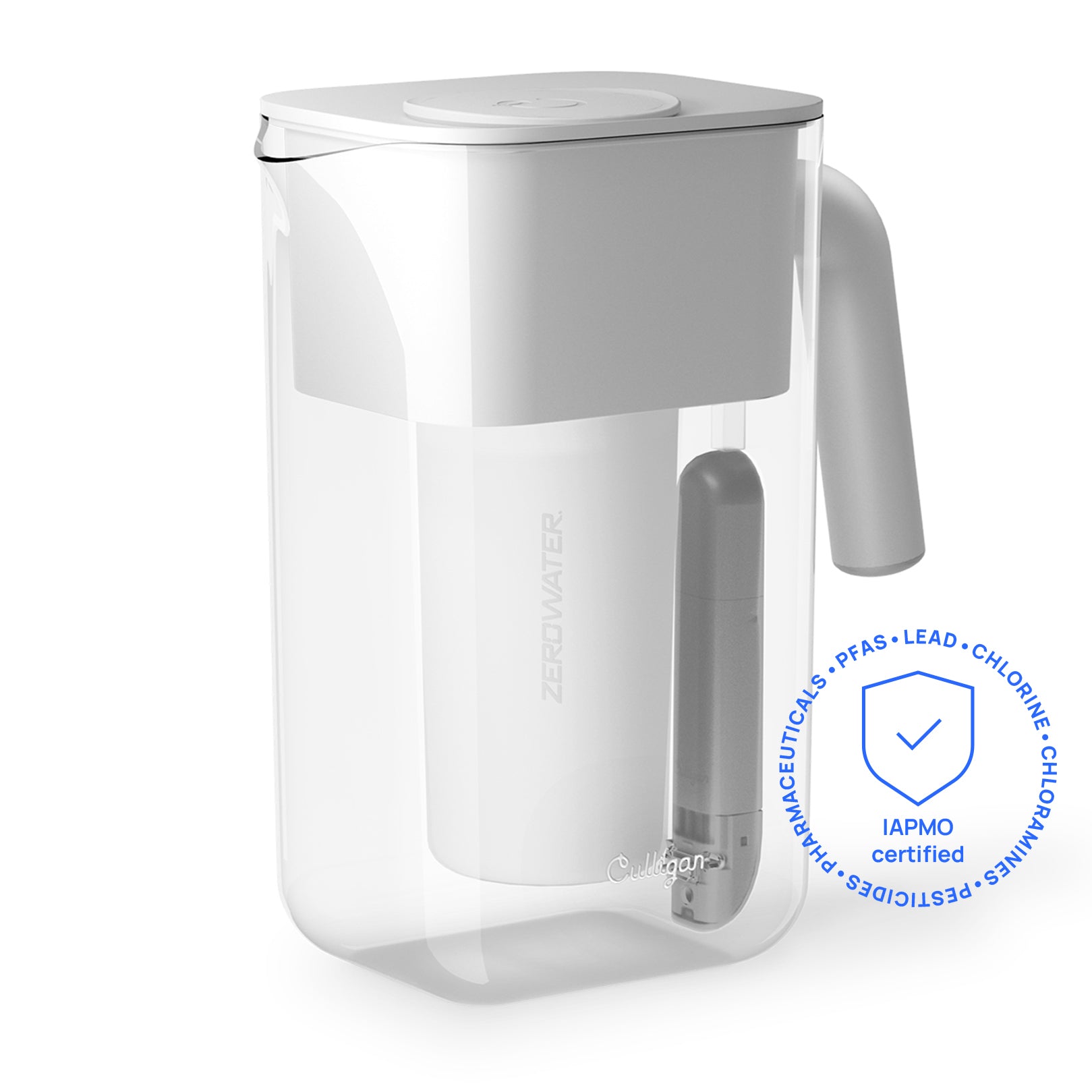
The Culligan 10 Cup Pitcher with ZeroWater Technology is model ZEROP10, UPC 810136500349. The current package is a gravity pour-through pitcher with one new top-drop 5-stage filter, a removable TDS meter that stores in the pitcher dock and two AAA batteries. The official collection also lists the same 10-cup vessel in Cool Gray, Matte Black, Aqua, Lilac and Sage, using the corresponding SKUs ZEROP10, ZEROP10BLKRF, ZEROP10AQURF, ZEROP10LILRF and ZEROP10SAGRF. These are finish variants of the same functional capacity/filter arrangement, not five different reduction profiles.
Ten cups is the middle choice between Culligan’s 7-cup and 12-cup pitchers. It gives more listed vessel capacity than the compact ZEROP07 without moving to the largest pitcher in this line. That can be a sensible compromise when the household wants more water ready between refills, but the cup rating is not a claim that ten cups of finished filtered water emerge from one reservoir fill.
Fridge dimensions are useful, but not a fit guarantee
The manufacturer lists this pitcher at 10 cups / 80 ounces, 4 pounds empty and 9.5 by 5 by 10.5 inches. Its product page describes the design as fitting most fridge shelves. The dimensions themselves do not label height, width or depth, so they are not enough to confirm a strict shelf-height limit. A nominal “most shelves” statement is not a substitute for measuring your own fridge, especially if the pitcher will be stored under a shelf or placed in a door bin.
Even when it fits, the upper fill reservoir occupies part of the vessel. Think of the 80-ounce label as the model’s listed total capacity, not the amount of finished water always available after a single pour-in. If your goal is fewer refill cycles, the 12-cup ZEROP12 adds two cups of nominal capacity; if a smaller footprint matters most, compare the 7-cup sibling. The source does not establish an axis-specific height for any of these three, so the finder will not claim a precise shelf fit.
A separate filter system—not the older screw-in ZeroWater
ZEROP10 uses the current Culligan with ZeroWater Technology filter, one ZEROF01 element in the one-filter package. It drops into the upper reservoir and turns clockwise to lock. Culligan’s current compatibility guide distinguishes this top-drop cartridge from legacy ZeroWater filters that screw into the reservoir bottom; the new filter is explicitly not compatible with earlier devices.
This package is therefore not interchangeable with a legacy ZP-010 or the older 12-cup Ready-Pour model simply because both use a five-stage “ZeroWater” label. If you are replacing a cartridge for a pitcher already at home, read its model and fit instructions before ordering. A replacement filter page identifies the new one-filter unit as ZEROF01; the performance data sheet uses the broader ZEROFXX family name because the final digits reflect pack count.
What the test sheet supports
The current manufacturer performance sheet names ZEROP10 and lists testing under NSF/ANSI 42, 53 and 401. Its table reports reduction for specific substances, including total PFAS, lead at pH 6.5 and 8.5, fluoride, chlorine, and named emerging compounds. As examples, the sheet reports average total-PFAS reduction of 99.7%, lead reductions of 98.9% and 98.8% at the two stated pH conditions, and fluoride reduction of 99.7%. These figures belong to the stated laboratory challenges, not to your tap and not to an unlisted contaminant.
That precision matters. The product includes a TDS meter and the support page describes a 6-or-higher reading with an orange indicator as a filter-change cue. TDS is an aggregate measure of dissolved material; it is not a lead strip, PFAS assay, microbial test or complete safety check. The manufacturer says to use potable water and warns against using microbiologically unsafe or unknown-quality water without proper disinfection before or after the system. If the concern is a particular contaminant, start with a local water report or suitable test and compare that issue with the exact performance sheet.
Filter life and cleaning should influence the choice
The sheet assigns this filter a rated capacity of 20 gallons at a listed service flow of 2 gallons per day and recommends replacement at that point. The support FAQ also gives estimated lifetimes that vary with incoming TDS and household use, with some projected ranges above 20 gallons. We use 20 gallons as the conservative rated-capacity field; do not read the higher projections as a universal limit. Actual filter use depends on the water being treated, and the meter cue is not a contaminant-specific test.
For first use, the manual calls for a warm-soapy wash of the pitcher, a 30-second rinse of the filter’s outer shell, and a clockwise lock into the upper reservoir. Fill it with cool or room-temperature water. The manufacturer specifies potable water and an operating range of 40–90°F. After more than seven days idle, the performance instructions say to dispense filtered water, hand-wash the device and flush one reservoir before returning to normal use if the meter reads zero. That small maintenance routine is part of the practical cost of choosing this technology.
Who should choose the ZEROP10?
This model fits a shopper who wants a mid-size pitcher, the current Culligan-with-ZeroWater cartridge route and an included meter. On the finder, select ten cups and the new Culligan filter format to distinguish it from the ZEROP07, ZEROP12 and legacy screw-in models. A 20-gallon filter minimum and a need for a documented lead or fluoride result are supported by the cited sheet. An essential microbial result, a precise maximum shelf-height requirement or a requirement to dispense while the reservoir is filtering is not confirmed here.
The maker also sells New Parent Starter and Baby & Me packages built around a 10-cup vessel with extra filters. Those packages change how many cartridges arrive; they do not make the pitcher itself a different capacity or establish a different filter result. Confirm the exact ZEROP10 color SKU and bundle contents before ordering.
Key details at a glance
| Listed pitcher capacity | 10 cups |
|---|---|
| Included filter | Culligan with ZeroWater top-drop ZEROF01 cartridge |
| Stated filter capacity | 20 gal |
| Lead result in exact-filter test data | Yes |
| Empty weight | 4 lb |
| Reusable filter shell | No |
| Made without BPA | Yes |
| What the filter is documented to reduce | The current manufacturer sheet explicitly names ZEROP07 and states testing to NSF/ANSI 42, 53 and 401. Its table lists average reductions for total PFAS (99.7%), lead at pH 6.5/8.5 (98.9%/98.8%), fluoride (99.7%), and named other substances. Results apply to the data-sheet challenge conditions, not a measurement of a household tap. It does not establish microbial safety or test every possible contaminant. |
| Use and care | For potable water only; the data sheet says not to use microbiologically unsafe or unknown-quality water without proper disinfection before or after filtration. Cold-water use; operating temperature listed as 40–90 F. Store only in that temperature range. |
| Separate TDS meter included | Yes |
| Manufacturer dimensions as listed | 9.5 x 5 x 10.5 in; exact manufacturer page does not label the axes |
| Pitcher material | Plastic; Culligan describes the pitcher family as BPA-free polypropylene and ABS |
| Stainless-steel body | No |
| Glass water reservoir | No |
| Fluoride result in exact-filter test data | Yes |
Use the exact model’s instructions for operating limits, supplied equipment and version differences.
Sources for this assessment
- Culligan 10 Cup Pitcher with ZeroWater Technology — exact model page
- Culligan ZeroWater pitcher and dispenser family manual; models include ZEROP07
- Culligan ZeroWater Technology Performance Data Sheet; exact models include ZEROP07
- Culligan with ZeroWater Technology replacement filter; one-filter model ZEROF01
- Culligan filter compatibility guide: new top-drop and legacy bottom-thread filters
- Culligan with ZeroWater Technology support and TDS-meter FAQ
- Culligan 10 Cup Pitcher with ZeroWater Technology official exact-size product image

Check the exact filter setup before you shop.
Capacity, filter type and the written reduction claims belong to the pitcher-and-cartridge combination, not just the pitcher shape.