
Your needs, this model
Does it fit your priorities?
Is a listed 10-cup filtered-water reservoir the capacity you want?
The manufacturer lists 80 ounces/10 cups in the lower filtered-water chamber; the approximately half-gallon top reservoir is feed water, not the ready filtered capacity.
Explore this need in the finder →Do you need a specific P-RF route with a manufacturer-listed fluoride result?
The current Clearly Filtered pitcher performance table has a fluoride result for its exact pitcher filter; this is not a certification to NSF/ANSI fluoride reduction.
Explore this need in the finder →Does the exact pitcher performance record need to list a lead-reduction test result?
The manufacturer table lists a lead test result for the P-V3/P-RF; NSF/ANSI 372 certification refers to lead-free materials and does not certify lead removal.
Explore this need in the finder →Can you accept a replacement limit of 100 gallons or six months, whichever comes first?
P-RF is rated at 100 gallons; the manufacturer also directs replacement at six months of use even if that gallon total is not reached.
Explore this need in the finder →Do you have at least 10.9 inches of shelf height for this pitcher?
The manufacturer lists 10.87 inches tall. A 10.9-inch limit passes the documented number, but measure clearance for lid opening and do not treat that as extra clearance beyond the stated height.
Explore this need in the finder →Check the version on the filter record, not just the headline
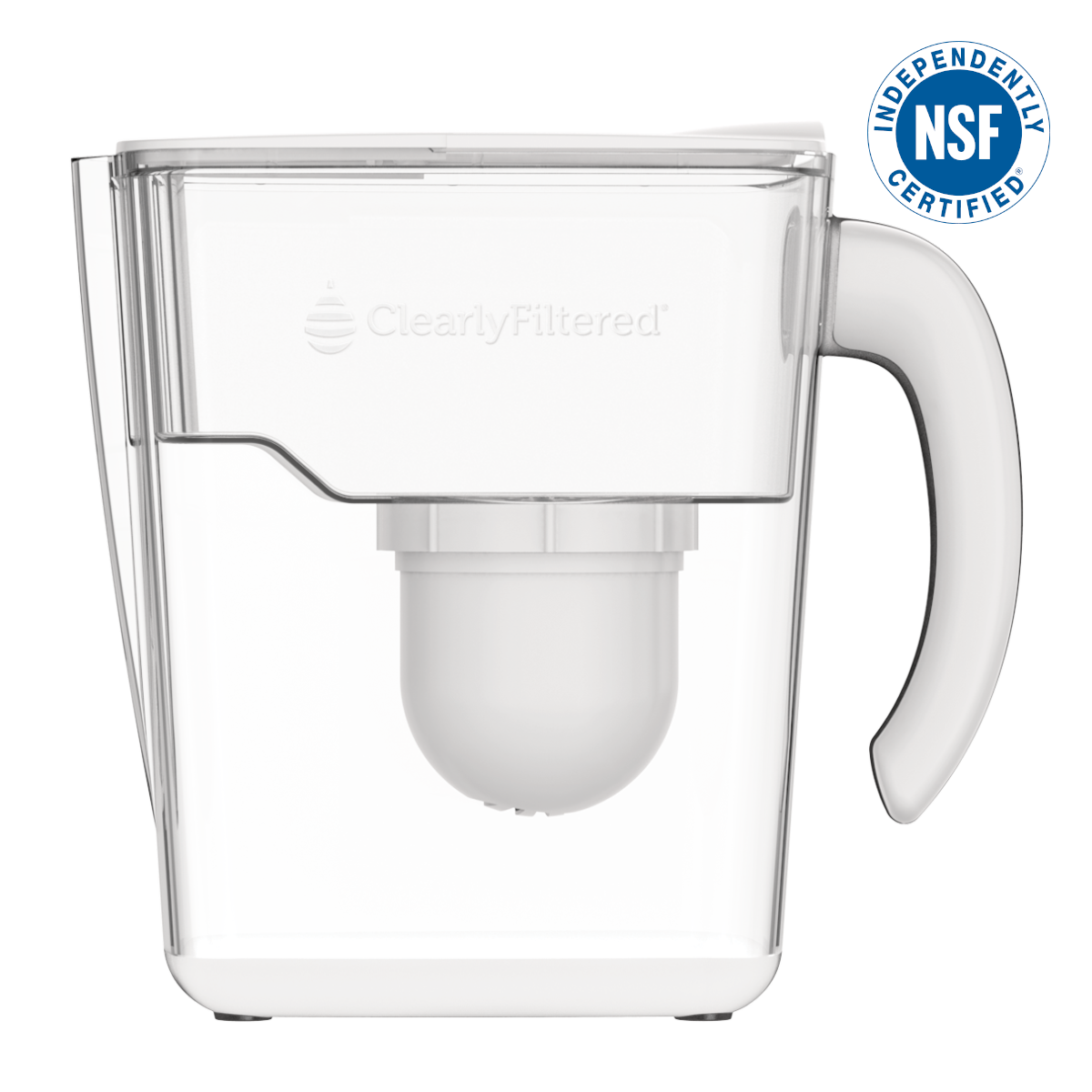
This assessment is for Clearly Filtered’s current US Filtered Water Pitcher, system model P-V3, sold with one P-RF replacement element. The company’s pitcher collection also lists P-V3-based pitcher-plus-filter bundles, a P-NF-V3 pitcher body without a filter, and individual P-RF filters. The exact bundle illustrations show three or six additional filter elements alongside the installed one. Those are package differences around the same pour-through product family, not three different filtration technologies. The body-only listing is not a complete filter system unless you already own a compatible P-RF element.
For comparison, the manufacturer’s product page lists an 80-ounce (10-cup) lower reservoir, dimensions of 11.4 by 5.25 by 10.87 inches, and a BPA/BPS-free Tritan body. Its support page separates the roughly half-gallon upper reservoir from the 10-cup filtered-water chamber. Treat ten cups as the clean-water storage figure, not as the amount ready immediately after one fill: gravity filtration takes time. The listed height is under eleven inches, but the footprint is not especially narrow. Measure the shelf and door opening, including room to lift the hinged cover and remove the reservoir. Clearly Filtered’s own two pages disagree on empty weight (2.3 versus 2.8 pounds), so I leave that number unresolved rather than choose one.
What the exact performance record says—and what it does not
The useful distinction here is between a laboratory result and a certification claim. The P-V3/P-RF performance sheet names chlorine taste-and-odor reduction to NSF/ANSI 42 and lead-content limits for wetted materials under NSF/ANSI 372. Its chlorine result is 98.2% across the rated 100-gallon life; the 372 result is a lead-free-materials check, not a lead-removal certification. The company’s pitcher-performance table separately lists test results for individual contaminants, including fluoride and lead, under stated challenge conditions. Those are manufacturer-published laboratory results, not a test of your tap water, and not proof of certification to every protocol mentioned elsewhere on the company’s marketing pages. The current product resources and performance sheet support 42 and 372 as the certifications to rely on.
Its rated element is 100 gallons, but Clearly Filtered also recommends replacing it by six months, whichever comes first. A half-gallon upper reservoir makes frequent top-ups part of the routine; people filling it several times per day can reach the gallon limit well before six months. Hard or sediment-heavy water can shorten service life or slow flow. The filtering element targets a long list of substances, but this is still a pour-through system for potable, municipally treated water—not a purifier for untreated, microbiologically unsafe, or unknown-quality sources. If your concern is a specific contaminant, compare your utility report or a suitable well test with the exact row and challenge conditions in the manufacturer’s data, rather than relying on a broad “hundreds of contaminants” headline.
Budget for setup, wait time, and hand washing
The current P-V3 quick-start guide says the filtered pitcher includes one filter and a reusable priming bag. Priming is not an optional polish: remove the intake sticker, saturate and press water through the element with the bag several times, and seat the gasket and filter securely on the upper reservoir. The manufacturer considers a full upper reservoir processed in 35 minutes or less a successful prime. If a new, correctly primed filter is slower, its guide recommends a four-to-six-hour soak and contacting support before discarding another element. This setup takes more hands-on work than dropping in a cartridge designed to start with a short rinse. It also means you should refill before the filtered reservoir is empty rather than expect water on demand.
Use cool or room-temperature water within the documented operating range. The filter is not dishwasher safe and should not be washed with soap; remove it and hand-wash the pitcher body and reservoir. The guide advises drinking stored filtered water within four to five days. The new lid opens on a hinge, which avoids removing the whole cover for a top-up, but the reservoir’s fit is deliberately snug. Check the gasket if water leaks around the filter instead of assuming that every slow fill is a bad cartridge.
Who it suits, and when another pitcher makes more sense
The P-V3 is worth considering when you want a clearly documented 10-cup filtered-water reservoir, the particular P-RF test table includes a contaminant you care about, and you accept the priming, refill, and replacement schedule. Its strongest differentiator in this group is the breadth of the manufacturer’s separate test table, including fluoride results—not an assumption that every result is an NSF certification. A household that wants a simple taste-and-odor cartridge swap may prefer a less demanding setup.
LifeStraw Home Essential 7-Cup is a smaller alternative with a different architecture: separate membrane and carbon-plus-ion-exchange elements, separate replacement limits, and manufacturer-reported bacteria and parasite reduction under specified conditions. It is not a substitute for treating unsafe water, and it requires tracking two elements. Epic Pure XP is another gravity option: its exact August 2026 data sheet reports a 100-gallon element and its own contaminant results, while the filter housing’s replaceable inner core is a different replenishment design. Compare those individual records rather than transferring claims between brands. If your non-negotiable need is a test result, high volume, or exact shelf clearance, choose the product only after its own model number, replacement part, capacity, and source-water limits line up with that need.
Key details at a glance
| Listed pitcher capacity | 10 cups |
|---|---|
| Included filter | Clearly filtered affinity p v3 |
| Stated filter capacity | 100 gal |
| Typical replacement interval | 6 months |
| Lead result in exact-filter test data | Yes |
| Height | 10.87 in |
| Width | 5.25 in |
| Length | 11.4 in |
| Reusable filter shell | No |
| Made without BPA | Yes |
| What the filter is documented to reduce | The P-V3/P-RF performance sheet lists 98.2% chlorine taste-and-odor reduction across the rated 100-gallon capacity and certifies NSF/ANSI 42 and 372. The maker's exact pitcher performance page lists a fluoride row (>99.54% at 2.18 mg/L challenge, <0.01 mg/L output) and a lead row (99.34% at 152 µg/L challenge, 1 µg/L output). Those table results are individual laboratory results, not certifications to those reduction standards or a guarantee for every local water condition. The sheet says the system is for potable water and not microbiologically unsafe or unknown-quality input. |
| Use and care | Use only with potable, treated tap water and cool/room-temperature water between 40°F and 85°F. Do not use for microbiologically unsafe or unknown-quality water without adequate disinfection. Replace at 100 gallons or six months, whichever comes first; hard, highly contaminated, or sediment-heavy water can reduce life or flow. For maximum efficiency, the PDS says process no more than four gallons per day. |
| Manufacturer dimensions as listed | 11.4 in long × 5.25 in wide × 10.87 in high per the current product/support pages; the filtered-water reservoir is listed at 80 oz/10 cups and the upper reservoir at approximately 64 oz. |
| Pitcher material | Tritan body, described by the manufacturer as BPA- and BPS-free; manufacturer's P-V3 data sheet names the exact system model. |
| Microbial test result in exact filter data sheet | No |
| Manual-stated daily use limit | 4 gal/day |
| Fluoride result in exact-filter test data | Yes |
Use the exact model’s instructions for operating limits, supplied equipment and version differences.
Sources for this assessment
- Clearly Filtered US pitcher collection and product feed
- Clearly Filtered exact current P-V3 filtered pitcher page
- Clearly Filtered pitcher performance data: P-V3/P-RF; 100-gallon rating and test table
- Clearly Filtered P-V3/P-RF Performance Data Sheet, dated May 2026
- Clearly Filtered P-V3 pitcher quick-start guide and operating instructions
- Clearly Filtered pitcher specifications and body-care FAQ
- Clearly Filtered pitcher filter lifetime and flow guidance
- Clearly Filtered current priming-bag instructions and flow-time guidance
- Clearly Filtered pitcher cleaning directions
Check the exact filter setup before you shop.
Capacity, filter type and the written reduction claims belong to the pitcher-and-cartridge combination, not just the pitcher shape.