
Your needs, this model
Does it fit your priorities?
Do you require a faucet-pressure fill rather than a gravity reservoir?
CWS100AW is an earlier faucet-connected configuration. No current Clear2O body offer was found, so a faucet-pressure need returns no current Clear2O match; do not substitute GRP200.
Explore this need in the finder →Is the exact old lead-and-cyst PDS record useful when identifying this pitcher?
The all-model PDS names CWS100AW and legacy cartridges and reports lead and Cryptosporidium-cyst results under stated conditions. Do not transfer those results to the newer CWF503 page without a performance crosswalk.
Explore this need in the finder →Do you need a confirmed nine-glass vessel size?
The catalog says both 1.75 liters and nine 8-ounce glasses, which conflict. The exact capacity is therefore not a safe requirement to infer from this reference.
Explore this need in the finder →The faucet connection defines this version
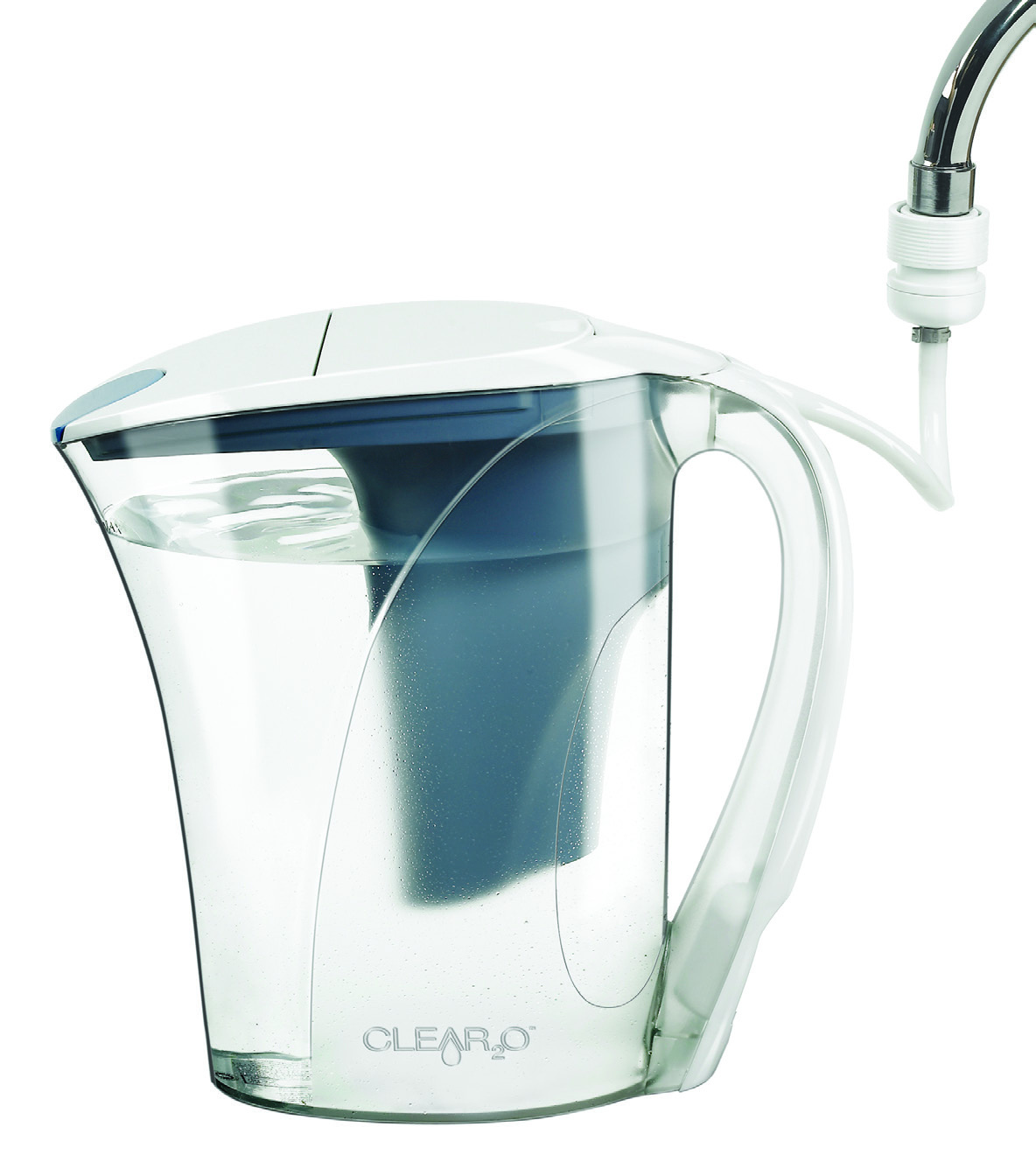
CWS100AW is the exact model label on Clear2O’s 2015 water-pitcher catalog page. It belongs to the older CWS100 family, but the suffix matters: this assessment is for the pictured AW configuration, not a claim that every CWS100A, CWS100A2, CWS100B or CWS100B2 body or package is identical. The all-models use-and-care manual lists those separate codes and describes a quick-connect hose that uses faucet pressure to move water through a replaceable cartridge and into a serving pitcher. This is not the later GRP200 gravity reservoir.
The catalog calls the vessel 1.75 liters and also says it holds nine 8-ounce glasses. Those statements do not agree: nine 8-ounce glasses equal 72 fluid ounces, while 1.75 liters is less. The manual’s common parts list separately labels the pitcher as 72 ounces. Because the exact volume descriptions conflict, a nine-glass or exact-liter requirement should not be treated as settled. If you already own one, use the fill line and markings on your own unit rather than planning a serving count from the brochure.
Use the older cartridge record, not a nearby replacement claim
The all-models manual identifies the original CWS100 cartridge family, including CWF101 single filters and CWF103 multipacks; its technical table also lists the later legacy CWF1014, CWF1034 and CWF1016 packages for CWS100AW. Clear2O’s 2015 catalog says one filter is included but does not name that included cartridge code. A current CWF503 three-pack page lists CWS100AW as compatible. That is useful replacement-fit information, but it is not a performance crosswalk from the older cartridges in the manual’s test record to CWF503. Check the cartridge label and the current filter documentation before relying on an old test result for a replacement part.
The older manual and catalog rate the filter at 50 gallons. The performance sheet warns that actual performance can vary with local water conditions. The catalog describes the TrueLife indicator as a way to monitor filter changes, but its AW material does not publish the later CWS100 manual’s color-by-gallon thresholds. Keep the model generations separate rather than transferring a familiar indicator schedule or a broad “number of contaminants” phrase from another version.
There is a specific older test record
Unlike the later CWS100 support sheet, the archived all-models manual contains a performance data sheet that explicitly names CWS100A, CWS100A2, CWS100AW, CWS100B and CWS100B2 and identifies the legacy replacement cartridges covered. The sheet states that the system was tested and certified by NSF International against NSF/ANSI 42 and 53 for the reductions it lists. Its table reports, among other entries, lead results at pH 6.5 and 8.5 and a Cryptosporidium cyst result under its stated laboratory conditions. Those are the maker’s documented results for that named system/cartridge record; they do not tell you what is in your tap water, guarantee the same result at home, or establish equivalent testing for a newer compatible cartridge. The manual also lists 34–85°F water and 20–100 psi supply parameters.
The cyst row is not permission to use this pitcher as a disinfection device. The manual says to use potable source water and warns against unknown or microbiologically unsafe water without adequate prior disinfection. A specific test result should be compared with your water report and the exact current cartridge record if lead or another contaminant is essential.
Faucet and upkeep are the tradeoffs
This arrangement needs a compatible threaded faucet connection and hose. The manual shows removal of the faucet aerator and lists a connector with adapters; it also cautions that some pull-out sprayer faucets may not accept the fitting. A fixed faucet with a removable aerator is the more plausible setup, but check the actual thread before counting on it. The system uses cold water only. A fast fill is convenient when the hose fits; it is less flexible than a pitcher you can carry to any tap.
Before the first use, the manual calls for hand-washing the pitcher, lid and filter reservoir, and the 2015 catalog says a filter is included. The family manual instructs users to discard three pitcher fills after a filter change. Do not put the parts in a dishwasher. For an older or secondhand unit, inspect the hose, connector, seal, reservoir and model label, then follow the instructions supplied for the exact piece in hand.
An owner reference, not a current shopping pick
The current Clear2O pitcher collection and all-products feed checked for this review list the GRP200 pitcher but not a CWS100AW body. The CWF503 replacement listing remains online, but a compatible replacement cartridge is not proof that the pitcher body is currently sold or that a warranty applies. This page is useful for identifying a CWS100AW already in a cupboard; it does not establish a recall, prove that every retailer has stopped selling old stock, or offer a current buying link.
For a current Clear2O system, compare the GRP200 review: it is a separate six-glass gravity pitcher using GRF201/GRF203 filters, not a replacement body for this faucet-connected system. If faucet-pressure filling is essential, verify a presently supported model and its exact performance documentation before choosing another system.
CWS100 all-models manual and performance sheet · Clear2O 2015 catalog · CWF503 replacement page
Key details at a glance
| Included filter | Clear2o cws100 cwf500 |
|---|---|
| Stated filter capacity | 50 gal |
| Lead result in exact-filter test data | Yes |
| What the filter is documented to reduce | For CWS100AW with the listed older cartridge family, the PDS states NSF International testing/certification against the listed reductions under NSF/ANSI 42 and 53. It reports >99.3% lead at pH 6.5 and 8.5 and >99.99% cyst reduction based on Cryptosporidium parvum. These results apply to the stated system and test conditions; no corresponding CWF503 performance crosswalk was located. |
| Use and care | Cold potable municipal-treated or private-well water only, within the manual’s 34–85°F and 20–100 psi supply parameters. Do not use microbiologically unsafe or unknown-quality input without adequate prior disinfection. A pull-out sprayer may not accept the connector. |
| Separate TDS meter included | No |
| Dispense while reservoir filters | No |
| Microbial test result in exact filter data sheet | Yes |
| Button-controlled electric dispensing | No |
| Stainless-steel body | No |
| Glass water reservoir | No |
| Powered filtration | No |
Use the exact model’s instructions for operating limits, supplied equipment and version differences.
Sources for this assessment
Check the exact filter setup before you shop.
Capacity, filter type and the written reduction claims belong to the pitcher-and-cartridge combination, not just the pitcher shape.