
Your needs, this model
Does it fit your priorities?
Do you want a pitcher that fills from faucet pressure instead of a gravity reservoir?
The CWS100 manual documents a faucet-connected hose-and-filter routine; it is not the current gravity-fed GRP200 and is retained as an owner reference rather than a purchase candidate.
Explore this need in the finder →Is a nine-glass vessel essential if current offers may not include the CWS100 body?
The FAQ describes nine 8-ounce glasses, but the code is reference-only because the current official pitcher surfaces show no CWS100 body offer. Do not read filter compatibility as availability.
Explore this need in the finder →Does an exact lead-reduction result matter more than broad marketing language?
The old CWF500-series sheet marks a PASSED column but gives no numerical lead-reduction percentage or named formal certification. This reference is not a positive lead-test match.
Explore this need in the finder →A pitcher that connects to the faucet
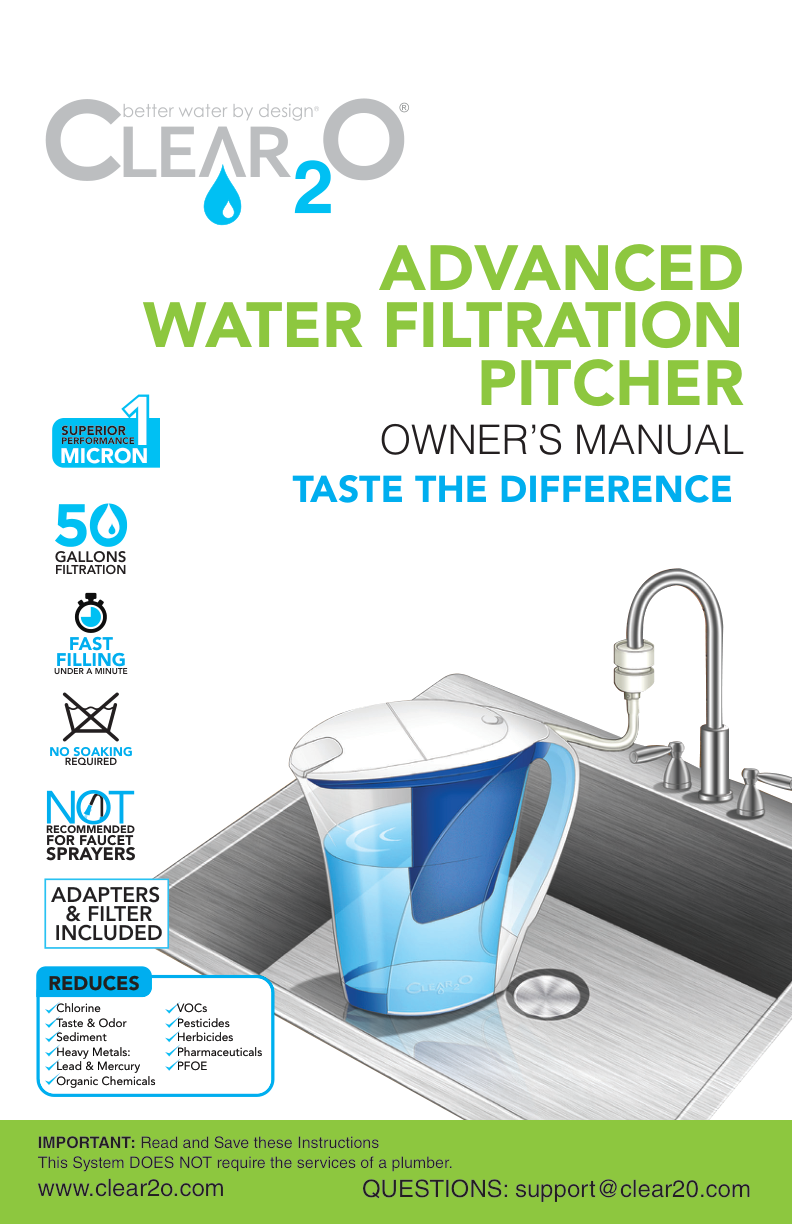
CWS100 is an older CLEAR2O Advanced Water Filtration Pitcher documented in an owner’s manual dated 2018. It is not the gravity-fed GRP200. A quick-connect hose joins the pitcher to a compatible faucet, and tap pressure pushes water through its cartridge. The manufacturer’s FAQ says the CWS100 holds nine 8-ounce glasses and fills in under a minute; treat both as maker statements, not independent measurement. The real distinction is the connection: this pitcher depends on a threaded faucet adapter and cannot simply be carried to a sink and refilled through a top opening like the current GRP200.
The manual says the system does not require plumbing services, but it still needs a compatible faucet adapter. It specifically warns that a pull-out style sprayer may not accept the required connection. A fixed faucet with the right removable aerator is the more plausible setup; check thread fit before planning to use one. The manual cover’s illustration shows the hose, adapter and pitcher together, but that drawing is not a photograph and does not verify the exact finish of any used unit.
Keep the CWF500 cartridge family separate
The CWS100 manual identifies a one-micron solid carbon-block filter and says this pitcher uses genuine Clear2O CWF500-series replacements. The FAQ recommends CWF501 as a single and CWF503 as a three-pack. The current CWF503 page lists compatibility with CWS100 plus CWS100AW, CWS100A, CWS100B and CWS100B2. That is a replacement-filter compatibility list only. It does not establish the body construction, package contents, finish, revision or exact manual for each letter-suffix code, so this review is specifically about the CWS100 model named in the manual.
The maker rates the CWS100 filter at 50 gallons. Its FAQ describes that as about two months for routine use, while the manual warns actual filtration can vary with sediment and other source-water conditions. The light is green through 40 gallons, yellow for another 10, then red at the replacement point. If flow slows earlier, the manual says to replace the cartridge sooner. These are not the GRP200’s GRF201/GRF203 cartridges or 60-gallon indicator; the shared brand name does not make the filter families interchangeable.
Read performance claims conservatively
Clear2O’s manual describes the CWS100’s one-micron solid-carbon-block design and promotes broad contaminant reduction. Its linked CWF500-series performance sheet is family-level rather than a table tied to each exact body code. The sheet uses a “PASSED” column, but it does not provide numerical percentages for individual rows. I therefore do not turn its marks into a quantified reduction claim or formal certification, and I do not treat general copy about a large number of contaminants as proof of a specific result for your tap water. If lead or another contaminant is a must-have, ask for the exact CWS100-era test record and conditions, and compare it with a current filter whose exact system sheet answers your question. The records reviewed here do not establish a bacteria, virus or cyst result.
This setup is for cold potable municipal-treated or private-well water only. The manual warns against microbiologically unsafe or unknown-quality water without adequate disinfection. Before using a stored unit, inspect the hose, connector, pitcher and filter chamber, identify the cartridge code, and follow the exact leaflet. The maker’s instructions say to discard the first three pitcher fills after installing a replacement filter to flush the system and remove initial air and carbon particles.
Setup and care are the practical tradeoffs
Faucet pressure can make the fill feel quick, but the connection is more involved than gravity filling. The hose must be attached without damaging the quick-connect, and the faucet has to be turned to cold. The first-use purge consumes three pitcher fills that should not be drunk. The pitcher and lid are hand washed with mild detergent; the manual says not to use the dishwasher. When done, the hose can be stored in the handle compartment. Check the seal and connector before each use, especially on a unit bought used or stored for a long period.
If you already own a CWS100, this page helps identify its replacement family and its faucet-dependent routine. The current Clear2O pitcher collection instead lists GRP200, a 48-ounce gravity model with a different cartridge. I did not find a current CWS100 body listing in the manufacturer’s current collection or all-products feed, even though support and replacement material remain online. That absence does not prove a recall or that no dealer has stock; it is why this exact review is classified as a model reference and has no buying link. For a current Clear2O purchase, start with the GRP200 review. If the faucet connection is essential, verify a presently supported model directly with the manufacturer rather than treating an old manual as proof of current availability.
CWS100 owner manual · CWF503 replacement page · CLEAR2O FAQ
Key details at a glance
| Listed pitcher capacity | 9 cups |
|---|---|
| Included filter | Clear2o cws100 cwf500 |
| Stated filter capacity | 50 gal |
| What the filter is documented to reduce | CLEAR2O describes the one-micron solid carbon-block media and says it has been tested on many contaminants. The linked CWF500-family sheet uses a PASSED column and provides no numerical percentage. These sources do not establish a specific result for every named contaminant, standard certification, or a microbial-safety claim. |
| Use and care | Use only with cold potable municipally treated or private-well water. Do not use untreated, microbiologically unsafe or unknown-quality sources without adequate disinfection. A pull-out sprayer faucet may not accept the adapter; confirm your exact faucet thread before considering a serviceable unit. |
| Separate TDS meter included | No |
| Dispense while reservoir filters | No |
| Button-controlled electric dispensing | No |
| Stainless-steel body | No |
| Glass water reservoir | No |
| Powered filtration | No |
Use the exact model’s instructions for operating limits, supplied equipment and version differences.
Sources for this assessment

Check the exact filter setup before you shop.
Capacity, filter type and the written reduction claims belong to the pitcher-and-cartridge combination, not just the pitcher shape.