
On this page
Your needs, this model
Does it fit your priorities?
Do you need a verified ten-cup filtered batch rather than a marketing capacity label?
No. The product page title says one gallon but the manual describes an approximately half-gallon upper reservoir and neither source specifies filtered output from one load. Ten-cup ready-to-pour capacity is unknown.
Explore this need in the finder →Is a documented lead-reduction result essential?
The reviewed first-party page names NSF/ANSI 42 testing and taste/odor/particle targets but gives no exact lead test result. Treat lead reduction as unknown, not a positive.
Explore this need in the finder →Would exact-model microbial-reduction evidence matter when using already-potable water?
It should matter if microbial reduction is essential. For this reference, the reviewed current product page provides no exact-filter pathogen results, while its older manual's broad pathogen language is not tied to a matching performance report. The documented operating plan is for already-potable cold tap water only; this pitcher is not shown to make unknown-source water safe.
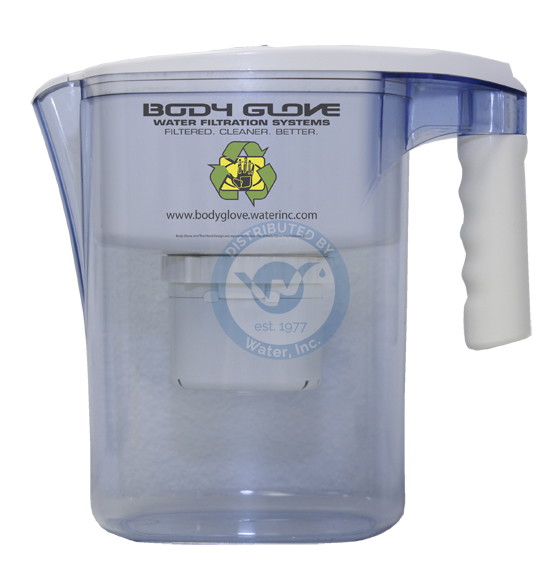
Explore this need in the finder →The Body Glove Portable Water Filter Pitcher is an unusual large, manual pitcher: its filter pack is flushed at a faucet before use, rather than simply rinsed and dropped into a hopper. Water, Inc.’s dedicated Body Glove page still describes the product and directs shoppers to a dealer locator for availability. The company’s separate installation/manuals page lists the W-961 Rev. 6-09 pitcher instructions, but I could not confirm a current exact-body offer. This is therefore an owner/reference assessment, not a new-purchase recommendation.
Read the capacity claims cautiously
The product page calls it a “1 gallon” pitcher and lists outside dimensions of 5.5 inches wide, 10.5 inches high and 11.5 inches deep. But the instructions say the upper reservoir holds about one-half gallon, then refer to the assembled pitcher’s total filtered output separately. The page does not say how much filtered water is ready after one reservoir load, and it also uses both “up to 150 gallons” and “150 refills” wording for the filter. Those are not interchangeable units. If a one-gallon ready-to-pour batch, a precise refill yield or a refrigerator-door fit is essential, verify it against the exact unit in hand instead of treating the title as a capacity measurement.
The dimensions suggest this is a countertop or shelf pitcher, not a slim door-pocket design. Measure the actual storage space, including clearance to lift the lid and remove the reservoir. Its large shell could suit someone who wants to keep a bigger supply close by, but the manual does not publish a settled filtered-chamber volume to compare directly with ordinary cup-rated pitchers.
The setup is more involved than a quick rinse
The 2009 instruction sheet says to hand-wash the pitcher, lid and reservoir with mild detergent before the first use; do not put those parts in a dishwasher and do not wash the filter pack. Before filtering, attach the pack’s rubber-bulb flushing assembly to a faucet and run a light flow of water through the cartridge for two minutes. Do not use hot water: the manual warns that heat can soften the bulb and let it detach. After flushing, remove that assembly, put the gasket in place, screw the filter pack onto the reservoir and tighten it firmly without overtightening.
That routine is a real tradeoff. It gives the pitcher a removable filter pack and a separate flushing accessory, but it is less convenient if you cannot connect the bulb to your faucet or prefer a cartridge that is ready after a brief rinse. Keep the flushing pieces if you own one. For storage lasting 90 days or more, the 2009 manual says to flush the pack using one tablespoon of chlorinated bleach in about one-half gallon of water, then remove the reservoir/filter-pack assembly, dry it on a paper towel and reassemble it for storage. Because the manual does not identify a body revision or explain recommissioning after storage, check with Water, Inc. before reusing a long-stored unit rather than improvising beyond those instructions. The manual says to replace the pack after about six months depending on use and water quality, and sooner if taste changes or flow becomes restricted. Its 150-gallon statement is a maker’s upper capacity claim, not a promise that every household will reach it.
Do not read the broadest claims as a test report
The current Body Glove product page says the pitcher filter was tested to NSF/ANSI 42 and lists taste, odor, cloudiness, chlorine, sand and sediment. It does not provide a model-specific performance sheet, a list of exact challenge results, or an independent certification record on the page I reviewed. The older instruction sheet uses much broader promotional language about pathogens and chemicals, but it does not supply test conditions or a corresponding detailed table. I would not use those statements to conclude that this pitcher makes unsafe source water safe or meets a specific health-contaminant requirement.
For an essential lead, PFAS, fluoride or microbial reduction need, use an exact pitcher-and-filter performance document that names the reduction, capacity and test conditions. The Body Glove materials reviewed here do not establish those results for the filter pack. The manufacturer also describes camping and boating use, but those settings do not change the evidence gap: treat it as a filter for already-potable water, not a disinfection device.
Who should keep the manual nearby?
This reference is most useful to someone who already owns the Body Glove body and needs to identify the filter-pack routine, dimensional envelope or replacement procedure. The manufacturer says its newer replacement pack contains a dual-filter set and housing that fits the current pitcher shell, but it gives no exact part code or cross-generation compatibility list on the page. Check the body and replacement packaging before ordering; the information here cannot determine whether every older pack and shell interchange.
If you are shopping for a current household pitcher instead, compare a current model with an exact cup rating, an available replacement-filter code and a detailed performance document. For example, the Brita Tahoe with Elite filter review covers a current 10-cup configuration and its separate filter route. Neither that alternative nor the Body Glove is a substitute for checking the contaminant that matters in your water. The Body Glove has a distinctive flush-first routine and a large-format shell, but its exact filtered batch size, current availability and health-effect performance remain unconfirmed from the manufacturer material reviewed here.
Key details at a glance
| Included filter | Body glove ionic adsorption micro-filtration (manufacturer wording) |
|---|---|
| Stated filter capacity | 150 gal |
| Typical replacement interval | 6 months |
| Height | 10.5 in |
| Width | 5.5 in |
| Length | 11.5 in |
More specifications and setup details
| Reusable filter shell | No |
|---|---|
| Made without BPA | Yes |
| What the filter is documented to reduce | The Body Glove product page lists taste, odor, cloudiness, chlorine, sand and sediment as maker-stated reduction targets and says testing was to NSF/ANSI 42. It supplies no exact contaminant performance table or test conditions. The 2009 manual makes broader claims about pathogens and chemicals but does not provide a matching test report; those claims are not used to satisfy essential reduction needs. |
| Use and care | Treat only already-potable water. The reviewed materials do not establish treatment of unsafe/unknown-source water, despite the older manual’s broad promotional wording about pathogens. |
| Separate TDS meter included | No |
| Dispense while reservoir filters | No |
| Manufacturer dimensions as listed | 5.5 in wide x 10.5 in high x 11.5 in deep, per the exact manufacturer product page. |
| Pitcher material | Manufacturer calls it BPA-free and FDA food-grade; exact resin is not stated. |
| Button-controlled electric dispensing | No |
| Stainless-steel body | No |
| Glass water reservoir | No |
Use the exact model’s instructions for operating limits, supplied equipment and version differences.
Sources for this assessment
- Body Glove 1 gallon Portable Water Filter Pitcher
- Body Glove Water Filtration Pitcher Features, Use and Care Instructions, W-961 Rev. 6-09
- Manufacturer product page image: Body Glove portable water filter pitcher
- Manufacturer product page image: Body Glove pitcher replacement pack
- Water, Inc. installation instructions and manuals page


Check the exact filter setup before you shop.
Capacity, filter type and the written reduction claims belong to the pitcher-and-cartridge combination, not just the pitcher shape.