
Your needs, this model
Does it fit your priorities?
Do you want powered filtration into a removable glass pitcher that you lift and pour, rather than gravity or button dispensing?
AquaTru lists a powered RO cycle that fills a removable 64-ounce glass carafe; this exact package includes 10AT100VFA01 and serves by pouring. Capacity is not an immediate output from the feed tank.
Explore this need in the finder →Is this exact AquaTru Carafe Alkaline Mineral Boost finishing-filter route the one you want?
The exact variant SKU is 90AT100ATA01, and its final-filter code is 10AT100VFA01; the other final-filter route is a separate product option.
Explore this need in the finder →Would you choose the non-Smart, non-app Carafe setup?
This SKU is the non-Smart Carafe; its physical filter indicators are separate from the Smart model app feature.
Explore this need in the finder →The Carafe with a mineral-boost finishing filter
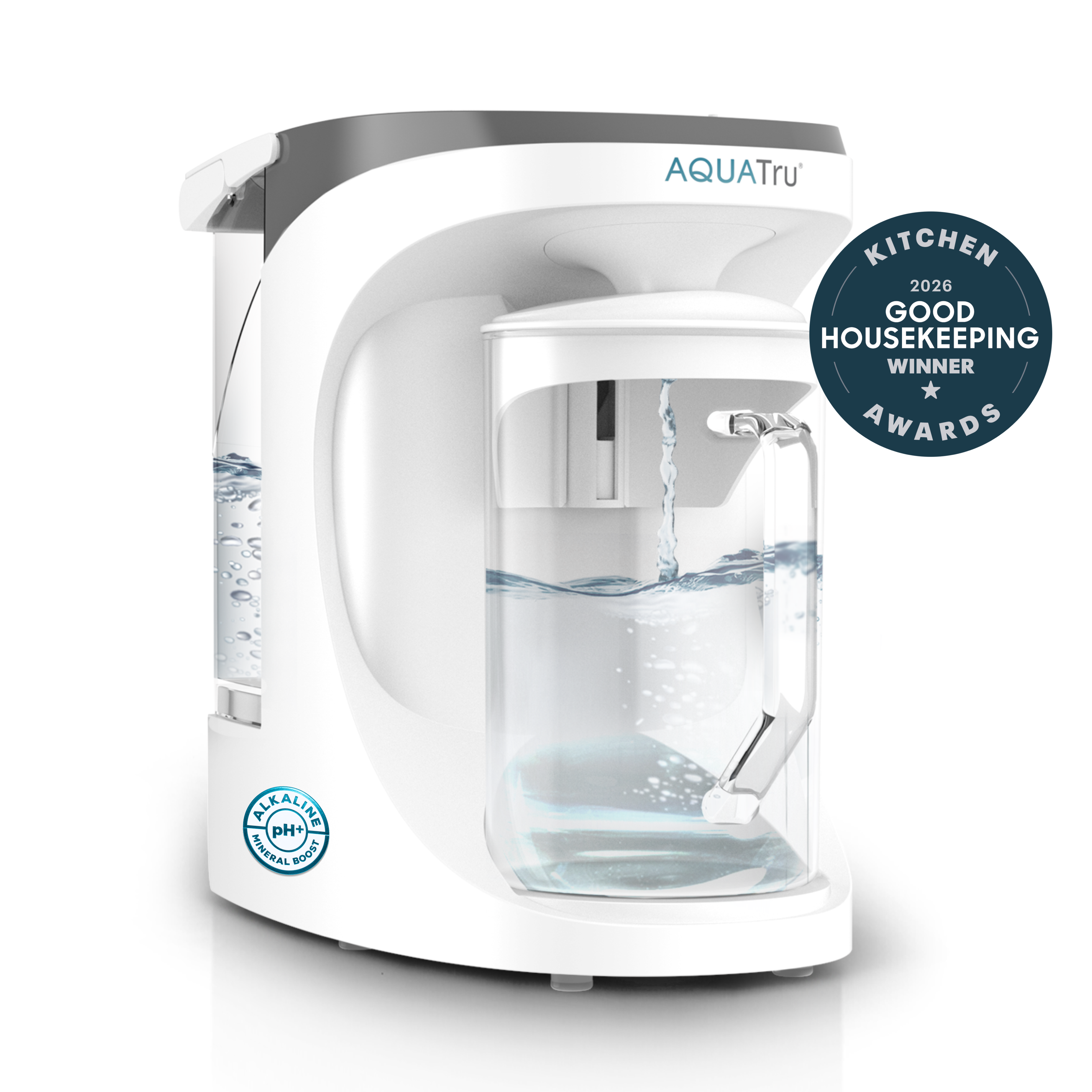
SKU 90AT100ATA01 is the AquaTru Carafe package with the Alkaline Mineral Boost VOC Filter. The most important choice is still the appliance format: the machine uses power for a reverse-osmosis filtering cycle, but the clean water collects in a removable 64-ounce glass carafe that you pour yourself. It is not a button dispenser, and it is not a passive gravity pitcher. If the main reason you are shopping is to avoid plugging in and tending a tap-water tank, a conventional pour-through pitcher will be simpler. If you want a small, separate reservoir of filtered water to carry or refrigerate, this powered-pour design is worth comparing.
The page lists a 2.5-liter feed tank, a 1.9-liter clean-water tank, 120-volt power and an appliance footprint of 7.5 by 14 by 13 inches. The 64-ounce carafe holds eight ordinary eight-ounce servings as a unit conversion, but it does not produce eight cups at the instant raw water is poured into the separate feed tank. You wait for the filtration cycle, and the manufacturer does not publish a single guaranteed household cycle time. Allow space to lift out both tanks and empty the used water rather than placing the unit in a tight spot just because the purifier itself looks compact in its product image.
What changes, and what does not
The box and Carafe performance sheet distinguish a standard VOC Carbon finishing filter (10AT100VF01) from this Alkaline Mineral Boost VOC filter (10AT100VFA01). AquaTru describes the boost as adding calcium and magnesium after the RO stage. That is a manufacturer-described mineral and taste feature; it is not evidence of a medical benefit or a reason to infer a different health outcome. If you do not care about the mineralized finish, the standard VOC Carafe package is the more direct route. If you prefer the maker's post-RO mineral feature, this exact SKU documents that option.
The PDS names the AT100–AT140 system family but does not map retail SKU 90AT100ATA01 one-to-one to a system code. Its mineral-boost cartridge is identified, but the contaminant table remains family-level; get an exact SKU-and-cartridge performance record if a named reduction is essential.
The common Carafe sheet lists its AT100–AT140 product family and performance claims for NSF/ANSI 42, 53, 58 and 401, plus NSF/ANSI 372 lead-free construction. It includes both the regular VOC and mineral-boost replacement filter part numbers. Its named tables include lead, fluoride, PFOA/PFOS, cysts, chlorine, chloramine and TDS, among other substances. A claim belongs to the conditions and filter configuration documented in the sheet; it does not mean every possible contaminant is removed. AquaTru's manual is explicit that the appliance is for cold municipal or otherwise known microbiologically safe water. Cyst results in a performance table are not a reason to put unsafe or unknown water through a countertop RO appliance.
Replacement and cleaning are part of the purchase
The three internal cartridges have different service intervals: pre/carbon, 300 gallons or six months; reverse osmosis, 600 gallons or 24 months; and the mineral-boost VOC cartridge, 300 gallons or 12 months. They are separate maximums, not one promise that the whole unit goes a year without attention. Usage and source water can change timing. When the unit asks for a tank refill, dump the concentrated remainder from the feed tank before refilling; failure to do so can damage the system and void the warranty. Wash the carafe and tanks weekly by hand, keep them away from sunlight and hot surfaces, and watch for scaling. The product data sheet sets a maximum hardness of 10 gpg unless water is softened before it enters the unit.
The practical tradeoff is clear: this version spends more counter space and adds electrical and waste-water chores to get RO filtration into a pourable, removable vessel. It does not give you instantaneous water at a faucet, and the added mineral filter does not shorten those chores. Carafe Smart models add the manufacturer's app and Wi-Fi onboarding; they are separate SKUs, not a software toggle on this non-Smart package. Compare those models only if you actually want connected filter-life and usage tracking.
The image is the manufacturer's studio rendering of the exact alkaline option. Its Alkaline Mineral Boost seal and award badge are visible in the composite; neither graphic is an independent filtration test. References: AquaTru Carafe product page, Carafe performance sheet, and Carafe owner's manual.
Key details at a glance
| Listed pitcher capacity | 8 cups |
|---|---|
| Listed tank capacity | 1.9 L |
| Included filter | AquaTru Carafe Alkaline Mineral Boost VOC final filter |
| Stated filter capacity | 300 gal |
| Typical replacement interval | 6 months |
| Height | 13 in |
| Width | 7.5 in |
| Length | 14 in |
| Empty weight | 9 lb |
| Reusable filter shell | No |
| What the filter is documented to reduce | The Carafe family PDS lists specific reductions under NSF/ANSI 42, 53, 58 and 401, including named results for lead, fluoride, PFOA/PFOS, cysts, free chlorine/chloramine, TDS and microplastics. Tables specify laboratory challenge conditions; actual performance varies. |
| Use and care | Cold water only (PDS 39–100°F); municipal or otherwise known microbiologically safe supply. Max hardness 10 gpg unless softened; max TDS 1500 mg/L; chlorine <2 ppm; pH 3–11; turbidity <=5 NTU. Empty concentrated reject water from feed tank at each refill; hand-wash tanks/carafe weekly; keep out of direct sun/heat. |
| Separate TDS meter included | No |
| Dispense while reservoir filters | No |
| Manufacturer dimensions as listed | 7.5 in W x 14 in D x 13 in H; approximately 9 lb. |
| Pitcher material | Removable glass clean-water carafe and separate tap-water reservoir; exact glass composition and reservoir polymer grade are not specified in sources examined. |
| Button-controlled electric dispensing | No |
| Glass water reservoir | Yes |
| Manufacturer-listed feature note | AquaTru calls Carafe a compact purifier with a removable 64-ounce glass pitcher. Filtration requires the included 120V AC plug; clean water is served by manually pouring the carafe. |
| Clean-water glass carafe | 64 oz |
| Tap-water tank | 2.5 L |
| Powered filtration | Yes |
| Smart app tracking | No |
| Mineral-boost feature | Yes |
Use the exact model’s instructions for operating limits, supplied equipment and version differences.
Sources for this assessment
- AquaTru U.S. Water Purifiers feed, page 1
- AquaTru Carafe exact U.S. product page
- AquaTru Carafe native product record
- AquaTru Carafe performance data sheet 09.25.R5
- AquaTru Carafe owner manual
- AquaTru exact Carafe image for SKU 90AT100ATA01
- Carafe ONLY Pre/Carbon Filter
- Carafe ONLY Reverse Osmosis Filter
- Carafe ONLY Mineral Boost Alkaline VOC Filter
- AquaTru Carafe/Carafe Smart filter replacement instructions
- AquaTru Carafe filters collection

Check the exact filter setup before you shop.
Capacity, filter type and the written reduction claims belong to the pitcher-and-cartridge combination, not just the pitcher shape.