
Your needs, this model
Does it fit your priorities?
Do you want powered filtration into a removable glass pitcher that you lift and pour, rather than gravity or button dispensing?
AquaTru lists a powered RO cycle that fills a removable 64-ounce glass carafe; this exact package includes 10AT100VF01 and serves by pouring. Capacity is not an immediate output from the feed tank.
Explore this need in the finder →Is this exact AquaTru Carafe VOC Carbon finishing-filter route the one you want?
The exact variant SKU is 90AT100AT01, and its final-filter code is 10AT100VF01; the other final-filter route is a separate product option.
Explore this need in the finder →Would you choose the non-Smart, non-app Carafe setup?
This SKU is the non-Smart Carafe; its physical filter indicators are separate from the Smart model app feature.
Explore this need in the finder →A plug-in purifier that ends with a pourable glass carafe
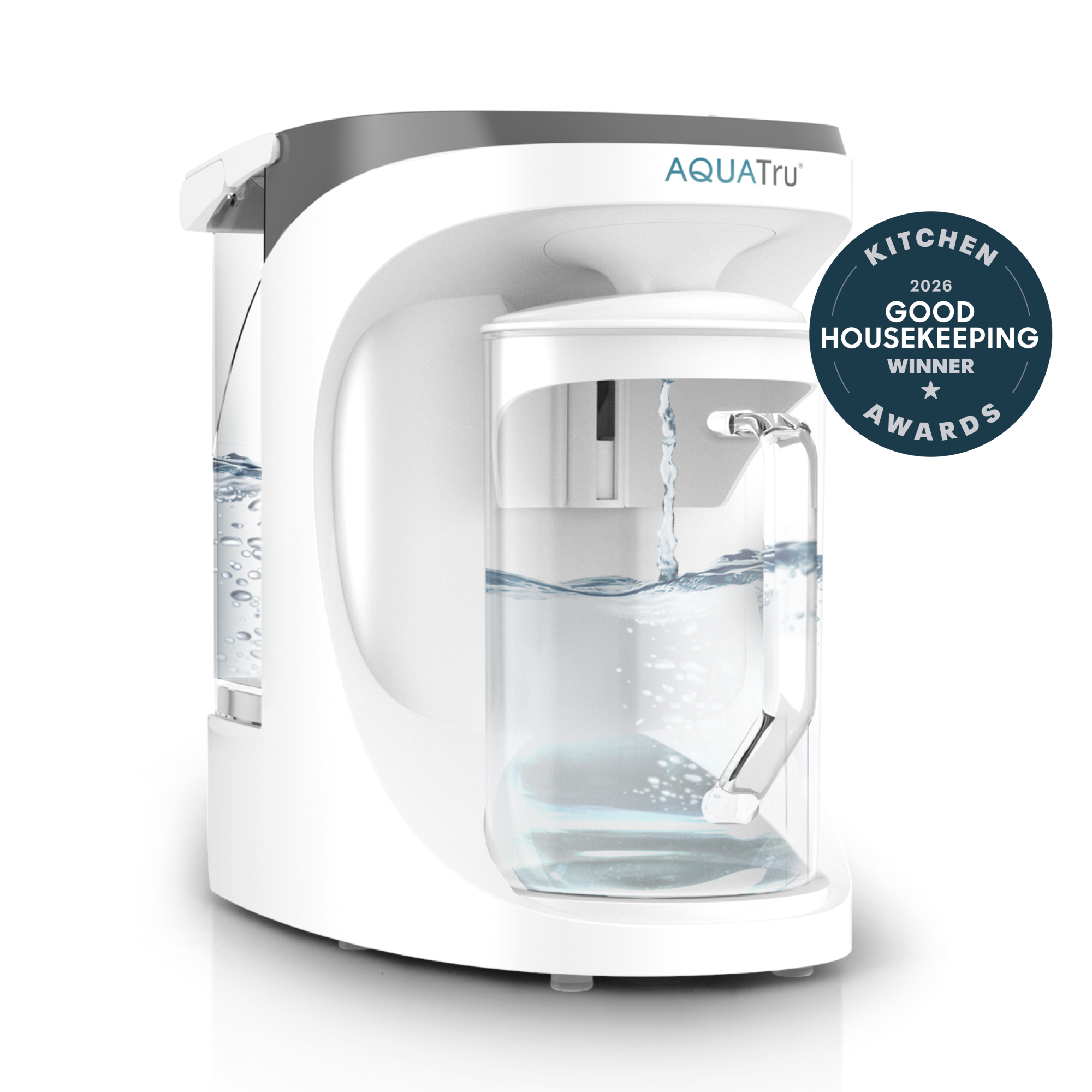
The AquaTru Carafe with the VOC Carbon Filter, SKU 90AT100AT01, sits between a conventional gravity pitcher and a countertop water dispenser. It is a four-stage reverse-osmosis purifier that plugs into a 120-volt outlet, fills its removable glass carafe, and then asks you to lift and pour. There is no button that dispenses a glass directly from the appliance. That distinction matters: choose this version if you want a small batch of treated water to carry to the table or chill in the refrigerator, not if you want a passive filter or an outlet nozzle.
AquaTru lists a 64-ounce glass carafe and a separate 2.5-liter tap-water tank. The 64 ounces are the clean-water vessel, not the volume ready immediately when you fill the raw-water tank. In the finder, eight cups is a conversion of the maker's 64-ounce listing using eight-ounce cups; the specification to measure at home remains 64 ounces. The maker lists the case at 7.5 inches wide, 14 inches deep and 13 inches high, about nine pounds empty. Check room for the tank to lift out, a wall outlet and access to discard the reject water before deciding the footprint will work.
What the three cartridges are intended to do
This is not just a pitcher with a carbon cartridge. The first cartridge combines the pre-filter and carbon stages, the middle cartridge is the reverse-osmosis membrane, and the third is the VOC Carbon finishing filter. AquaTru's Carafe performance sheet lists a system family (AT100 through AT140) and reduction results under NSF/ANSI 42, 53, 58 and 401, along with lead-free construction under 372. Its tables name results including chlorine and chloramine, lead, fluoride, PFOA/PFOS, cysts, TDS and microplastics. Those are laboratory results under the listed challenge conditions, not a guarantee for every tap supply or for every substance absent from the tables. The instructions also limit the product to cold tap water that is already municipally treated or otherwise known to be microbiologically safe. Do not use a reduction table as permission to treat untreated well water or an unknown source.
The PDS names the AT100–AT140 system family but does not map the retail SKU 90AT100AT01 to one of those system codes. I keep the listed family tests as context; for an essential contaminant-specific choice, ask AquaTru for current documentation explicitly covering this exact SKU and its VOC cartridge before treating a reduction as confirmed.
The VOC route's exact replacement filter is 10AT100VF01. The performance sheet lists the pre/carbon cartridge 10AT100SF01 at 300 gallons or six months, the RO cartridge 10AT100RF01 at 600 gallons or 24 months, and the VOC filter at 300 gallons or 12 months, whichever limit arrives first for each part. The appliance's filter indicators help, but the whole system does not have one universal change interval. Replacement shopping should use the Carafe filter codes rather than the superficially similar AquaTru Classic or Under Sink filters.
The everyday routine is more involved than filling a pitcher
Fill the tap tank with cold water and let the machine run until the clean-water carafe is full. When the refill indicator appears, the leftover water in the tap tank is concentrated reject water; the manual says to empty it before adding fresh water. Leaving it behind can damage the unit and void the warranty. You then remove the full carafe to serve. AquaTru recommends washing the carafe and tanks weekly by hand, keeping the purifier out of direct sunlight and away from hot surfaces, and addressing scaling rather than waiting for a slow membrane cycle. Hardness above 10 grains per gallon is outside the maker's recommended use unless the water is softened first. This is regular kitchen maintenance, not the near-zero-work routine of a disposable gravity cartridge.
Who is it for? A smaller household that wants a removable, lidded glass reservoir and is comfortable with electricity, a set of three replacement elements and a waste-water step. A high-volume household may prefer a larger storage route, while a renter wanting simplicity may be happier with a non-powered pour-through model. AquaTru Carafe Smart adds app monitoring and setup needs; the alkaline variant changes the last filter. Those are real purchase branches, not alternate finishes.
The image is AquaTru's studio product rendering for this SKU. It includes a promotional awards badge; that graphic is part of the supplied artwork, not evidence used in this review. Manufacturer references: AquaTru Carafe product page, Carafe performance data sheet, and Carafe owner's manual.
Key details at a glance
| Listed pitcher capacity | 8 cups |
|---|---|
| Listed tank capacity | 1.9 L |
| Included filter | AquaTru Carafe VOC Carbon final filter |
| Stated filter capacity | 300 gal |
| Typical replacement interval | 6 months |
| Height | 13 in |
| Width | 7.5 in |
| Length | 14 in |
| Empty weight | 9 lb |
| Reusable filter shell | No |
| What the filter is documented to reduce | The Carafe family PDS lists specific reductions under NSF/ANSI 42, 53, 58 and 401, including named results for lead, fluoride, PFOA/PFOS, cysts, free chlorine/chloramine, TDS and microplastics. Tables specify laboratory challenge conditions; actual performance varies. |
| Use and care | Cold water only (PDS 39–100°F); municipal or otherwise known microbiologically safe supply. Max hardness 10 gpg unless softened; max TDS 1500 mg/L; chlorine <2 ppm; pH 3–11; turbidity <=5 NTU. Empty concentrated reject water from feed tank at each refill; hand-wash tanks/carafe weekly; keep out of direct sun/heat. |
| Separate TDS meter included | No |
| Dispense while reservoir filters | No |
| Manufacturer dimensions as listed | 7.5 in W x 14 in D x 13 in H; approximately 9 lb. |
| Pitcher material | Removable glass clean-water carafe and separate tap-water reservoir; exact glass composition and reservoir polymer grade are not specified in sources examined. |
| Button-controlled electric dispensing | No |
| Glass water reservoir | Yes |
| Manufacturer-listed feature note | AquaTru calls Carafe a compact purifier with a removable 64-ounce glass pitcher. Filtration requires the included 120V AC plug; clean water is served by manually pouring the carafe. |
| Clean-water glass carafe | 64 oz |
| Tap-water tank | 2.5 L |
| Powered filtration | Yes |
| Smart app tracking | No |
| Mineral-boost feature | No |
Use the exact model’s instructions for operating limits, supplied equipment and version differences.
Sources for this assessment
- AquaTru U.S. Water Purifiers feed, page 1
- AquaTru Carafe exact U.S. product page
- AquaTru Carafe native product record
- AquaTru Carafe performance data sheet 09.25.R5
- AquaTru Carafe owner manual
- AquaTru exact Carafe image for SKU 90AT100AT01
- Carafe ONLY Pre/Carbon Filter
- Carafe ONLY Reverse Osmosis Filter
- Carafe ONLY VOC Carbon Filter
- AquaTru Carafe/Carafe Smart filter replacement instructions
- AquaTru Carafe filters collection

Check the exact filter setup before you shop.
Capacity, filter type and the written reduction claims belong to the pitcher-and-cartridge combination, not just the pitcher shape.