
Your needs, this model
Does it fit your priorities?
Would an eight-cup vessel be the right size, even if current alternatives use a different dispensing routine?
The older PWFS pitcher is an 8-cup vessel; size alone does not establish availability or replacement compatibility.
Explore this need in the finder →Do you need the PWFS replacement family identified for an existing unit?
The older pitcher codes AQ-PWFS-P-W/P-B pair with the PWFS-R-D/R-R replacement family; the visually similar CWM family has a different cartridge code.
Explore this need in the finder →Is an exact lead and cyst test record important, with the manual’s water-safety limits respected?
The PWFS PDS lists test results for lead and live cyst reduction, but the manual restricts unsafe or unknown-quality input unless adequate disinfection is provided.
Explore this need in the finder →Are you identifying a PWFS package that includes both a pitcher and a separate dispenser vessel?
The manual groups five combo-kit codes in a contents diagram showing both vessels; exact code-to-finish mapping is not printed, so use the actual package label.
Explore this need in the finder →A powered pitcher with its own exact model family
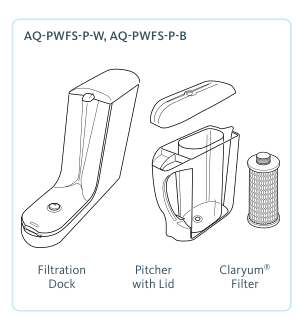
The Aquasana Powered Water Filtration System pitcher is identified by the older AQ-PWFS-P-W (white) and AQ-PWFS-P-B (black) labels. Aquasana’s PWFS manual and performance data sheet list those exact pitcher-only models. They are related in appearance and filtration approach to the later Clean Water Machine, but the model prefix is different and so is the replacement cartridge. Keep the name and label together when comparing parts: AQ-PWFS uses AQ-PWFS-R-D/R-R; the later AQ-CWM uses AQ-CWM-R-D/R-R; the current CWM2 family has its own AQ-CWM2-R code.
This is a reference for identifying an older machine, not a verified current purchase. Aquasana’s current counter-top directory shows its AQ-CWM2-B model as a powered dispenser, and its broad page’s pitcher link resolves to that tank-and-outlet model. The exact P-W/P-B codes remain useful when maintaining a system already in a kitchen, but they should not be inferred from the generic “Clean Water Machine” wording on a listing.
Filter first, pour second
The PWFS pitcher holds 8 cups, or half a gallon, according to its manual. Its filtering dock runs the pitcher cycle automatically: install the matching cartridge, plug the dock into an outlet, fill the pitcher’s center reservoir with cold water, then seat the lidded pitcher squarely onto the dock. The system begins filtering into the surrounding chamber, and the manual says the initial run may take up to two minutes to start. Let the cycle finish before removing the pitcher. The stand-alone pitcher kit does not have the dispenser’s button outlet; once water is filtered, you pour it from the pitcher.
That arrangement makes the system a middle ground between a passive gravity jug and a dedicated electric dispenser. The pump avoids waiting for a slow gravity drip, while the removable half-gallon vessel can be taken to the table or refrigerator. The complete pitcher system is listed around 11⅝ inches high, 17½ inches long and 4½ inches wide; the pitcher body by itself is about 9⅞ by 11¼ by 4½ inches. Measure your counter for the dock and your fridge for the pitcher body separately.
Refill discipline is part of the design. The manual says the system runs until the center reservoir is empty and warns not to refill it while filtered water remains in the outer chamber; doing so can make the system overflow. New filters require one full pitcher cycle to flush. The red/blue light is only illuminated while the system runs: solid blue indicates optimal performance, solid red indicates 90 percent capacity, and blinking red indicates 100 percent and a need to replace the filter. If the cycle does not start, follow the exact manual’s setup checks rather than substituting another Aquasana filter family.
Capacity, test results and water-quality limits
The PWFS data sheet lists a 320-gallon rated cartridge life and 0.5-gallon-per-minute rated flow, along with a 20–70 psi pressure range and 40–90°F operating temperature. Those are system test specifications, not a guarantee that every kitchen will see a specific time to fill. The sheet names results for lead, chlorine and chloramine, live Cryptosporidium/Giardia cysts, PFOA/PFOS and other listed substances under its stated standards and protocol. It cautions that tests used standard laboratory conditions, that real-world results may vary and that the listed filter does not address every substance that might be in tap water.
The owner guide restricts use to cold water and says not to use the filter on microbiologically unsafe or unknown-quality water without adequate disinfection before or after. The cyst claim applies to disinfected water that may contain filterable cysts. A performance table does not turn this into a purifier for untreated water, and it does not remove the need to check local water information.
How to assess the older kit
For an existing pitcher, the decisive details are the full AQ-PWFS-P-W/P-B label, the 8-cup removable pitcher and the filter code. The PWFS data sheet also lists mixed package codes AQ-PWFS-RB1, AQ-PWFS-RB2, AQ-PWFS-RB1W, AQ-PC and AQ-PC-BK; the manual groups those bundles with a pitcher, separate dispenser, dock and cartridge. Those packages add a second vessel and are not the same as the pitcher-only P-W/P-B kit. The manual does not map every bundle code to a finish, so inspect the parts and exact replacement label rather than assuming a particular color from the suffix.
This reference suits an owner who is comfortable with a plug-in cycle, has counter space for a dock and wants a pitcher to pour after filtering. Choose a current gravity pitcher if you want no power and fewer connected parts; choose a current button dispenser if serving directly into a glass matters more than taking a chilled pitcher to the table. Confirm cartridge compatibility before purchasing any secondhand machine or replacement filter.
Manufacturer documents: Powered Water Filtration System setup and care manual and AQ-PWFS performance data.
Key details at a glance
| Listed pitcher capacity | 8 cups |
|---|---|
| Included filter | Aquasana powered water filtration system pwfs |
| Stated filter capacity | 320 gal |
| Lead result in exact-filter test data | Yes |
| Height | 11.62 in |
| Width | 4.5 in |
| Length | 17.5 in |
| What the filter is documented to reduce | The exact AQ-PWFS-P-W/P-B system family appears on the PWFS Performance Data Sheet with the AQ-PWFS-R-D/R-R replacement filter, 320-gallon rating, 0.5-gpm rated flow, 20–70 psi and 40–90°F conditions. Listed tests include chlorine/chloramine, lead at pH 6.5 and 8.5, live Cryptosporidium/Giardia cysts, and other named substances under the specified standards and protocol. The PDS says performance was tested in standard laboratory conditions, does not cover every possible tap-water contaminant, and may vary in actual use. |
| Manufacturer dimensions as listed | Complete powered pitcher system: 11 5/8 in high × 17 1/2 in long × 4 1/2 in wide. Removable pitcher body: 9 7/8 × 11 1/4 × 4 1/2 in. |
| Microbial test result in exact filter data sheet | Yes |
| Button-controlled electric dispensing | No |
Use the exact model’s instructions for operating limits, supplied equipment and version differences.
Sources for this assessment
Check the exact filter setup before you shop.
Capacity, filter type and the written reduction claims belong to the pitcher-and-cartridge combination, not just the pitcher shape.