
Your needs, this model
Does it fit your priorities?
Would an eight-cup vessel be the right size, even if current alternatives use a different dispensing routine?
The older CWM pitcher is an 8-cup vessel; the category answer is size only and does not make the reference model currently purchasable.
Explore this need in the finder →Do you need the old CWM cartridge family identified before comparing replacement parts?
Check for AQ-CWM-P-W/P-B and use the CWM-R-D/R-R family only when the machine label confirms it; this route is not the PWFS or CWM2 cartridge.
Explore this need in the finder →Do you need a named lead and cyst test record rather than a broad taste claim?
The exact CWM PDS lists lead and live Cryptosporidium/Giardia cyst results, but its input-water safeguards still apply and the assessment does not make this older unit a current recommendation.
Explore this need in the finder →Are you comparing the older pitcher format with Aquasana’s current countertop model?
The old CWM pitcher filters into a removable jug to pour; the current AQ-CWM2-B has a separate tank and dispensing outlet. Confirm the full product and cartridge code rather than relying on the shared Clean Water Machine name.
Explore this need in the finder →The important choice is pitcher versus dispenser
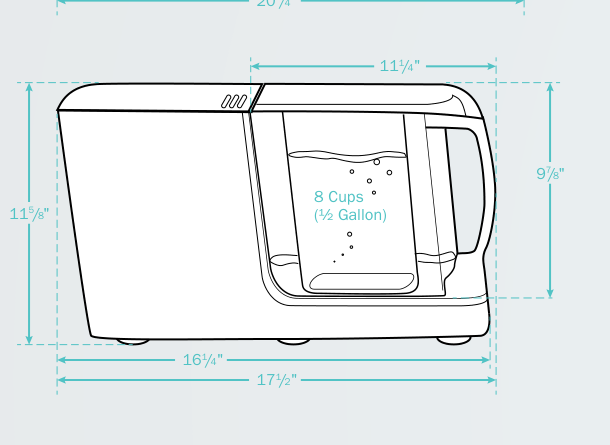
Aquasana’s earlier Clean Water Machine pitcher is an electric countertop filter system with a removable vessel, not the newer Clean Water Machine 2 tank dispenser. The pitcher-only model labels are AQ-CWM-P-W (white) and AQ-CWM-P-B (black). The older model-specific performance sheet lists both codes; its setup manual shows an 8-cup, half-gallon pitcher that sits on a powered filtration dock. The water is filtered into that pitcher, then poured from it. There is no push-button cup outlet on this pitcher-only configuration.
That distinction matters if you are looking at Aquasana’s current pages. A current general information page still describes a fridge-door pitcher variant, but its pitcher link resolves to the current AQ-CWM2-B page. That exact model’s owner manual documents a water tank over a dispensing dock, with button operation, rather than a removable pitcher body. Treat the old P-W/P-B labels as an owner-identification reference unless the exact older model and its replacement parts are verified; the general Clean Water Machine name alone does not confirm a current pitcher offer.
Powered filtering still means waiting for a vessel cycle
For the older CWM pitcher, the daily routine starts with cold tap water in the pitcher’s center reservoir. Set the lidded pitcher onto its dock and the unit runs automatically until the center reservoir empties. The manual describes a short start delay and says the first run can take a couple of minutes to begin. After the cycle, remove the pitcher only when the status light turns off. The dock needs an electrical outlet, so this is not a travel pitcher or a no-power fallback.
The listed 8 cups is the complete vessel capacity, not a promise that 8 filtered cups appear instantly from an empty pitcher. Water first occupies the inner reservoir and then moves to the filtered chamber. Aquasana warns not to refill the center reservoir while filtered water remains in the outer chamber because it can overflow. The body itself is about 9⅞ inches high, 11¼ inches long and 4½ inches wide; with the dock, the listed complete system measures about 11⅝ by 17½ by 4½ inches. Aquasana says the pitcher version fits a refrigerator door, but check your own shelf and door clearance rather than assuming the countertop dock belongs in the fridge.
Use the matching CWM cartridge, not a similar-looking generation
The exact CWM performance table rates the system at 320 gallons and a 0.5-gallon-per-minute service flow, within stated pressure and temperature conditions. The CWM replacement instructions name the AQ-CWM-R-D / AQ-CWM-R-R family, and the current general replacement page gives a 320-gallon or up-to-three-month replacement limit. The CWM manual’s light changes from blue to a red warning at about 80 percent capacity and indicates replacement at 100 percent. Follow the exact filter package and machine label if the status light or parts list differs.
Do not order a cartridge simply because the label says Aquasana or Claryum. The similarly named older AQ-PWFS pitcher uses AQ-PWFS-R-D/R-R, while the current CWM2 uses AQ-CWM2-R. The manuals distinguish these systems and their fittings. A filter that appears close is not proof of compatibility; check the full housing code before buying.
What the test sheet can—and cannot—tell you
The CWM PDS identifies the AQ-CWM-P-W/P-B configuration and includes results for lead at two pH conditions, live Cryptosporidium and Giardia cysts, chlorine, chloramine, PFOA/PFOS and other listed substances under the cited standards and protocol. The sheet describes controlled laboratory testing, says real performance may vary, and warns that it does not cover every contaminant that could be in tap water. Use the exact table for a concern you can identify in your local water report; broad “many contaminants” wording is not a substitute for a named result.
There is also an important safety boundary: Aquasana says not to use this system with microbiologically unsafe or unknown-quality water unless adequate disinfection occurs before or after filtration. Its cyst results apply to disinfected water that may contain filterable cysts. The pitcher is not a disinfection device, and its test data should not be read as making untreated water safe.
Who should look elsewhere
This reference is most useful to someone already comparing an AQ-CWM-P-W/P-B unit, planning its half-gallon pitcher routine and checking the CWM-specific replacement cartridge. If you want an effortless serving button, compare a current dedicated dispenser instead. If you want a simple no-electricity pour-through, compare gravity pitchers. If you need to buy a new Aquasana product, first establish the exact model: the live pitcher link currently lands on a different tank-and-outlet system, so this older exact code should not be treated as an interchangeable current listing.
Manufacturer documents: Clean Water Machine setup and care manual, AQ-CWM performance data and CWM replacement-filter information.
Key details at a glance
| Listed pitcher capacity | 8 cups |
|---|---|
| Included filter | Aquasana clean water machine cwm |
| Stated filter capacity | 320 gal |
| Lead result in exact-filter test data | Yes |
| Height | 11.62 in |
| Width | 4.5 in |
| Length | 17.5 in |
| What the filter is documented to reduce | The exact AQ-CWM-P-W/P-B family appears in Aquasana’s model-specific performance table: 320-gallon rating, 0.5-gpm rated flow, 20–70 psi, 40–90°F, with tests for listed claims under NSF/ANSI 42, 53 and 401 and protocol P473. The PDS includes lead at pH 6.5 and 8.5, Cryptosporidium/Giardia cysts, chlorine/chloramine, PFOA/PFOS and many named chemicals. Aquasana cautions that testing used standard laboratory conditions, not all contaminants are listed, and the filter does not remove everything in tap water. |
| Manufacturer dimensions as listed | Complete powered pitcher system: 11 5/8 in high × 17 1/2 in long × 4 1/2 in wide. Removable pitcher body: 9 7/8 × 11 1/4 × 4 1/2 in. |
| Microbial test result in exact filter data sheet | Yes |
| Button-controlled electric dispensing | No |
Use the exact model’s instructions for operating limits, supplied equipment and version differences.
Sources for this assessment
- Aquasana U.S. Countertop Water Filters collection
- Aquasana product owners manuals directory, countertop section
- Aquasana Simple and Easy Installation Water Filters, Clean Water Machine section
- Aquasana Clean Water Machine setup and use manual, model family
- Aquasana Clean Water Machine Performance Data Sheet, 2018-02-19
- Aquasana Clean Water Machine replacement cartridge instructions
- Aquasana Clean Water Machine replacement filter page
- Aquasana Clean Water Machine AQ-CWM2-B product page
- Aquasana Clean Water Machine AQ-CWM2-B owner manual
- Aquasana Clean Water Machine AQ-CWM2 performance data sheet
- Aquasana AQ-CWM2 replacement-filter instructions
Check the exact filter setup before you shop.
Capacity, filter type and the written reduction claims belong to the pitcher-and-cartridge combination, not just the pitcher shape.