
Your needs, this model
Does it fit your priorities?
Would an 11-cup gravity pitcher with one B15 cartridge fit your normal routine?
The exact U.S. Standard package lists 11 cups, one B15 cartridge and an open-pour gravity format; the 11-cup listing is not the amount filtered in a single fill.
Explore this need in the finder →Is one included B15 cartridge the package you want, rather than B25 or MAXFOR+?
Aquaphor lists one B15 in the Standard box. Time and base Amethyst list B25, while Amethyst Plus is a separate MAXFOR+ package.
Explore this need in the finder →Does the exact page-listed 45-gallon B15 limit meet your minimum?
The Standard page lists 45 gallons. This conservative comparison is not a guarantee of months of service; a higher minimum is not met.
Explore this need in the finder →Is a model-specific lead-performance result non-negotiable?
The exact Standard/B15 pages use broad contaminant language but do not show a Standard-specific lead table, conditions, percentages or certification result. Do not meet that need with this unknown.
Explore this need in the finder →A compact 11-cup Aquaphor pitcher built around B15
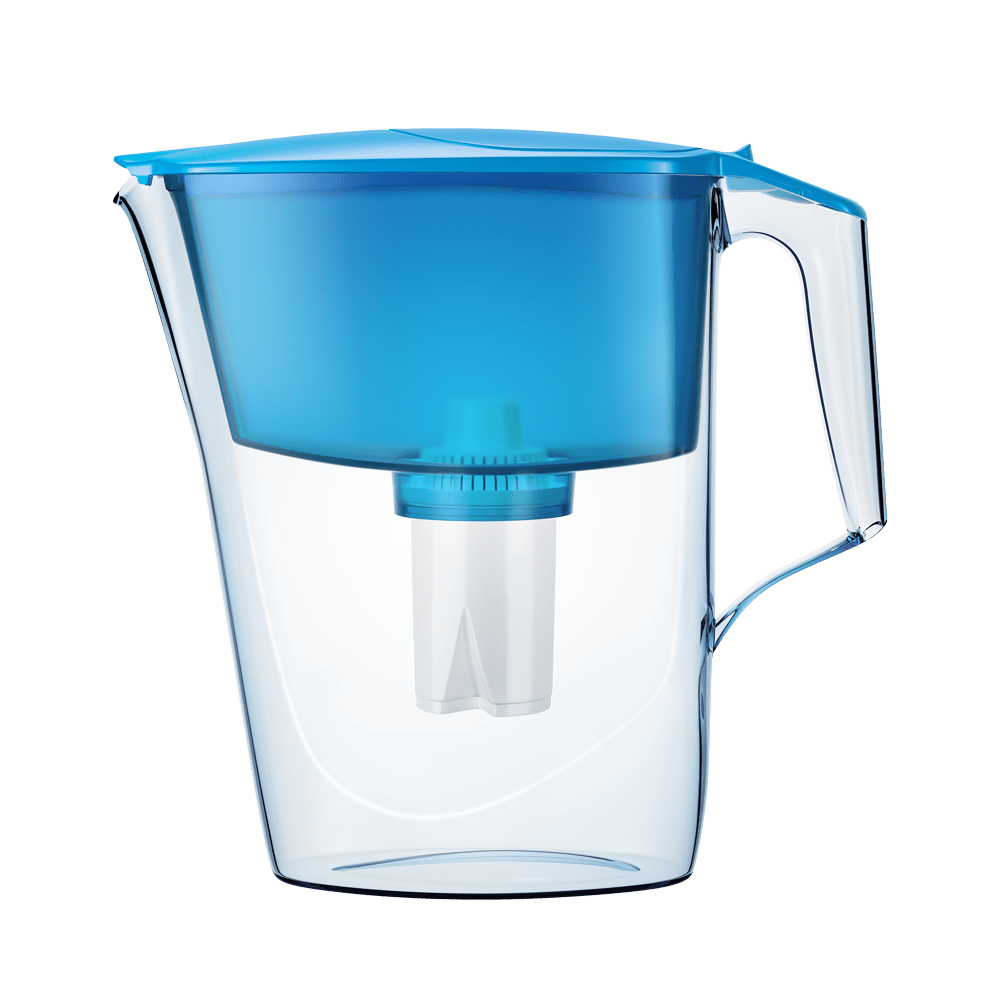
The current U.S. Standard listing is a blue Aquaphor gravity pitcher, native product ID 23 and finish SKU 204992. Its equipment list names one B15 replacement cartridge, a jug, a funnel and a lid. That makes the filter route the first useful distinction: it is not the B25-equipped Time or base Amethyst, and it is not the three-MAXFOR+ Amethyst Plus package. Confirm the B15 marking on the box and refill before buying; similar-looking jug cartridges do not automatically share a fit.
Aquaphor lists the Standard at 11 cups and says it fits in a refrigerator door. Treat those as two separate clues, not a guarantee that the entire listed amount is filtered and ready at once or that the pitcher fits every shelf. The top funnel must drain through the cartridge into the serving reservoir, and the U.S. page does not give its usable volume or outside dimensions. If you need a specific filtered batch size, shelf height or door clearance, measure your space and look for a source that names the relevant dimension before committing.
B15 replacement is a different routine from a jug counter
The exact Standard page lists 45 gallons of filter life and the linked B15 cartridge page gives 170 liters, approximately the same rating. Use 45 gallons as the conservative U.S. threshold when comparing minimum stated life. It is not a promise of months: the pages do not give a Standard-specific calendar interval, and actual service can depend on the incoming water and use. A 50-gallon requirement therefore rules Standard out; a stated 45-gallon requirement can include it.
The B15 cartridge page says the cartridge has a visual calendar. That is a reminder on the cartridge, not a meter in the pitcher measuring gallons, flow or water quality. The U.S. Standard copy calls its reminder an “indicator of remaining filter life,” but the detailed feature list does not describe a pitcher-mounted counter. I would not buy Standard expecting the Amethyst-style lid arrow or another verified mechanical jug counter. If any reminder is essential, inspect the exact refill and package in hand and follow its replacement directions rather than treating the visual calendar as a test of water quality.
Read the reduction language at the right level
Aquaphor’s U.S. Standard page names chlorine, organic compounds, heavy metals, rust and phenols in broad product copy, and the detail list says chlorine is removed. The B15 page similarly uses general impurity language. Those statements are not a Standard-and-B15 performance table: the inspected exact pages do not give challenge water, test conditions, reduction percentages or a model-specific certification result. If you need a verified lead result, microbial reduction or a particular contaminant percentage, do not count Standard as satisfying that requirement based on a category list. Compare an exact configuration with a performance sheet that names the result and conditions you need.
This is a pour-through pitcher for household tap-water post-treatment, not a way to disinfect microbiologically unsafe water. The exact current Aquaphor instructions index does not list a Standard-specific manual, so I cannot responsibly supply a startup, flushing, cleaning or dishwasher procedure from another jug’s manual. Use the instructions in the exact package and the current B15 directions; do not infer that Amethyst or Time care details necessarily apply to this body.
One unresolved lid detail matters to some kitchens
Aquaphor’s Standard product description calls the lid an easy-fill flip-top, while the detailed specifications label the lid “Twist-on.” The archived manufacturer image identifies the blue Standard body and its funnel, but it does not settle how the lid opens. This is a real source conflict, not a reason to guess from the model family. If you refill one-handed or want to avoid removing a lid, verify the exact SKU’s lid before purchase. By contrast, the exact Time listing and its family manual clearly describe a flip-top, and the Amethyst has a different sliding-lid arrangement plus a mechanical opening reminder.
Who should shortlist Standard?
Standard makes most sense if you want a manually filled, open-pour pitcher, the B15 cartridge format and the maker’s compact refrigerator-door fit claim, while 11-cup listed capacity and a 45-gallon cartridge rating match your routine. It is a straightforward alternative to Time when the B15 route is preferred over B25; Time is also listed at 11 cups but has a 50-gallon B25 rating and a documented 1.1-liter funnel. The base Amethyst is listed at 12 cups, uses one B25 and has the verified lid-opening reminder; Amethyst Plus adds two extra MAXFOR+ cartridges, a different purchase package. None of those options should be selected by broad contamination wording alone.
Skip Standard if your essential checklist includes a verified lead or microbial performance result, a 50-gallon minimum, exact exterior dimensions, a confirmed lid-opening style, or setup and care instructions that are not supplied with the item. For a basic gravity pitcher on suitable tap water, its useful distinctions are modest and concrete: one B15 in the box, an 11-cup listing, a 45-gallon filter rating and an unresolved lid description.
Aquaphor Standard U.S. product page · Aquaphor B15 cartridge page · Aquaphor U.S. instructions index
Key details at a glance
| Listed pitcher capacity | 11 cups |
|---|---|
| Included filter | Aquaphor b15 |
| Stated filter capacity | 45 gal |
| Reusable filter shell | No |
| Made without BPA | Yes |
| What the filter is documented to reduce | The exact U.S. Standard page names chlorine, organic compounds, heavy metals, rust and phenols in broad marketing copy and says chlorine is removed. No Standard/B15-specific result table or certification record was found in the inspected pages; do not translate the copy into quantified or certified performance. |
| Use and care | A gravity pitcher is for post-treatment of suitable tap water; it is not a disinfection device and is not a way to make microbiologically unsafe or unknown water safe. |
| Separate TDS meter included | No |
| Dispense while reservoir filters | No |
| Pitcher material | The Standard page states food-grade materials and BPA-free; it does not identify the body polymer. |
| Button-controlled electric dispensing | No |
| Stainless-steel body | No |
| Glass water reservoir | No |
| Powered filtration | No |
| Smart app tracking | No |
Use the exact model’s instructions for operating limits, supplied equipment and version differences.
Sources for this assessment
Check the exact filter setup before you shop.
Capacity, filter type and the written reduction claims belong to the pitcher-and-cartridge combination, not just the pitcher shape.