
Your needs, this model
Does it fit your priorities?
Would you prefer active pressure filtration to a passive gravity cycle, while still pouring the filtered water yourself?
J. SHMIDT 500 uses a charged pneumatic pressure pump to push municipal drinking water through JS 500, then the user pours from the pitcher. It is not gravity-only and not a tap dispenser.
Explore this need in the finder →Do you need the exact JS 500 replacement cartridge route?
The exact page includes one JS 500 cartridge and its manual says to use only JS 500. Do not substitute the B25/B15/A5 or another Aquaphor route based on brand alone.
Explore this need in the finder →Is a 12-cup listed vessel the size you want, even though one filtered batch is about five cups?
The U.S. page lists 12 cups; the linked manual gives a 1.24-liter (5-cup) funnel and filtered-water volume per batch. Repeated cycles require transferring filtered water out before the next batch.
Explore this need in the finder →Must a model-specific quantified lead or microbial test result be documented?
The product page/manual state broad reduction claims and name three bacteria, but the reviewed exact sources do not provide challenge conditions and quantified reduction percentages or an exact-system certification record. Do not use unknown as a positive test result.
Explore this need in the finder →An active-pressure pitcher, not an ordinary gravity jug
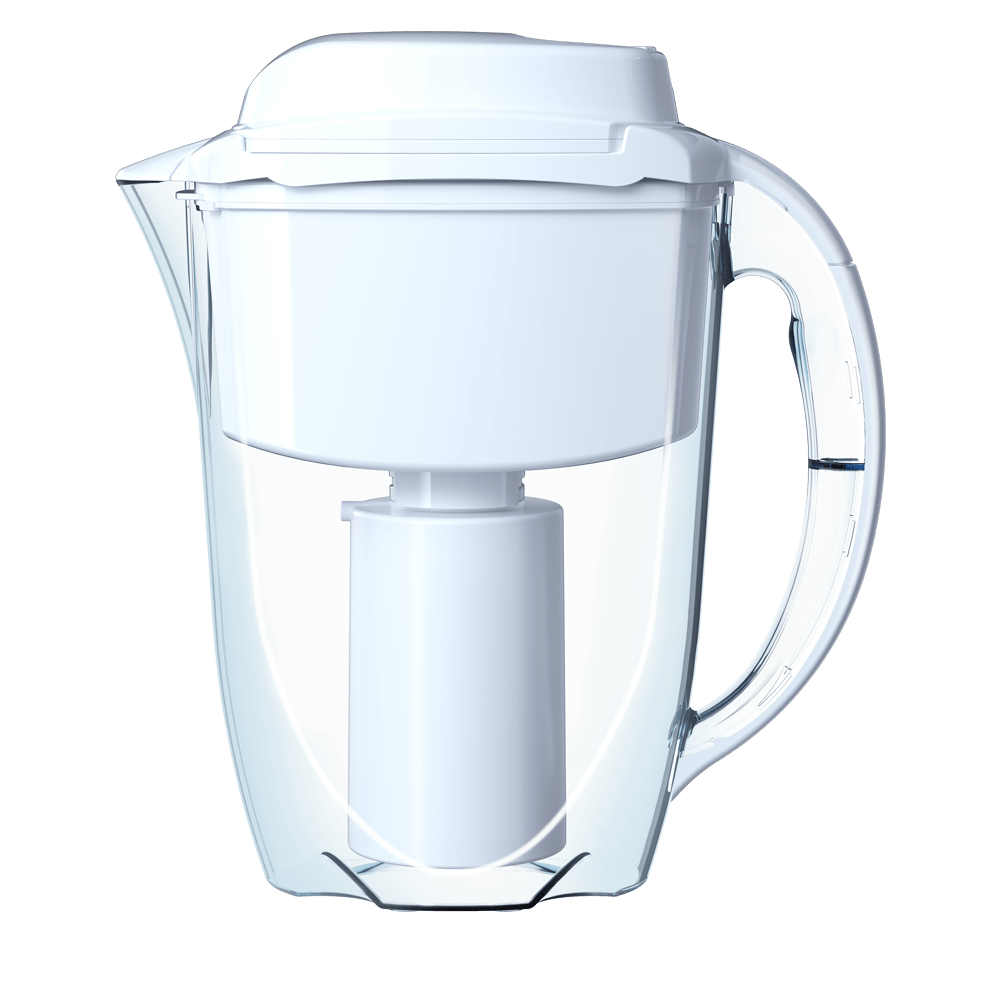
Aquaphor’s U.S. category and product page place J. SHMIDT 500 among filter pitchers. The exact page identifies product 152, White SKU 514590 and one included JS 500 cartridge. Its manual describes active, battery-powered pressure filtration: fill the funnel, close the lid, seat the electronics unit and press the button. A pneumatic compressor pushes water through the cartridge. The filtered water is then poured from the vessel; the button starts filtration rather than dispensing water, and gravity alone does not drive the cycle.
That distinction is the reason to consider it. It is portable and needs no plumbing connection, but the filtering step has an electronic module that must be charged and kept dry. If you want the least complicated routine, a conventional gravity pitcher is easier. If you want a tap at the appliance so you can dispense directly into a cup, choose a true dispensing model instead. J. SHMIDT sits between those formats: active pressure filtration, followed by a normal pour.
Read the capacity as two different numbers
The U.S. product page lists 12 cups, while the manual specifies a 1.24-liter funnel and filtered-water amount per batch (five cups). The listed vessel size is not what passes through the filter in one cycle. For more ready water, plan repeated fills and transfers: the manual says to pour the clean water into another container before the next batch or risk overflow.
Aquaphor advertises a flow rate of up to one liter per minute, but that is a ceiling in the product description, not a guarantee that every source-water batch will clear at that speed. The manual sets a four-minute maximum for one continuous operating run; if water remains in the funnel after that, it directs the user to restart the cycle. Do not translate the headline 12-cup capacity into 12 cups of immediately filtered output or into a guaranteed serving rate.
One cartridge route and an electronic reminder
The package includes one JS 500 cartridge, and the exact manual says that only the JS 500 replacement cartridge may be used. Aquaphor’s U.S. page rates it at 130 gallons. The manual gives a 500-liter service-life figure (about 132 U.S. gallons) and warns that actual life can vary with the source water, including its impurity load or hardness. I use the lower U.S.-page number for matching rather than rounding the manual’s metric figure upward. Neither value promises a fixed number of months.
The FILTER light estimates cartridge life; BATTERY indicates charge. Neither measures water quality. The electronics module contains a 3.7-volt, 1,000-mAh battery. The manual specifies at least about three hours for a full charge with the supplied cable and 5-volt USB supply, and warns against a supply above 5 volts. Aquaphor says daily recharging is unnecessary but gives no dependable liters-per-charge runtime. If you want an appliance that needs no charge planning, this is the wrong tradeoff.
Claims need the right boundary
The cartridge combines AQUALEN fiber sorbent, fine activated carbon and a hollow-fiber membrane with nominal 0.1-micron pores. The manual describes chlorine, chlorine-organic compounds, heavy metals and iron reduction, scale protection and named bacterial retention; the U.S. page also makes broad lead and contaminant claims. But I found no model-specific performance sheet with challenge-water conditions and quantified reductions, or exact-system certification record. A pore-size statement is not itself a result for every organism. If a specific lead or microbial result is essential, require documentation for that concern; the reviewed claims do not count as exact test results.
The operating manual is more restrictive than the marketing language about where to use the system: it describes pre-purification of municipal drinking-water supplies. It is not a method for making untreated, microbiologically unsafe or unknown-quality water safe. For a well, travel source or emergency supply, first establish what treatment is appropriate for that water; do not infer disinfection from the 0.1-micron membrane description.
Setup, handling and care are part of ownership
Before first use, rinse the body, funnel and electronics-unit seal, check the float, fit the non-slip feet, install the cartridge and seat the electronics unit tightly. Fill only to the funnel’s lower neck edge. A new cartridge needs three funnel volumes filtered and discarded; after more than a week idle, discard the first two. The startup and pause routines are more involved than simply swapping a gravity cartridge and pouring.
Care also has a specific limitation: wash the body, funnel and lid with warm water and detergent, but never put the lid or funnel in a dishwasher and never wash the electronics unit. Keep water away from the unit’s connector and charging cable. The manual gives dimensions of 252.5 × 117 × 279.5 mm and a maximum weight of 1.1 kg; those measurements are more useful for a shelf check than the product photo. Aquaphor describes the body as Tritan, but I found no exact-page BPA-free statement. Do not assume dishwasher compatibility or a material claim that the manufacturer has not made.
Who should compare it—and what to compare instead
J. SHMIDT 500 suits someone who wants a 12-cup-listed pitcher without plumbing, active pressure filtration and accepts five-cup batches, charging, one specific cartridge and hand-cleaning. Its U.S. page lists 130 gallons versus 50 on Aquaphor’s Jasper gravity pitcher, but those use different cartridges and systems, so this is not proof of equivalent performance. Jasper is the closer comparison for the same listed size without a pump; a direct-dispensing electric pitcher is closer if you prefer a tap over lifting and pouring.
Skip J. SHMIDT if you need a dishwasher-safe jug, a one-batch 12-cup filtered reserve, a verified exact lead or microbial test result, or treatment for unsafe input water. Its unusual pump is useful only when the active-pressure workflow solves a real problem for you. The right choice depends less on the large capacity number than on whether you are comfortable charging, running and cleaning a small filtration appliance for each batch.
Aquaphor J. SHMIDT 500 U.S. product page · Aquaphor JS500 operating manual (English section)
Key details at a glance
| Listed pitcher capacity | 12 cups |
|---|---|
| Included filter | Aquaphor js500 |
| Stated filter capacity | 130 gal |
| Fill-lid opening | Twist on |
| Height | 11.01 in |
| Width | 4.61 in |
| Length | 9.95 in |
| What the filter is documented to reduce | Aquaphor's exact product page and manual describe sorption plus a nominal 0.1-micron hollow-fiber membrane. The manual names chlorine, chlorine-organic compounds, heavy metals and iron, scale protection and three bacteria in manufacturer claims. Exact challenge-water conditions, reduction percentages and an exact-system certification record remain unconfirmed. |
| Use and care | Designed for pre-purification of municipal drinking-water supplies. Not a method for making untreated, microbiologically unsafe or unknown-quality water safe. Use the exact JS 500 cartridge only. |
| Dispense while reservoir filters | No |
| Manufacturer dimensions as listed | 252.5 × 117 × 279.5 mm (L × W × H), converted from the exact manual; approximately 9.95 × 4.61 × 11.01 in. |
| Pitcher material | Aquaphor describes its shock-resistant body as Tritan™ on the U.S. product page; no separate exact-page BPA-free statement was found. |
| Button-controlled electric dispensing | No |
| Rechargeable battery | 1000 mAh |
| Powered filtration | Yes |
Use the exact model’s instructions for operating limits, supplied equipment and version differences.
Sources for this assessment

Check the exact filter setup before you shop.
Capacity, filter type and the written reduction claims belong to the pitcher-and-cartridge combination, not just the pitcher shape.