
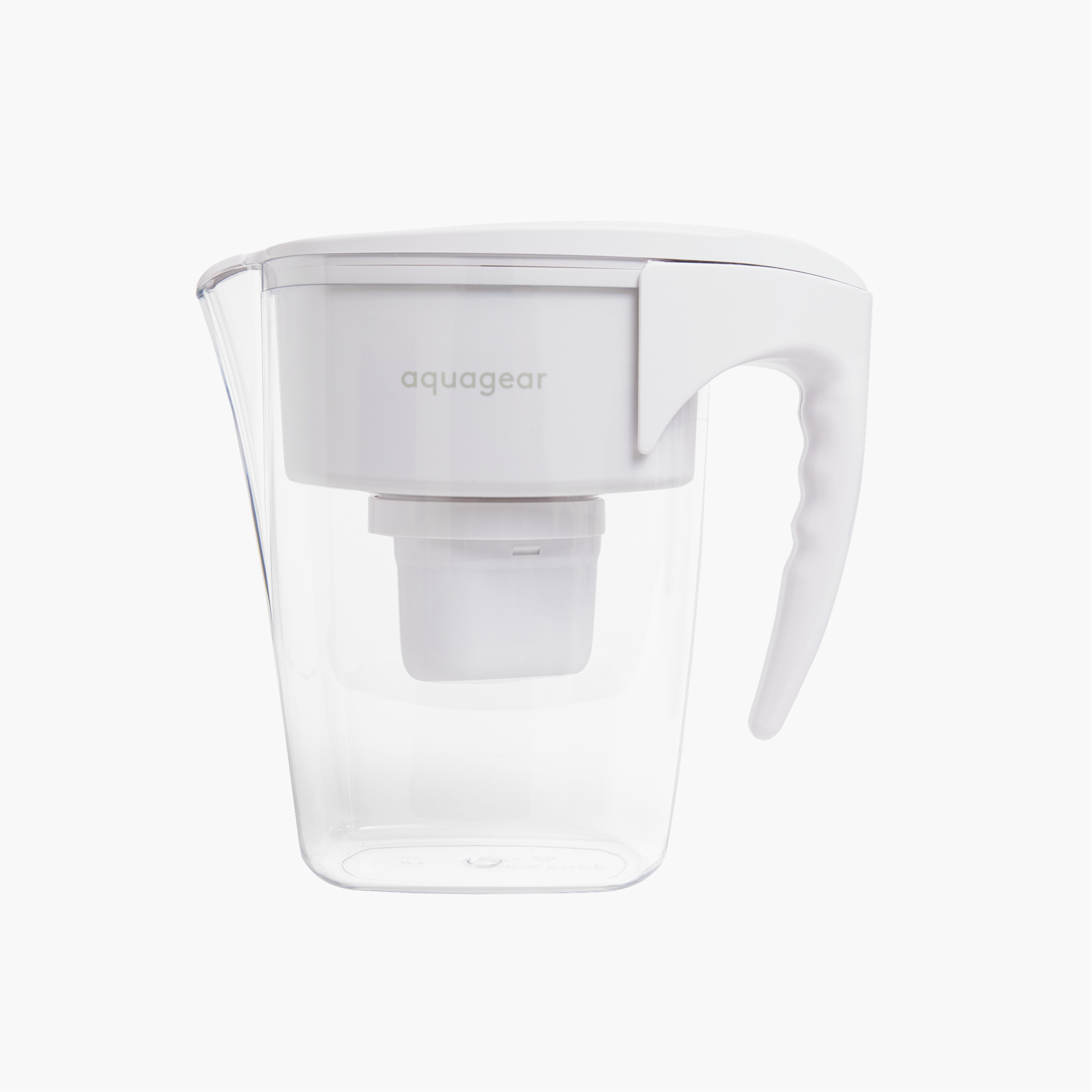
Your needs, this model
Does it fit your priorities?
Would a listed 10-cup pitcher capacity and the Aquagear cartridge route meet your serving and replacement preferences?
Aquagear lists 10 cups / 2.4 L and a 120-gallon filter rating. The number is the vessel capacity, not instant filtered output; gravity flow and the six-month replacement recommendation matter too.
Explore this need in the finder →Is a 120-gallon listed cartridge rating sufficient for your minimum?
The maker lists 120 gallons and recommends replacement at six months even if you estimate a lower volume. A requirement above 120 gallons does not fit the published rating.
Explore this need in the finder →Do you need a lead-reduction test result, rather than a microbial-safety claim?
Aquagear publishes a lead result in its test materials, but says the pitcher is not designed or tested to remove bacteria or viruses and is only for already-potable water.
Explore this need in the finder →Fit the pitcher to the way you actually refill
Aquagear’s Filter Pitcher is a straightforward gravity-fed countertop or refrigerator pitcher, not an electric dispenser or an emergency-water purifier. Its current US listing identifies the single pitcher configuration as AG-P-TAP (UPC 852659947454). The manufacturer lists 10 cups, or 2.4 liters, and outside dimensions of 11 inches long by 6 wide by 11 high. Those numbers help check a refrigerator shelf, but ten cups is the vessel’s listed capacity, not a promise that one reservoir fill immediately yields ten cups of ready-to-drink water. Gravity filtration takes time, and Aquagear itself warns that flow may be slower than other filters. If you regularly need water on demand, keep a batch ahead or compare a powered option instead.
The filter route is the main reason to consider it
The pitcher uses Aquagear’s own filter, with activated coconut-shell carbon and a proprietary ion-exchange blend, according to its support explanation. The manufacturer’s product specifications give a filter capacity of 120 gallons (454 liters); support recommends replacement at six months even if you estimate that you have filtered less than 120 gallons. Treat those as two different limits: your use may reach the volume first, while the maker’s calendar guidance still applies. Aquagear lists a replacement filter for the pitcher, SKU 77-W18H-9YPP. The pitcher product page does not separately identify a cartridge code for the filter supplied with every package, so I would use the pitcher-specific replacement route rather than assume a code from another Aquagear item.
There is meaningful manufacturer performance information here, but it needs careful reading. The linked three-page test sheet and the product page publish challenge-test results, including lead reduction; the page lists 98.4% for lead, 96.5% for chlorine and 98.2% for PFOA/PFOS among its figures. The specifications page names contaminant classes associated with NSF 42, 53, 401 and P473, and the company says testing is performed by an ISO 17025-accredited laboratory. Its own FAQ explains that “tested to NSF standards” describes testing protocols; that wording is not the same as saying the pitcher is NSF-certified. Lab percentages also do not predict a particular home’s tap water. If you require a particular certification or contaminant result, check the linked sheet’s exact test conditions and an independent certification listing for the exact system before treating that requirement as met.
Keep the potable-water boundary clear
This pitcher is designed for potable tap water that is already microbiologically safe. Aquagear says its filter is not designed or tested to remove bacteria or viruses and should not be used on unsafe water. So a lead test result is not a microbial-safety result, and this is not the right product for untreated well, stream or emergency water. The published performance information covers named test substances; it should not be stretched into a claim that every local contaminant is reduced. If your concern is a specific substance, start with a local utility report or suitable well test and compare its name and concentration with the exact manufacturer data.
Setup and care are manageable, but not automatic
Aquagear’s setup instructions describe flushing a filter before inserting it and filling the pitcher. The support page says to wash the lid, reservoir and carafe every two to three weeks with hot soapy water, while rinsing the filter with water only. The company also recommends keeping the pitcher out of direct sunlight and preferably refrigerated to limit bacterial growth. That is ordinary hands-on care, but it matters if you want a low-maintenance setup: the filter is not a replace-it-and-forget-it system, and the maker’s notes acknowledge both slower flow and a recurring replacement schedule. The current published specifications do not identify the pitcher body material, an electronic change indicator or an empty weight, so those should not be assumed from a product image.
What changes when you answer the finder questions
Choosing a ten-cup pitcher alone will leave several sizes in the results. Selecting Aquagear’s filter route narrows that to this cartridge system; a 120-gallon minimum matches its stated rating, while a requirement above 120 gallons does not. Selecting the lead-result option is consistent with the manufacturer’s listed lead test, but it does not turn the test into a certification or a guarantee for your water. Choosing a microbial-reduction claim must exclude this pitcher because the maker explicitly says that bacteria and viruses are outside its design and test scope. The recommendation only makes sense when the entire need is potable-water use, the Aquagear filter route and the capacity/service-life limits described above.
Compare the compromises, not just the headline claims
For a ten-cup vessel with a different refill routine, the Culligan with ZeroWater ZEROP10 is a useful contrast: its documented package includes a separate TDS meter and a push-to-dispense spigot, while its stated filter capacity is much shorter than Aquagear’s. That may suit someone who values the meter-and-spigot setup more than a long stated cartridge life. Brita Denali and Tahoe models offer distinct Original and Elite replacement routes; compare the exact filter and its own data rather than assuming similar-size bodies share claims or cartridge compatibility. Aquagear is most compelling for someone who wants its own published lab-test table and 120-gallon/six-month replacement plan, is comfortable keeping a batch ahead, and has confirmed the concern is compatible with potable-water filtration. It is a poor fit if you need microbial protection, certification that the cited materials do not establish, a specified body material, or fast dispensing on demand.
Key details at a glance
| Listed pitcher capacity | 10 cups |
|---|---|
| Listed tank capacity | 2.4 L |
| Included filter | Aquagear pitcher filter (AG-P-TAP) |
| Stated filter capacity | 120 gal |
| Typical replacement interval | 6 months |
| Lead result in exact-filter test data | Yes |
| Height | 11 in |
| Width | 6 in |
| Length | 11 in |
| What the filter is documented to reduce | Aquagear’s current page and linked data sheet publish manufacturer laboratory challenge-test results, including lead 98.4%, chlorine 96.5%, PFOA/PFOS 98.2%, VOC 99.9%, pharmaceuticals 98.3%, pesticides/herbicides 98.6%, and industrial compounds 97.8% as shown on the page. They are stated test results, not a household water test or blanket guarantee. |
| Use and care | For potable tap water that is already microbiologically safe. Aquagear says this filter is not designed or tested to remove bacteria or viruses and is not for microbiologically unsafe water. Flow may be slower than many competing pitcher filters; maker support recommends contacting Aquagear if flow seems abnormally slow. |
| Manufacturer dimensions as listed | 11 inches long x 6 inches wide x 11 inches high |
| Microbial test result in exact filter data sheet | No |
| Button-controlled electric dispensing | No |
Use the exact model’s instructions for operating limits, supplied equipment and version differences.
Sources for this assessment
- Aquagear current all-products page
- Aquagear native all-products feed, page 1
- Aquagear native all-products feed, page 2
- Aquagear Filter Pitcher exact US product page
- Aquagear Filter Pitcher native product record
- Aquagear Pitcher Replacement Filter product page
- Aquagear Filter Bottle exact US product page
- Aquagear Filter Bottle native product record
- Aquagear Bottle Replacement Filter (3-Pack) exact page
- Aquagear Bottle Replacement Filter native record
- Aquagear setup page
- Aquagear Filter Pitcher setup instructions, PFP0925
- Aquagear Filter Pitcher Performance Data Sheet
- Aquagear Product Specifications
- Aquagear filter-life support answer
- Aquagear pitcher cleaning and maintenance answer
- Aquagear potable-water limitation
- Aquagear slow-flow support answer
- Aquagear filter-material explanation
- Aquagear “Tested to NSF Standards” explanation
Check the exact filter setup before you shop.
Capacity, filter type and the written reduction claims belong to the pitcher-and-cartridge combination, not just the pitcher shape.